
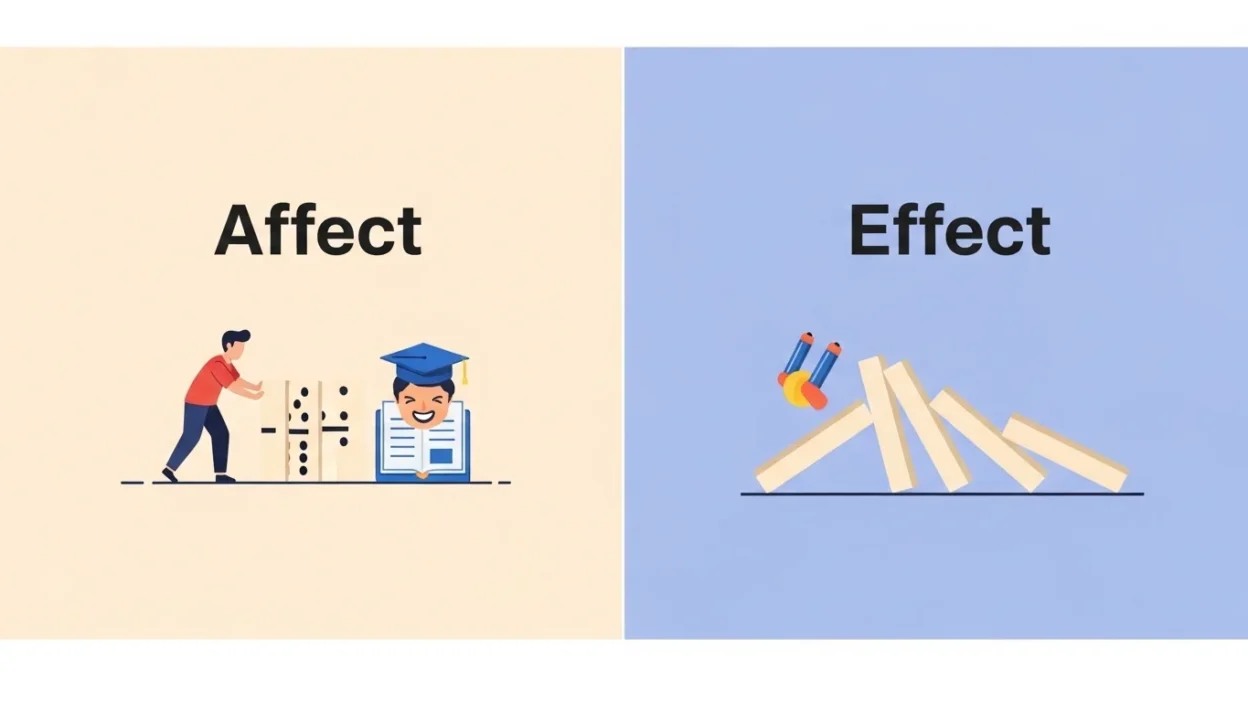
Many learners mix up affect and effect because they look and sound very similar. They both talk about change, results, or influence. When you are writing or speaking, it can be hard to decide which one is correct.
The good news is: once you understand one simple idea, the confusion goes away. This guide will explain everything in very easy English, with examples you can use in real life.
Quick Answer
Here is the simple rule:
- Affect = usually a verb (an action)
→ It means to influence or change something - Effect = usually a noun (a thing)
→ It means a result or outcome
Easy way to remember:
- Affect = Action
- Effect = End result
Simple Background
Both words come from old Latin roots related to “doing” and “making.”
- Affect comes from a word meaning to influence or act on something
- Effect comes from a word meaning to bring something into existence
Over time, English kept both words, but gave them slightly different roles. That is why they are close in meaning but used differently in sentences.
Clear Explanation of the Difference
1. What is “Affect”?
Affect is usually a verb, so it shows an action.
It means:
👉 To change something
👉 To influence something
Examples:
- Lack of sleep can affect your mood.
- Rain will affect our plans.
- Stress can affect your health.
In all these sentences, something is changing or influencing something else.
2. What is “Effect”?
Effect is usually a noun, so it is a thing.
It means:
👉 A result
👉 Something that happens because of a cause
Examples:
- The medicine had a good effect.
- Pollution has a bad effect on the environment.
- One effect of exercise is better sleep.
Here, “effect” is the result of something.
Comparison Table
| Feature | Affect | Effect |
| Part of speech | Verb (action) | Noun (thing/result) |
| Meaning | To influence or change | A result or outcome |
| Use in sentence | Before the result happens | After something happens |
| Example | This will affect your grade | This has a positive effect |
| Memory tip | A = Action | E = End result |
Which One to Use and When
Use affect when you are talking about an action or influence.
👉 Ask yourself: Is something changing something else?
If yes → use affect
Examples:
- Noise can affect concentration.
- Social media can affect behavior.
Use effect when you are talking about a result.
👉 Ask yourself: Is this the result of something?
If yes → use effect
Examples:
- The effect of noise is poor focus.
- The effect of exercise is better health.
Quick Trick
Try changing the word:
- If you can replace it with “influence”, use affect
- If you can replace it with “result”, use effect
Common Mistakes People Make
1. Using “effect” as a verb (by mistake)
❌ This will effect your mood
✔️ This will affect your mood
2. Using “affect” as a noun (by mistake)
❌ The affect of stress is serious
✔️ The effect of stress is serious
3. Forgetting the main rule
Many learners forget:
- Affect = action
- Effect = result
This is the biggest reason for confusion.
4. Overthinking
Some people try to memorize too many rules. You don’t need that.
Just remember:
👉 Action → affect
👉 Result → effect
Everyday Real Life Examples
1. In Emails
- Your delay may affect the project timeline.
- The delay had a negative effect on the team.
2. In News
- Rising prices affect many families.
- One effect of inflation is higher costs.
3. On Social Media
- Too much screen time can affect sleep.
- The effect of screen time is less rest.
4. In School
- Missing classes can affect your grades.
- One effect of studying is better results.
5. In Daily Conversation
- This decision will affect everyone.
- The effect of this decision is clear.
Short Learning Section for Students
Here is a simple way to practice:
Step 1: Learn the rule
- Affect = action
- Effect = result
Step 2: Try simple sentences
Fill in the blank:
- Lack of water can ______ plants.
- The ______ of sunlight is growth.
Answers:
- affect
- effect
Step 3: Make your own examples
Try writing:
- 3 sentences with affect
- 3 sentences with effect
This will help you remember faster.
Step 4: Speak it out loud
Say:
- “This will affect me”
- “This is the effect”
Speaking helps your brain learn better.
FAQ Section
1. Can “affect” ever be a noun?
Yes, but it is rare and used in psychology. For beginners, you can ignore this. Use affect as a verb.
2. Can “effect” be a verb?
Yes, but it means “to bring something into action,” and it is not common.
Example:
- The new law will effect change.
For beginners, it is better to use effect as a noun.
3. Which one is more common?
Both are common, but:
- Affect is often used in actions
- Effect is often used in results
4. What is the easiest way to remember?
Use this trick:
- Affect = Action
- Effect = End result
5. Can I always follow the simple rule?
Yes, in most everyday situations, the simple rule works perfectly.
6. Why do native speakers confuse them too?
Because they sound similar and have related meanings. Even native speakers sometimes make mistakes.
7. Is it okay if I make mistakes?
Yes, that is part of learning. With practice, you will improve.
8. How can I improve faster?
- Read simple sentences
- Practice writing
- Check your mistakes
- Use the A = Action trick
Conclusion
The difference between affect and effect is simple once you understand it clearly.
- Affect is an action → it changes something
- Effect is a result → it is what happens after
If you remember just one thing, remember this:
👉 Affect = Action
👉 Effect = End result
With a little practice, you will stop feeling confused and start using both words correctly in your daily life.

Steven Mark is a writer, researcher, and contributor at Meanefy.com, a platform dedicated to exploring word meanings, language nuances, and everyday linguistic curiosities. With a passion for words and clear communication, Steven focuses on making language simple, engaging, and accessible to all readers.