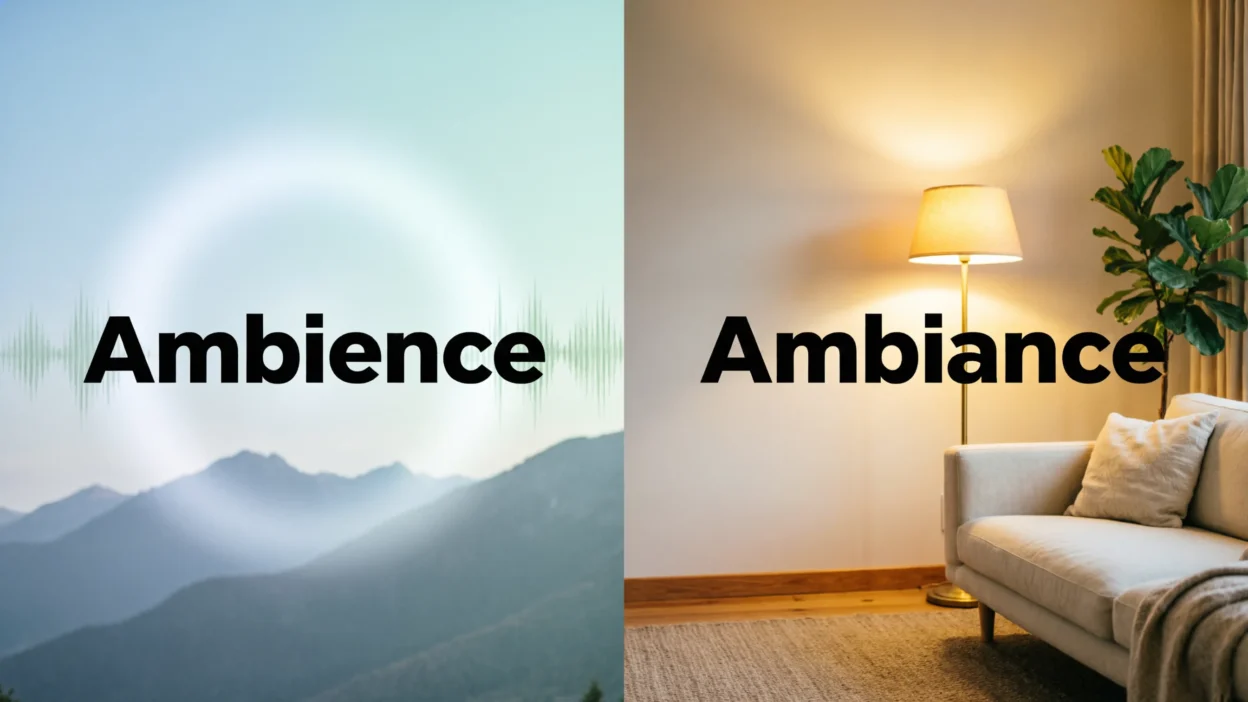
Many English learners and even native speakers feel confused about ambience and ambiance.
Are they different words?
Do they have different meanings?
Is one correct and the other wrong?
If you have ever stopped while writing and wondered which spelling to choose, you are not alone. This article will explain everything in very simple English so you can understand it clearly on the first read.
Quick Answer
Here is the simple truth:
- Ambience and ambiance mean the same thing.
- The difference is only in spelling.
- Ambiance is more common in American English.
- Ambience is more common in British English.
- You can use either one, but be consistent in your writing.
That’s it. The meaning does not change.
Where Do These Words Come From?
Both words come from the French word “ambiance.”
In French, it means:
- atmosphere
- mood
- surrounding feeling
When English borrowed the word, people started spelling it in two ways:
- Ambiance – kept the original French spelling
- Ambience – changed slightly to match English spelling patterns
Over time, both spellings became accepted in English.
What Do Ambience and Ambiance Mean?
Both words describe:
- The feeling of a place
- The mood in the air
- The atmosphere around you
For example:
- A candle-lit restaurant has a romantic ambience.
- A hospital has a quiet, serious ambiance.
- A beach at sunset has a peaceful ambience.
The word talks about how a place feels, not just how it looks.
Clear Explanation of the Difference
There is no difference in meaning.
The only difference is:
- Ambiance → more common in the United States
- Ambience → more common in the United Kingdom and some other countries
But even this is not a strict rule. People in both countries may use either spelling.
Think of it like:
- Color (American English)
- Colour (British English)
Different spelling, same meaning.
Comparison Table
| Feature | Ambience | Ambiance |
| Meaning | Atmosphere or mood | Atmosphere or mood |
| Correct? | Yes | Yes |
| Origin | From French | From French |
| More common in | British English | American English |
| Pronunciation | Same pronunciation | Same pronunciation |
Important: Both words are pronounced the same way:
/am-bee-uhns/
Which One Should You Use?
Here is an easy guide:
Use “ambiance” if:
- You are writing in American English.
- Your school or company follows American spelling.
- Most of your writing uses American spellings (like “color” and “organize”).
Use “ambience” if:
- You are writing in British English.
- Your school uses British spelling.
- You already use spellings like “colour” and “organise.”
Most Important Rule:
Be consistent.
Do not write:
- “The restaurant’s ambience was lovely. The ambiance made us relaxed.”
Choose one spelling and use it everywhere in your text.
Common Mistakes People Make
Let’s look at mistakes that often confuse learners.
1. Thinking They Have Different Meanings
Some people believe:
- Ambience = sound
- Ambiance = mood
This is not true. Both words describe the overall feeling of a place.
2. Spelling Confusion
Because the words look similar, people sometimes write:
- Ambiounce ❌
- Ambians ❌
- Ambiuns ❌
These are incorrect.
Only two correct spellings exist:
- Ambience
- Ambiance
3. Using It for People Instead of Places
Incorrect:
- “She has a happy ambiance.”
Better:
- “She creates a happy ambiance around her.”
The word usually describes a place or environment, not a person directly.
4. Overusing the Word
Instead of repeating it many times, you can use other words like:
- Atmosphere
- Mood
- Feeling
- Environment
This makes your writing more natural.
Everyday Real-Life Examples
Let’s see how these words appear in daily life.
1. In Emails
“Thank you for choosing our hotel. We hope you enjoy the peaceful ambiance.”
“Guests love the warm ambience of our café.”
2. In News Articles
“The city is famous for its cultural ambiance.”
“The festival created a joyful ambience across the town.”
3. On Social Media
“This place has such a cozy ambiance!”
“Loving the beach ambience tonight.”
4. In Daily Conversation
- “I like the ambiance here.”
- “The soft music adds to the ambience.”
- “The lighting improves the restaurant’s ambiance.”
You can see that both spellings are used naturally.
Simple Learning Section for Students and Beginners
If you are learning English, here is how to remember easily:
Step 1: Understand the Meaning
Ambience/Ambiance = The feeling of a place.
Step 2: Choose a Spelling Style
Ask yourself:
- Am I learning American English?
- Am I learning British English?
Step 3: Stay Consistent
Use only one spelling in one piece of writing.
Small Practice Exercise
Fill in the blanks:
- The soft lights created a romantic _______.
- The classroom has a calm _______.
- The dark colors gave the room a serious _______.
Answer: You can use either ambience or ambiance in all three.
FAQ Section
1. Are ambience and ambiance different words?
No. They have the same meaning. The only difference is spelling.
2. Which spelling is correct?
Both are correct. It depends on your English style (American or British).
3. Which spelling is more common?
Ambiance is more common in American English.
Ambience is more common in British English.
4. Are they pronounced differently?
No. Both are pronounced the same way.
5. Can I use them in formal writing?
Yes. Both are accepted in formal and informal writing.
6. Is one more modern than the other?
No. Both have been used for many years.
7. Can I use the word for outdoor places?
Yes. For example:
- “The forest had a peaceful ambiance.”
- “The beach has a relaxing ambience.”
8. What is a simple synonym?
The easiest synonym is atmosphere.
Final Thoughts
Now you know the full truth about ambience and ambiance.
There is no big difference.
There is no secret meaning change.
There is no correct vs. incorrect choice.
They mean the same thing.
The only difference is spelling:
- Ambiance → more American
- Ambience → more British
If you remember one simple rule, remember this:
Pick one spelling and stay consistent.
With this understanding, you will never feel confused again when writing. 😊

Anthony Charles is the founder and lead content creator at Meanefy.com, a platform dedicated to exploring word meanings, language nuances, and everyday curiosities. With a passion for language and a keen eye for detail, Anthony aims to make complex words and concepts simple and accessible for readers around the world.