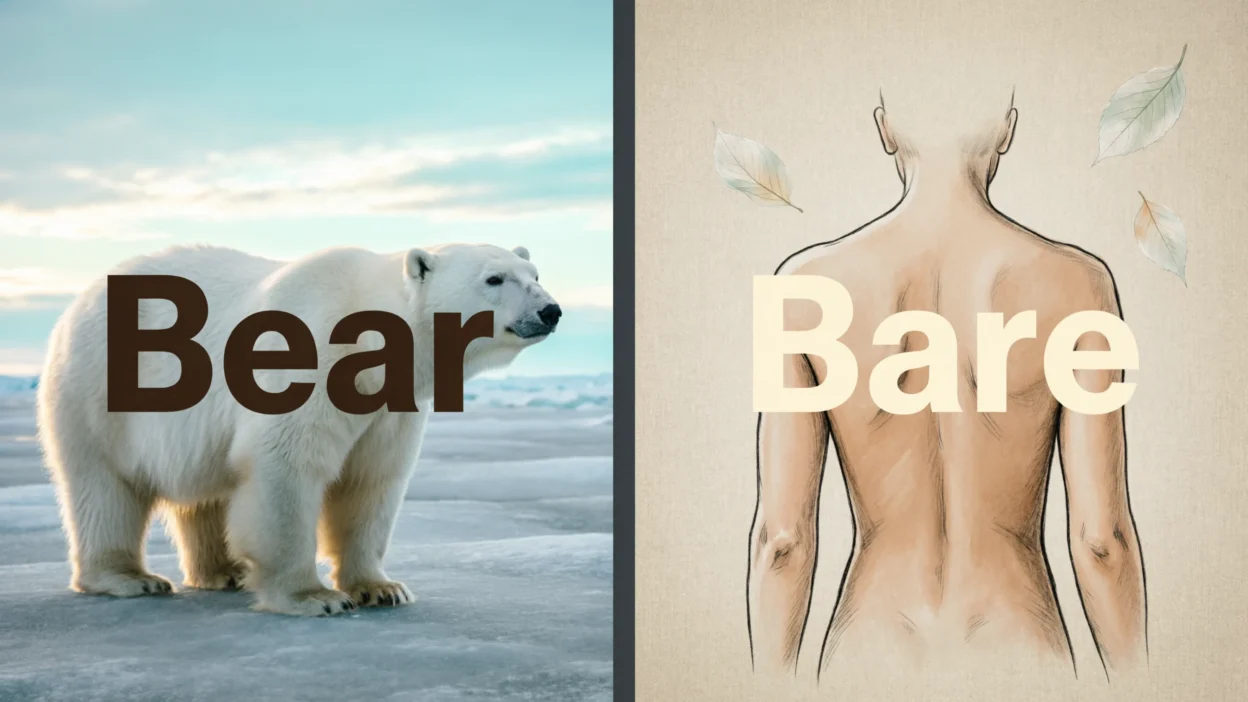
Many students and English learners mix up bear and bare.
They sound exactly the same when we speak. This makes them confusing. When two words sound the same but have different meanings and spellings, they are called homophones.
If you are not sure which one to use, don’t worry. You are not alone. Even native speakers sometimes make mistakes with these two words.
The good news is that the difference is actually very simple. After reading this guide, you will clearly understand when to use bear and when to use bare.
Quick Answer: Bear or Bare?
Here is the short and simple difference:
- Bear = to carry, to hold, to accept, or a large wild animal
- Bare = empty, uncovered, or without something
Easy memory trick:
- Bear has the letter A like “animal.”
- Bare has the word bar inside it. Think of something stripped down or empty.
Simple Background: Why Do They Sound the Same?
English has many words that sound the same but are spelled differently. These are called homophones.
Bear and bare sound the same because English spelling does not always match pronunciation. Over time, words changed in sound but kept different spellings.
Even though they sound alike, their meanings are very different. That is why it is important to learn them clearly.
What Does “Bear” Mean?
The word bear has several meanings.
1. Bear (verb) – to carry or hold
- She cannot bear the heavy bag.
- The bridge can bear the weight of the truck.
Here, bear means to carry or support something.
2. Bear (verb) – to accept or tolerate
- I cannot bear the noise.
- He could not bear the pain.
In this case, bear means to accept something difficult.
3. Bear (verb) – to give birth (formal use)
- She will bear a child next year.
This meaning is less common in everyday speech but still correct.
4. Bear (noun) – the animal
A bear is a large, strong wild animal.
For example:
- We saw a bear in the forest.
- The zoo has a brown bear.
Some well-known bears in stories and movies include:
- Winnie-the-Pooh
- Baloo
These are friendly story characters, but real bears can be dangerous.
What Does “Bare” Mean?
The word bare usually describes something without covering.
1. Bare = uncovered
- She walked on the bare floor.
- His head was bare (no hat).
2. Bare = empty
- The fridge was bare.
- The walls were bare after we moved out.
3. Bare (verb) – to show or reveal
- He bared his teeth.
- She bared her feelings.
In this case, bare means to uncover or show something that was hidden.
The Clear Difference Between Bear and Bare
Let’s make it very simple.
- Bear is usually about carrying, accepting, or the animal.
- Bare is about being empty or uncovered.
Think of it this way:
- If it is about weight, pain, responsibility, or an animal, use bear.
- If it is about skin, empty space, or showing something, use bare.
Comparison Table: Bear vs Bare
| Word | Part of Speech | Meaning | Example |
| Bear | Verb | To carry or support | This wall can bear the weight. |
| Bear | Verb | To accept or tolerate | I cannot bear the heat. |
| Bear | Noun | A large wild animal | A bear lives in the forest. |
| Bare | Adjective | Uncovered | His feet were bare. |
| Bare | Adjective | Empty | The room was bare. |
| Bare | Verb | To reveal or uncover | She bared her soul. |
This table shows the difference clearly and quickly.
Which One Should You Use?
Here is a simple guide.
Use “bear” when:
- You talk about carrying something
- You talk about accepting pain or difficulty
- You talk about responsibility
- You mean the animal
Examples:
- I cannot bear this stress.
- The table cannot bear that weight.
- The mother will bear the cost.
- A bear was seen in the mountains.
Use “bare” when:
- Something has no covering
- Something is empty
- Someone shows something hidden
Examples:
- He stood on the bare ground.
- The cupboard is bare.
- She bared her heart.
Common Mistakes People Make
Let’s look at mistakes many learners make.
Mistake 1: “Bare with me”
❌ Please bare with me.
✅ Please bear with me.
Why?
“Bear with me” means “be patient with me.” You are asking someone to tolerate something.
Mistake 2: Mixing up the animal
❌ I saw a bare in the forest.
✅ I saw a bear in the forest.
The animal is always spelled B-E-A-R.
Mistake 3: Using “bear” for uncovered things
❌ She walked on her bear feet.
✅ She walked on her bare feet.
Bare feet = feet without shoes.
Everyday Real Life Examples
Let’s see how these words appear in daily life.
In Emails
- “Please bear with me while I check the details.”
- “The office walls are still bare.”
In News
- “The company cannot bear more losses.”
- “The trees were left bare after the storm.”
On Social Media
- “I can’t bear this hot weather!”
- “No makeup today — just my bare face.”
In Daily Conversations
- “I can’t bear waiting any longer.”
- “The room looks bare without pictures.”
These examples show how common these words are in real life.
Simple Learning Section for Students
If you are a beginner or learner, try these steps:
Step 1: Use the Memory Trick
- Bear = heavy or hard things
- Bare = empty or uncovered
Step 2: Practice with Sentences
Fill in the blanks:
- I cannot _____ this noise.
- The baby walked on her _____ feet.
- We saw a _____ at the zoo.
- Please _____ with me.
Answers:
- bear
- bare
- bear
- bear
Step 3: Say It Out Loud
Both words sound the same. Practice saying them. Then focus on spelling when writing.
FAQ: Bear or Bare
1. Do bear and bare sound the same?
Yes. They are homophones. They sound the same but have different meanings and spellings.
2. What does “bear with me” mean?
It means “please be patient with me.” The correct spelling is bear, not bare.
3. What does “bare minimum” mean?
It means the smallest possible amount. “Bare” is used because it means “only” or “nothing extra.”
4. Is a bear always an animal?
No. It can also mean to carry or tolerate something.
5. Can “bare” be a verb?
Yes. “Bare” can mean to uncover or reveal.
Example: He bared his teeth.
6. Which word is used for responsibility?
Use bear.
Example: She will bear the responsibility.
7. How can I remember the difference easily?
Think:
- Bear carries weight.
- Bare shows skin.
8. Why is English spelling so confusing?
English words come from different languages and changed over time. That is why some words sound the same but look different.
Conclusion
The difference between bear and bare is simple once you understand it clearly.
- Bear is about carrying, accepting, supporting, or the animal.
- Bare is about being empty, uncovered, or showing something hidden.
If you remember one thing, remember this:
👉 If it is about weight, pain, or patience : use bear.
👉 If it is about skin, empty space, or revealing : use bare.
With a little practice, you will never confuse these two words again. Keep reading, keep writing, and most importantly, don’t be afraid to make mistakes. That’s how we learn.