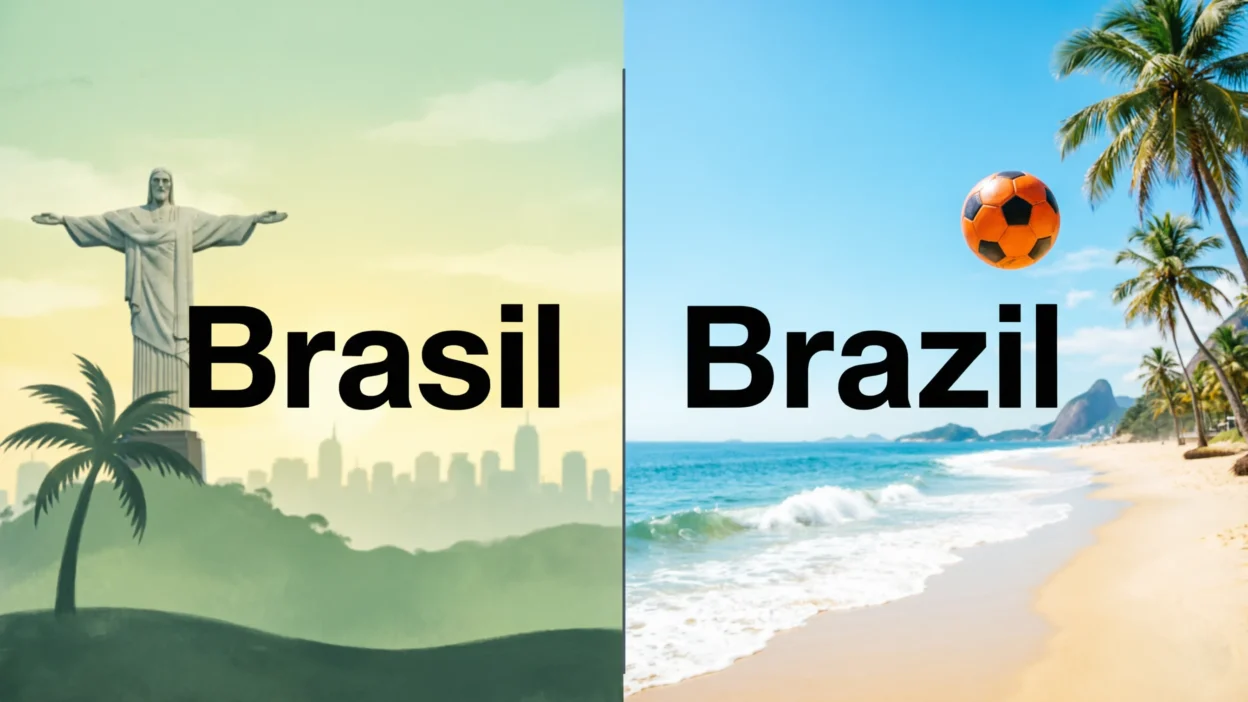
Many people feel confused when they see the words Brasil and Brazil.
Are they two different countries?
Is one wrong?
Which spelling should you use?
By the end, you will understand the difference completely.
Short Introduction: Why Do People Get Confused?
The confusion happens because both words look almost the same.
- They sound similar.
- They refer to the same country.
- But they are spelled differently.
So people often ask:
Is it Brasil or Brazil?
Let’s make it very clear.
Quick Answer
Here is the simple answer:
- Brasil is the name of the country in Portuguese.
- Brazil is the name of the same country in English.
- Both words mean the same place.
- The difference is only the language.
There is only one country. The spelling changes depending on the language.
Simple Background: Why Are There Two Spellings?
The country we are talking about is officially called:
Brazil
But inside the country, people speak Portuguese. In Portuguese, the country is written as:
Brasil
Portuguese is the official language of Brazil because it was once ruled by Portugal many years ago.
When English speakers write about the country, they use the English spelling:
Brazil
So:
- Portuguese spelling → Brasil
- English spelling → Brazil
The meaning does not change.
Clear Explanation of the Difference
Let’s break it down in the simplest way.
1. Language Difference
The biggest difference is language.
- In Portuguese → Brasil
- In English → Brazil
Just like:
- Germany (English)
- Deutschland (German)
Different languages, same country.
2. The Letter “S” and “Z”
In Portuguese, the word ends with S: Brasil
In English, it ends with Z: Brazil
That is the only spelling difference.
The pronunciation is also slightly different.
- In Portuguese: Bra-zeel (soft “s” sound)
- In English: Bruh-zil (with a “z” sound)
3. Official Use Inside the Country
Inside the country, on official documents, passports, and government websites, the spelling is:
Brasil
Because Portuguese is the national language.
4. International English Use
In English-speaking countries like:
- the United States
- the United Kingdom
- Canada
- Australia
The correct spelling is:
Brazil
Easy Comparison Table
Here is a simple table to make it very clear:
| Feature | Brasil | Brazil |
| Language | Portuguese | English |
| Used inside the country | Yes | No |
| Used in English books | No | Yes |
| Spelling ending | S | Z |
| Meaning | Same country | Same country |
There is no difference in meaning. Only the language changes.
Which One Should You Use?
Here is simple advice.
Use Brazil when:
- You are writing in English.
- You are doing English homework.
- You are writing an email in English.
- You are posting on social media in English.
- You are reading English news.
Use Brasil when:
- You are writing in Portuguese.
- You are speaking Portuguese.
- You are writing to someone in Brazil in Portuguese.
- You are using official documents in Portuguese.
If you are unsure, ask yourself:
What language am I using right now?
That answer will tell you which spelling to choose.
Common Mistakes People Make
Let’s look at some common mistakes.
Mistake 1: Mixing Languages
❌ I want to visit Brasil next year. (in English writing)
✔ I want to visit Brazil next year.
If you are writing in English, use “Brazil.”
Mistake 2: Thinking They Are Different Countries
Some people think:
- Brasil is one country
- Brazil is another country
This is wrong.
They are the same country.
Mistake 3: Thinking One Is Incorrect
Both words are correct.
They are just correct in different languages.
Mistake 4: Using “Brasil” in English Exams
If you are taking an English test, always write:
Brazil
Teachers will expect the English spelling.
Everyday Real-Life Examples
Let’s look at real-life situations.
Example 1: Writing an Email in English
Subject: My Trip to Brazil
Hello Sarah,
I am planning a trip to Brazil next summer.
✔ Correct (because the email is in English)
Example 2: Posting in Portuguese
Eu amo o Brasil.
✔ Correct (because the sentence is in Portuguese)
Example 3: News in English
“Brazil wins the football match.”
✔ English spelling
Example 4: A Passport
On a Brazilian passport, you will see:
República Federativa do Brasil
✔ Portuguese spelling
Example 5: Social Media Bio in English
Travel lover | Dreaming of Brazil 🇧🇷
✔ Correct in English
Example 6: School Project in Portuguese
Tema: Cultura do Brasil
✔ Correct in Portuguese
Short Learning Section for Students and Beginners
If you are learning English, here is an easy memory trick:
- English likes the letter Z
- Portuguese uses S
So remember:
English = Brazil (Z)
Portuguese = Brasil (S)
You can also practice by writing simple sentences:
- Brazil is in South America.
- People in Brasil speak Portuguese.
Notice how the spelling changes with the language.
Small Practice Exercise
Fill in the blank:
- I want to visit ______ next year. (English sentence)
- Eu moro no ______. (Portuguese sentence)
Answers:
- Brazil
- Brasil
Simple!
FAQ Section
1. Are Brasil and Brazil the same country?
Yes. They are the same country. The spelling changes because of language.
2. Which spelling is correct?
Both are correct.
- Use Brazil in English.
- Use Brasil in Portuguese.
3. Why does English use “Z”?
Because English spelling rules are different from Portuguese. English changed the letter to match English pronunciation.
4. What language do people speak in Brazil?
The official language is Portuguese.
5. Can I write “Brasil” in English?
It is not correct in formal English writing. You should write “Brazil” in English.
6. Is it wrong to say Brasil?
No, it is not wrong. It is correct in Portuguese.
7. How do you pronounce Brazil in English?
In English, it sounds like: Bruh-zil.
8. Why do official Brazilian documents use “Brasil”?
Because Portuguese is the official language of the country.
Conclusion
Now the confusion is gone.
Brasil and Brazil are the same country.
The only difference is language:
- Portuguese → Brasil
- English → Brazil
If you are writing in English, use Brazil.
If you are writing in Portuguese, use Brasil.
That’s it.
No mystery. No complicated rule. Just a language difference.
Now you can use the correct spelling with confidence every time.

Steven Mark is a writer, researcher, and contributor at Meanefy.com, a platform dedicated to exploring word meanings, language nuances, and everyday linguistic curiosities. With a passion for words and clear communication, Steven focuses on making language simple, engaging, and accessible to all readers.