Many English learners feel confused about “checkout” and “check out.” They look almost the same, but they are used in different ways.
Sometimes you see checkout written as one word, and other times you see check out written as two words. Because of this small difference, people are not always sure which one to use.
The good news is that the rule is actually very simple. Once you understand how each one works, the confusion disappears.
This guide explains everything in very simple English so students, beginners, and everyday readers can understand it easily.
Quick Answer
Here is the short and simple explanation:
- Checkout (one word) → a noun or adjective
- Check out (two words) → a verb phrase
In simple terms:
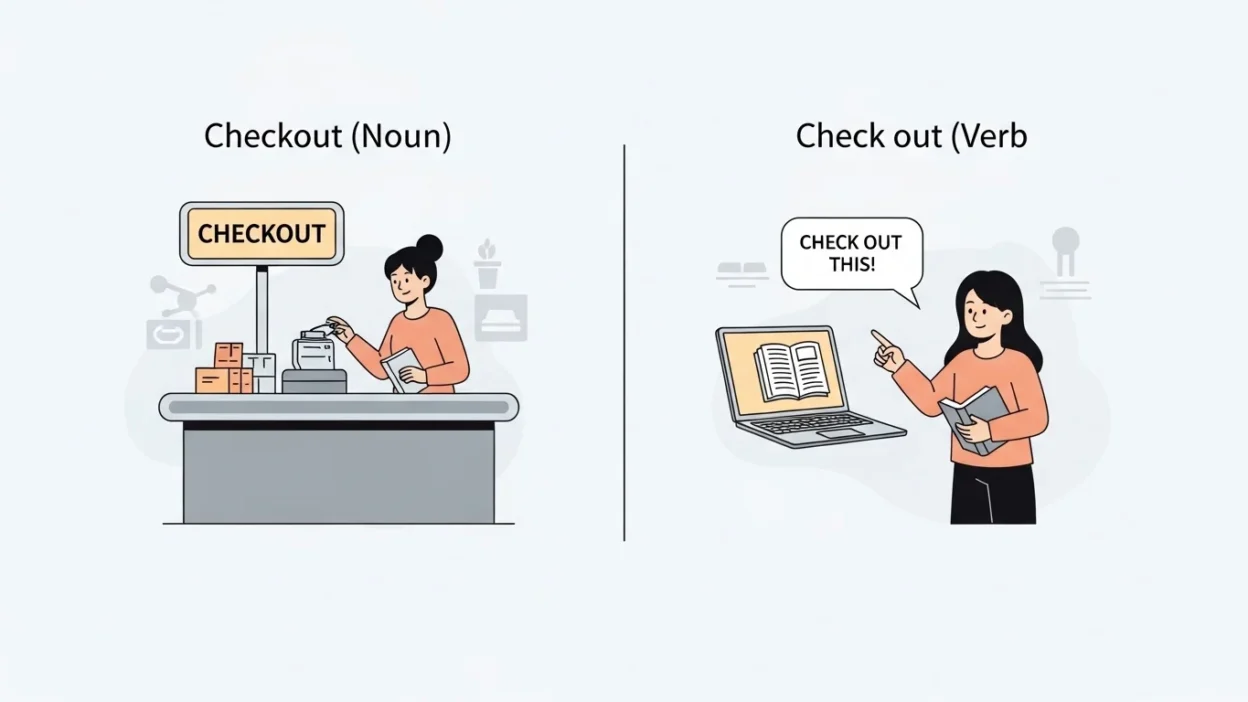
- Use checkout when you talk about a place, process, or time.
- Use check out when you talk about an action.
Examples:
- I paid at the checkout.
- Please check out this new book.
Simple Background
English often combines two words into one word over time.
Many words follow this pattern:
- Verb phrase first (two words)
- Later it becomes one word when used as a noun or adjective.
Examples:
| Verb Phrase | Noun |
| check out | checkout |
| log in | login |
| sign up | signup |
| set up | setup |
At first, people use the two word phrase as an action. Later, the language creates a single word to name the thing or process.
This is why both forms exist.
Clear Explanation of the Difference
1. “Check Out” (Two Words)
Check out is a verb phrase.
A verb phrase describes an action.
People use check out when they want someone to look at something, leave a place, or pay and leave a store.
Common meanings:
- To look at something
- To examine something
- To leave a hotel after paying
- To borrow something from a library
- To pay for items in a store
Examples:
- Please check out this article.
- We need to check out of the hotel at 11 a.m.
- She checked out three books from the library.
- Let’s check out that new café.
Notice that check out changes with grammar:
- check out
- checks out
- checked out
- checking out
This happens because it is a verb.
2. “Checkout” (One Word)
Checkout is usually a noun.
A noun names a thing, place, or process.
Common meanings:
- The place where you pay in a store
- The process of paying online
- The time when you must leave a hotel
Examples:
- The checkout line is very long.
- Online checkout is easy.
- Hotel checkout is at noon.
Sometimes checkout is also used as an adjective:
- checkout counter
- checkout page
- checkout system
In these cases, it describes something related to paying.
Comparison Table
| Feature | Check Out | Checkout |
| Word Type | Verb phrase | Noun / adjective |
| Number of Words | Two words | One word |
| Meaning | An action | A place, time, or process |
| Grammar Changes | Yes (checked, checking) | No |
| Example | Please check out this video. | The checkout line is long. |
This table shows the main difference: action vs thing.
Which One Should You Use?
Use this simple rule.
Use “Check Out” When Talking About an Action
Examples:
- Check out this website.
- I will check out of the hotel tomorrow.
- She checked out a book from the library.
You can test it with this question:
“Is someone doing something?”
If the answer is yes, use check out.
Use “Checkout” When Talking About a Thing or Process
Examples:
- The checkout counter is closed.
- The online checkout page is slow.
- Our hotel checkout time is 10 a.m.
Ask this question:
“Is it a thing, place, or time?”
If yes, use checkout.
Common Mistakes People Make
1. Writing “checkout” when a verb is needed
Incorrect:
- Please checkout this article.
Correct:
- Please check out this article.
Reason: The sentence describes an action.
2. Writing “check out” when a noun is needed
Incorrect:
- The check out line is long.
Correct:
- The checkout line is long.
Reason: The sentence talks about a place.
3. Confusing hotel usage
Incorrect:
- We will checkout at 11 a.m.
Correct:
- We will check out at 11 a.m.
Correct noun version:
- Checkout is at 11 a.m.
4. Mixing both forms in the same meaning
Incorrect:
- The store checkout you quickly.
Correct:
- The store checks out customers quickly.
Everyday Real Life Examples
Understanding how people use these words in daily life can help a lot.
Emails
- Please check out the attached document.
- The online checkout system is not working today.
Social Media
- Check out my new photo!
- The store added a faster checkout option.
News
- Customers waited a long time at the checkout.
- Police asked people to check out safely from the building.
Shopping
- I will check out after choosing these items.
- The checkout counter is near the door.
Hotels
- Guests must check out before noon.
- Checkout time is 12:00 p.m.
Libraries
- Students can check out books for two weeks.
- Book checkout is done at the front desk.
Learning Tips for Students and Beginners
If you want to remember the difference easily, try these tips.
Tip 1: Think “Action vs Thing”
- Check out → action
- Checkout → thing
Tip 2: Look for a Verb
If the sentence needs a verb, use check out.
Example:
- Please check out this video.
Tip 3: Look for “the” or “a”
If you see words like the, a, or this, it is probably a noun.
Example:
- The checkout line is long.
Tip 4: Practice with Sentences
Fill in the blank:
- Please ______ this article.
- The ______ counter is closed.
- We will ______ of the hotel tomorrow.
Answers:
- check out
- checkout
- check out
Practice helps your brain remember the pattern.
Frequently Asked Questions (FAQ)
1. Is “checkout” one word or two?
Both forms are correct.
- Checkout is a noun.
- Check out is a verb phrase.
2. Which one is used in shopping?
Both can be used.
Examples:
- Let’s check out now.
- The checkout line is long.
3. Which form is used for hotels?
Examples:
- We will check out tomorrow morning.
- Checkout time is 11 a.m.
4. Can “checkout” be a verb?
In standard English, checkout is usually not used as a verb.
The correct verb form is check out.
5. Why do people mix them up?
They look almost the same and sound exactly the same when spoken.
This makes writing more confusing for learners.
6. Is “check out” with a hyphen correct?
Sometimes you may see check out, but it is less common today.
Most modern writing uses:
- checkout (noun)
- check out (verb)
7. Can both appear in the same sentence?
Yes.
Example:
- Please check out at the checkout desk.
8. Do native speakers confuse them?
Sometimes, especially in fast writing like texts or social media.
But formal writing usually follows the correct rule.
Conclusion
The difference between checkout and check out is simple once you understand the rule.
Remember this:
- Check out = an action (verb phrase)
- Checkout = a thing, place, or process (noun)
Examples:
- Please check out this new article.
- The checkout line is very long.
By thinking about action vs thing, you can quickly choose the correct form every time.
With a little practice, this small grammar confusion becomes very easy to understand.

Daniel Matthew is a language enthusiast, writer, and contributor at Meanefy.com, where he explores the meanings, origins, and nuances of words and phrases. With a deep passion for language, Daniel aims to make complex concepts simple, engaging, and easy to understand for readers of all ages.