Many English learners feel confused about “cleanup” and “clean up.”
They look almost the same. The only difference is a small space. But that small space changes the meaning and the grammar.
You may ask:
- Is it one word or two words?
- When do I use “cleanup”?
- When do I use “clean up”?
- Are they both correct?
The good news is this: the difference is actually very simple. After reading this guide, you will understand it clearly and never feel confused again.
Quick Answer
Here is the short and simple explanation:
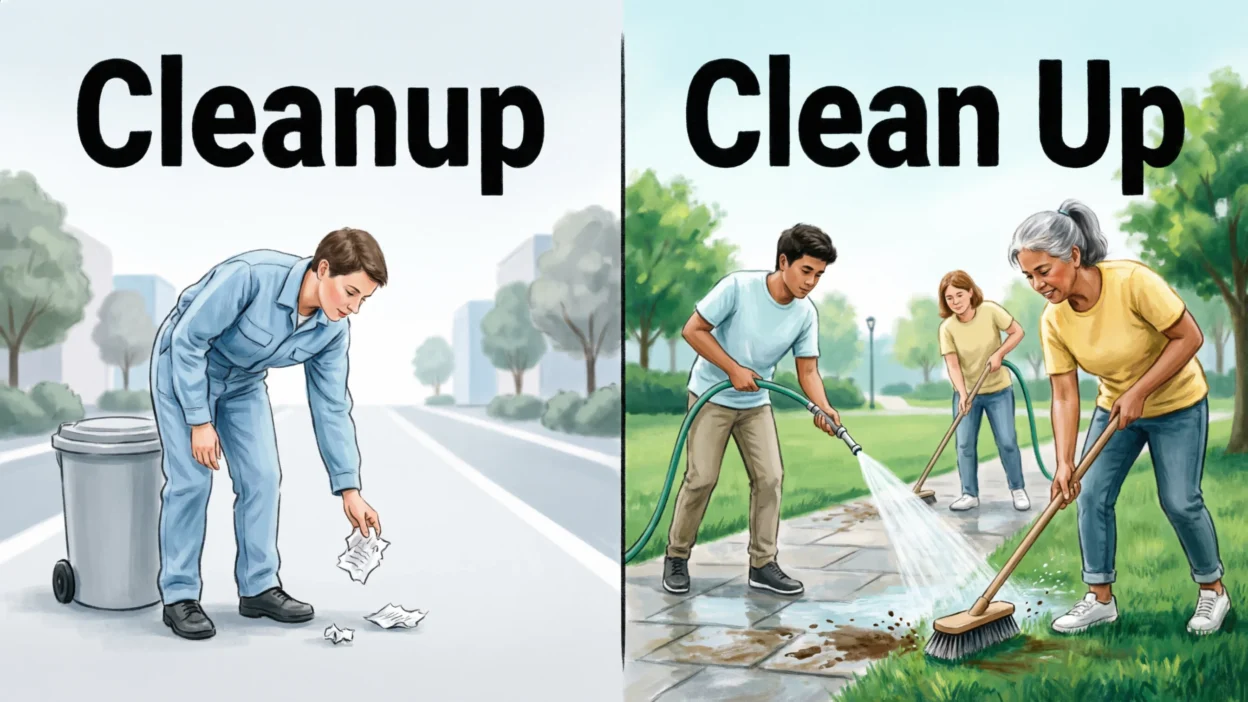
- Clean up (two words) = a verb (an action)
- Cleanup (one word) = a noun (a thing or event)
Even simpler:
- If you are talking about doing the action, use clean up.
- If you are talking about the event or result, use cleanup.
Let’s now understand this step by step.
Simple Background: How Did This Happen?
In English, many words start as two words and later become one word.
For example:
- Setup / set up
- Login / log in
- Workout / work out
At first, they are usually verb phrases (two words).
Later, the noun form becomes one word.
The same thing happened with:
- Clean up → verb
- Cleanup → noun
This pattern is very common in English.
Clear Explanation of the Difference
1. What Does “Clean Up” Mean?
Clean up (two words) is a verb phrase.
It means:
- To make something clean
- To remove dirt, trash, or mess
- To organize something
It shows an action.
Structure:
- I clean up.
- She cleans up.
- We are cleaning up.
- Please clean up.
Examples:
- Please clean up your room.
- The workers will clean up the street.
- I need to clean up my desk.
- After the party, we cleaned up.
In all these sentences, someone is doing the action.
2. What Does “Cleanup” Mean?
Cleanup (one word) is a noun.
It means:
- The act of cleaning
- A cleaning event
- The result of cleaning
It names a thing or event, not an action.
Examples:
- The city organized a beach cleanup.
- The cleanup took three hours.
- The storm caused damage, and the cleanup was expensive.
- School cleanup starts at 9 a.m.
Here, “cleanup” is something you can talk about as a thing.
Comparison Table
Here is a simple table to help you see the difference quickly:
| Feature | Clean Up (two words) | Cleanup (one word) |
| Word type | Verb (action) | Noun (thing/event) |
| Meaning | To make clean | The act of cleaning |
| Example | Please clean up. | The cleanup was hard. |
| Shows action? | Yes | No |
| Can add -ing? | Yes (cleaning up) | No (not “cleanuping”) |
This small space makes a big difference.
Which One Should You Use and When?
Here is a simple trick:
Ask yourself:
Am I talking about doing the action?
If yes → Use clean up
If no → Use cleanup
Use “Clean Up” When:
- You give instructions
- Someone is doing the action
- It comes after a subject (I, you, they, etc.)
Examples:
- Clean up the kitchen.
- I will clean up later.
- She cleaned up the mess.
- They are cleaning up now.
Use “Cleanup” When:
- You talk about an event
- You describe a situation
- You name the activity
Examples:
- The park cleanup starts tomorrow.
- The cleanup was successful.
- We joined the neighborhood cleanup.
- The cleanup cost a lot of money.
Common Mistakes People Make
Let’s look at mistakes that learners often make.
❌ Mistake 1: Using “cleanup” as a verb
Wrong:
- Please cleanup your room.
Correct:
- Please clean up your room.
Why?
Because this sentence needs an action (verb).
❌ Mistake 2: Using “clean up” as a noun
Wrong:
- The clean up took two days.
Correct:
- The cleanup took two days.
Why?
Because this sentence is talking about the event.
❌ Mistake 3: Forgetting the pattern
Some people think both forms are always okay. They are not.
Remember:
- Verb = two words
- Noun = one word
Everyday Real-Life Examples
Let’s see how people use these words in daily life.
1. In Emails
- Please clean up the meeting room before you leave.
- The office cleanup will happen this Friday.
2. On Social Media
- Time to clean up my closet!
- Join our community cleanup this weekend.
3. In School
- Students must clean up after art class.
- Our class cleanup starts at 3 p.m.
4. In News Stories
- Volunteers helped clean up after the flood.
- The flood cleanup will take months.
5. At Home
- Can you clean up the dishes?
- The kitchen cleanup was easy today.
You can see how both forms are common in daily English.
Short Learning Section for Students and Beginners
If you are learning English, here is an easy way to remember:
Step 1: Find the action
If the sentence shows someone doing something → use clean up
Example:
- I need to clean up.
Step 2: Check if it is a “thing”
If you can add words like:
- the
- a
- this
- that
Then it is probably a noun → use cleanup
Example:
- The cleanup was difficult.
- A cleanup is planned tomorrow.
You cannot say:
- The clean up was difficult. ❌
But you can say:
- The cleanup was difficult. ✅
Practice makes it easy. Try writing five sentences using each form.
FAQ Section
1. Is “cleanup” one word or two words?
It depends on how you use it.
- As a noun → one word
- As a verb → two words
2. Can I say “cleanup the room”?
No.
You must say:
- Clean up the room.
Because you need a verb.
3. Why does English do this?
English often changes verb phrases into one-word nouns.
This is normal in the language.
4. Is “clean-up” with a hyphen correct?
Sometimes people use “clean-up” with a hyphen when it describes a noun.
Example:
- A clean-up event.
But in most modern writing:
- Noun → cleanup
- Verb → clean up
5. How can I remember the rule easily?
Think like this:
Action = space
Thing = no space
6. Can “clean up” be in different tenses?
Yes.
- I clean up.
- I cleaned up.
- I am cleaning up.
- I will clean up.
7. Can “cleanup” be plural?
Yes.
You can say:
- Several cleanups happened this year.
But this is less common.
8. Do native speakers make mistakes with this?
Yes, sometimes.
Even native speakers forget the space.
But now you know the correct difference.
Conclusion
The difference between cleanup and clean up is small but important.
Here is the final summary:
- Clean up (two words) = verb (an action)
- Cleanup (one word) = noun (a thing or event)
If someone is doing the action → use clean up.
If you are naming the event or result → use cleanup.
That’s it.
A small space.
A big difference.
Now you can use both forms correctly and confidently in school, emails, social media, and everyday life.