Many students, English learners, and beginners get confused between dialog and dialogue. Both words sound almost the same and are about talking, but when to use which can be tricky.
This article will explain everything in very simple English so you can understand it easily and remember it forever.
If you have ever written a story, an email, or even a chat message, you might have wondered:
- Should I write dialog or dialogue?
- Are they the same, or is one wrong?
The truth is, both are correct, but their use depends on where you are from and what you are writing. Understanding this difference will make your English more natural and professional.
Quick Answer
Here is a simple quick answer for beginners:
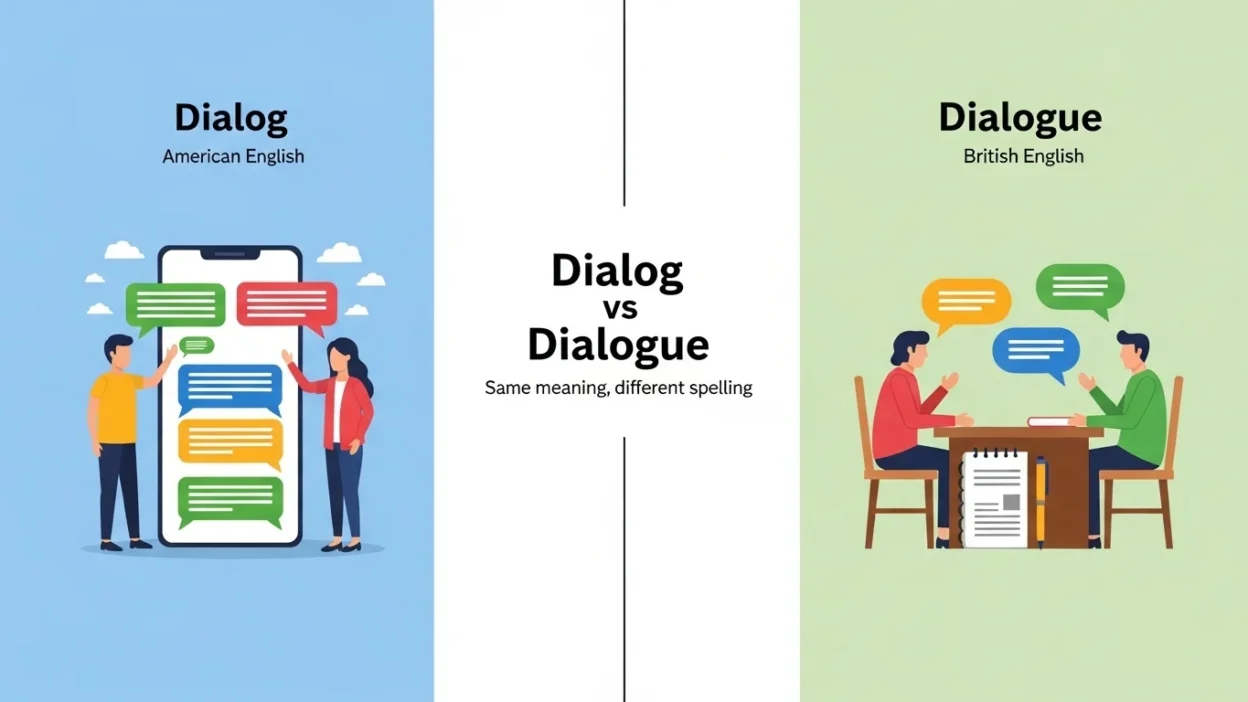
- Dialogue – This is the traditional and standard spelling. Used in British English, formal writing, books, and articles.
- Dialog – This is mainly American English, often used in computers, software, or tech writing.
So, in short:
- Dialogue = talking between people, standard English.
- Dialog = computer boxes, American spelling shortcut.
Simple Origin / Background
The word comes from the Greek word “dialogos”, which means “through words”. It has been used in English for hundreds of years.
- Dialogue – The original spelling in English since the 1500s.
- Dialog – A modern short form, first used in the 20th century, especially in computer and software language.
The main reason for the two spellings is regional preference and modern shortcuts.
Clear Explanation of the Difference
Here is the difference in very simple words:
- Dialogue
- Talking between two or more people.
- Used in books, plays, movies, and conversation.
- Preferred in British English.
- Example: “The dialogue in the movie was very funny.”
- Dialog
- Short form of dialogue.
- Common in American English, especially in technology.
- Often used for computer windows or boxes.
- Example: “Click OK in the dialog box.”
✅ Remember: If you are writing a story, article, or normal English, use dialogue.
✅ If you are writing about computers, apps, or software, you can use dialog.
Comparison Table
| Feature | Dialogue | Dialog |
| Spelling | Traditional | Short form |
| Region | British English preferred | American English (tech/modern) |
| Use | Talking between people, stories | Computer boxes, software terms |
| Formality | Formal, standard | Informal/technical |
| Examples | Story, play, movie conversations | “Save changes?” window in software |
Which One to Use and When
- Dialogue – Use this when:
- Writing a book or story
- Talking about conversations in general
- Writing essays, articles, or school work
- Dialog – Use this when:
- Writing about computers or software
- Using American English in technical instructions
- Describing a pop-up window on a website or app
💡 Tip: If you are unsure, always use dialogue. It is safe and correct everywhere.
Common Mistakes People Make
Here are mistakes beginners often make:
- Using dialog in stories or school essays – looks like a typo.
- Using dialogue for a computer pop-up – might seem old-fashioned in tech.
- Mixing the two in one text – it can confuse readers.
- Thinking dialog is wrong – it’s not wrong, just less common outside American tech writing.
Everyday Real Life Examples
Here are some situations you might see these words:
Emails & Messages:
- “Let’s have a dialogue about the new project.” ✅
- “The dialog box asks you to confirm your password.” ✅
News & Articles:
- “The leaders held a dialogue to solve the problem.” ✅
Social Media & Daily Use:
- “I love the dialogue between these characters in the show.” ✅
- “A warning dialog appeared on my phone.” ✅
Books & Stories:
- “The dialogue made the story very interesting.” ✅
Short Learning Section for Students and Beginners
- Dialogue → People talking → Story, book, movie
- Dialog → Computer window → Tech, software
Trick to remember:
- D-I-A-L-O-G-U-E → “U and E” for “Us and Everyone” → talking people
- D-I-A-L-O-G → short → computer short form
Practice sentences:
- “The dialogue in the novel is fun to read.”
- “The software shows a save dialog before closing.”
FAQ
1. Are dialog and dialogue the same?
- They have the same meaning for talking, but usage is different.
2. Which is correct in British English?
- Dialogue is preferred.
3. Which is correct in American English?
- Both are correct, but dialog is common in computers and tech.
4. Can I use dialog in a story?
- It’s better to use dialogue. Dialog looks like a typo in stories.
5. Can I use dialogue for computer windows?
- It works, but dialog is more common in technical instructions.
6. Is one spelling more formal than the other?
- Yes, dialogue is more formal. Dialog is informal or technical.
7. Why do we have two spellings?
- Old English used dialogue. Dialog is a modern, shorter American version.
8. How can I remember the difference?
- Dialogue = talking people → stories
- Dialog = short → computers
Conclusion
Understanding dialog and dialogue is easy if you remember these simple points:
- Dialogue = people talking, safe choice, British English, formal writing.
- Dialog = computers, tech, American English, short form.
When in doubt, use dialogue. It will always sound correct in stories, essays, and everyday English. With a little practice, you will never confuse them again.

Steven Mark is a writer, researcher, and contributor at Meanefy.com, a platform dedicated to exploring word meanings, language nuances, and everyday linguistic curiosities. With a passion for words and clear communication, Steven focuses on making language simple, engaging, and accessible to all readers.