Many people feel confused about “dieing” and “dying.” These two words look very similar, and both come from the verb “die.” Because of this, learners often think both spellings are correct.
But here is the truth: only one of them is correct in most situations.
This article will explain everything in very simple English so you can understand it clearly the first time.
Quick Answer
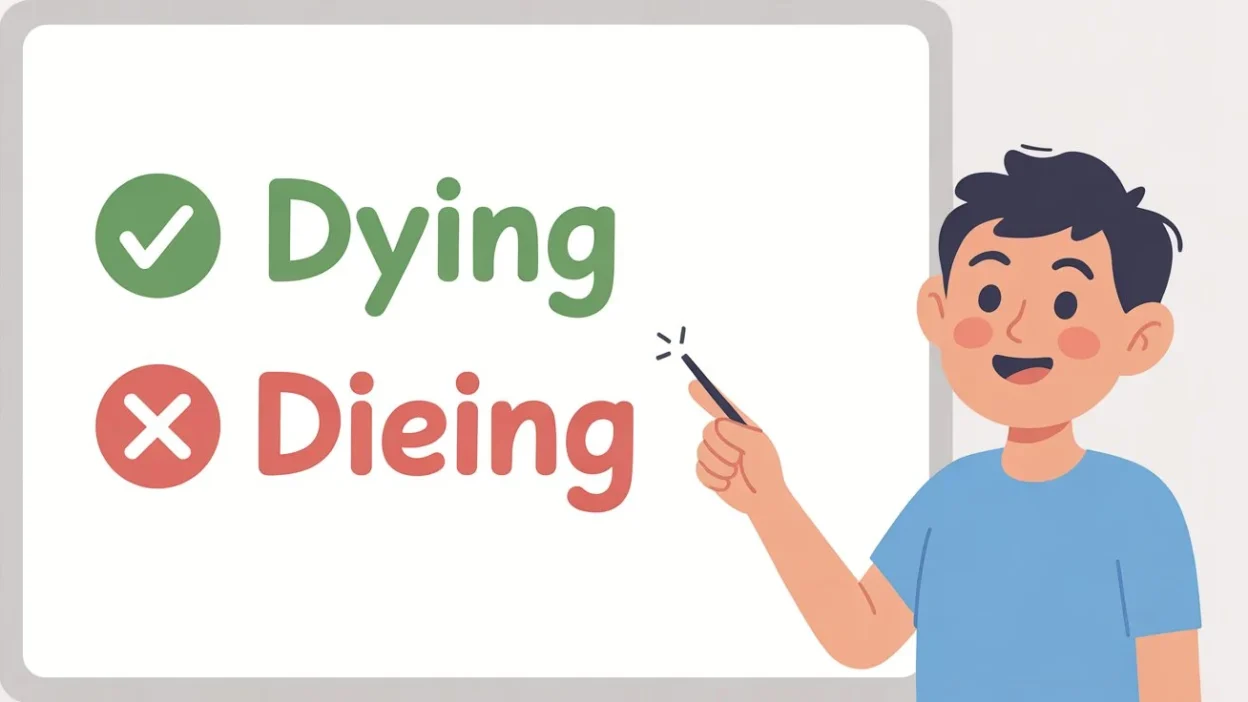
- ✅ Dying = correct spelling (used when talking about death)
- ❌ Dieing = usually incorrect (rarely used, and only in special cases)
👉 In everyday English, you should almost always use “dying.”
Simple Origin and Background
The verb “die” means:
- to stop living
- to lose life
When we change verbs into -ing form, we usually just add “ing”:
- run → running
- eat → eating
But with “die,” something special happens:
- die → dying (not “dieing”)
Why?
Because English spelling rules often drop the “e” before adding “-ing.”
But here, we also change “ie” → “y”.
So:
- die → dy + ing = dying
This is why “dieing” looks wrong to native speakers.
Clear Explanation of the Difference
Let’s break it down simply.
1. Dying (Correct Word)
Meaning:
- losing life
- about to die
- stopping existing
Examples:
- The plant is dying because it has no water.
- He is dying from a serious illness.
- The fire is slowly dying out.
👉 This is the word you should use in almost every situation.
2. Dieing (Rare and Special Use)
Meaning:
- related to “die” as a tool (used for cutting or shaping metal)
A “die” (noun) is:
- a tool used in machines
- used to shape or cut materials
So “dieing” can mean:
- using a tool called a “die”
Example (very rare):
- The workers are dieing the metal parts.
👉 Most people never use this form in daily life.
Comparison Table
| Feature | Dying ✅ | Dieing ❌ (rare) |
| Common use | Yes | No |
| Meaning | Losing life | Using a metal tool |
| Spelling rule | ie → y + ing | Direct “ie + ing” |
| Everyday use | Very common | Very rare |
| Should you use it? | Yes | Almost never |
Which One Should You Use and When?
Use “dying” when:
- talking about death
- talking about something ending
- describing something losing strength
Examples:
- The dog is dying.
- The battery is dying.
- His dream is dying.
Use “dieing” when:
- talking about machines or tools
- working with metal shaping tools
👉 But honestly, most learners never need this word.
Common Mistakes People Make
Here are some mistakes learners often make:
❌ Writing “dieing” instead of “dying”
- Wrong: He is dieing.
- Correct: He is dying.
❌ Thinking both spellings are correct
- Only “dying” is correct in normal use.
❌ Forgetting the spelling rule
Remember:
- ie → y + ing
❌ Overthinking the word
Some learners hesitate because:
- “dying” looks strange
- but it is 100% correct
Everyday Real Life Examples
1. In Emails
- “My phone is dying, I will reply later.”
- “Sorry, my laptop battery is dying.”
2. In News
- “The patient is dying in the hospital.”
- “A rare animal species is dying out.”
3. On Social Media
- “I’m dying laughing 😂”
- “This trend is dying fast.”
4. In Daily Conversation
- “The plants are dying because of heat.”
- “The light is dying, it’s getting dark.”
5. In School or Writing
- “The character is slowly dying in the story.”
- “Old traditions are dying in modern society.”
Learning Section for Students and Beginners
Here are some simple tips to remember:
1. Use This Easy Trick
👉 If it means death, use dying
2. Remember the Pattern
- lie → lying
- tie → tying
- die → dying
3. Practice Sentences
Try to complete:
- The flower is ______.
- My phone is ______.
- He is ______ from illness.
Answers:
- dying
- dying
- dying
4. Speak It Out Loud
Say:
- “dying” = /dai-ing/
This helps you remember the spelling.
FAQ Section
1. Is “dieing” a real word?
Yes, but it is very rare and used only for tools. Most people never use it.
2. Is “dying” always correct?
Yes, when talking about death or something ending.
3. Why is it not “dieing”?
Because English changes “ie” → “y” before adding “ing.”
4. Can I use “dieing” in exams?
No. Always use “dying” unless you are writing about tools.
5. Which word is used in daily life?
Dying is used in daily life.
6. Is “dying” used only for people?
No. It can be used for:
- people
- animals
- plants
- ideas
- batteries
7. How can I remember the correct spelling?
Think:
👉 “Die becomes dying (ie → y)”
8. Is “dying” difficult to learn?
No. Once you learn the rule, it becomes very easy.
Conclusion
The difference between “dieing” and “dying” is actually very simple.
- Dying is the correct and common word
- Dieing is rare and almost never used
If you remember just one thing, remember this:
👉 When talking about death or something ending, always use “dying.”
With this simple rule, you will never be confused again.

Daniel Matthew is a language enthusiast, writer, and contributor at Meanefy.com, where he explores the meanings, origins, and nuances of words and phrases. With a deep passion for language, Daniel aims to make complex concepts simple, engaging, and easy to understand for readers of all ages.