
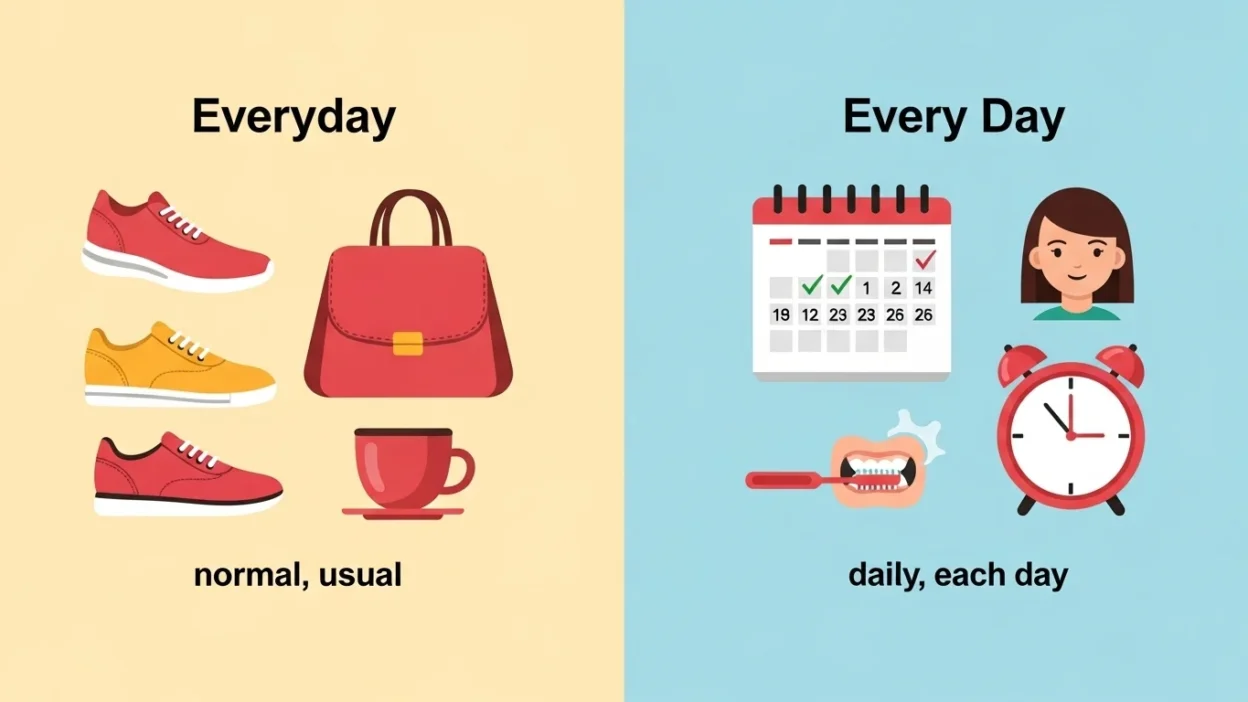
Many people get confused between “everyday” and “every day.” They sound almost the same, but they mean different things. Even native English speakers sometimes make mistakes. This article will explain the difference in the simplest way, so you can remember it forever.
English has many words that sound similar but have different meanings. “Everyday” and “every day” are one of these tricky pairs.
- People often use them interchangeably.
- Using the wrong one can make your writing look a little strange.
- Understanding the difference is easy once you know the rules.
This guide will help students, beginners, and learners master these words.
Quick Answer
Here is a fast way to remember the difference:
- Everyday (one word)
- Is an adjective (describes a noun).
- Means normal, common, or usual.
- Example: These are my everyday shoes.
- Every day (two words)
- Is an adverbial phrase (tells how often something happens).
- Means each day.
- Example: I go to school every day.
Tip: If you can replace the word with “each day,” use every day.
Origin / Background
The confusion comes from English shortening words over time.
- Everyday started as a single word to describe things that are normal or usual.
- Every day stayed as two words because it describes time, meaning “each day.”
Even though they sound the same, their roles in a sentence are different. One describes a thing, the other describes time.
Clear Explanation of the Difference
- Everyday (adjective)
- Use it before a noun to show that something is normal or common.
- It does not mean “each day.”
- Examples:
- These are my everyday clothes.
- Walking is an everyday activity for me.
- Every day (adverbial phrase)
- Use it to talk about something that happens daily.
- You can usually replace it with “each day” and the sentence will still make sense.
- Examples:
- I brush my teeth every day. → I brush my teeth each day.
- She practices the piano every day. → She practices the piano each day.
Remember:
- Everyday = normal/common
- Every day = daily
Comparison Table
| Feature | Everyday | Every Day |
| Part of Speech | Adjective | Adverbial phrase |
| Meaning | Normal, usual, common | Each day, daily |
| Example | My everyday bag is black. | I carry my bag every day. |
| Can you replace it with “each day”? | ❌ No | ✅ Yes |
| Usage | Before a noun | After a verb (or sentence) |
Which One to Use and When
Use “everyday” when:
- You describe something normal or common.
- It comes before a noun.
- Example: Everyday problems can be solved with patience.
Use “every day” when:
- You describe how often something happens.
- It can be replaced with “each day.”
- Example: I check my emails every day.
Common Mistakes People Make
- Wrong: I wear my every day shoes.
- ❌ Should be “everyday shoes” because shoes are a noun being described.
- Wrong: I go to work everyday.
- ❌ Should be “every day” because it talks about frequency.
- Confusing these is common, but a simple check (can you replace it with “each day”?) fixes it.
Everyday Real Life Examples
Here are some real-life sentences:
Emails
- Thank you for your everyday support. (Correct, describing support as normal)
- I send reports every day. (Correct, shows frequency)
News
- Everyday life in the city is busy. (Normal life)
- The store opens every day at 9 a.m. (Daily routine)
Social Media
- My everyday look is simple. (Style you normally wear)
- I post updates every day. (Daily posts)
Daily Use
- Coffee is part of my everyday routine.
- I drink coffee every day.
Notice the difference: one tells what is normal, the other tells how often something happens.
Short Learning Section for Students and Beginners
Here’s an easy trick:
- Everyday = normal/common → adjective → describes a noun.
- Every day = each day → adverbial phrase → tells when or how often.
Test Yourself:
- I wear my ______ shoes to school. → everyday
- I go to school ______. → every day
Remember: Replace “every day” with “each day” to check.
FAQ Section
- Can I say “everyday” for daily routines?
- No. Use “every day” for routines.
- Is “everyday” one word or two?
- One word.
- Can I use “every day” to describe normal things?
- No. That is “everyday.”
- How do I remember the difference?
- If you can replace it with “each day,” it’s every day.
- Can “everyday” be used alone?
- Usually not. It describes a noun: everyday tasks, everyday life.
- Are native speakers confused too?
- Yes! Even they sometimes mix them up.
- Example with email:
- I check my emails every day. ✅
- Your everyday emails are helpful. ✅
- Why does it matter?
- Using the wrong one can make your English unclear or look less natural.
Conclusion
Now you know the difference:
- Everyday = normal or usual → describes a noun
- Every day = each day → tells frequency
A simple check can help:
- Can you replace it with “each day”?
- Yes → every day
- No → everyday
With a little practice, you will never confuse everyday and every day again. Practice using them in emails, messages, and writing, and soon it will feel natural.

Daniel Matthew is a language enthusiast, writer, and contributor at Meanefy.com, where he explores the meanings, origins, and nuances of words and phrases. With a deep passion for language, Daniel aims to make complex concepts simple, engaging, and easy to understand for readers of all ages.