
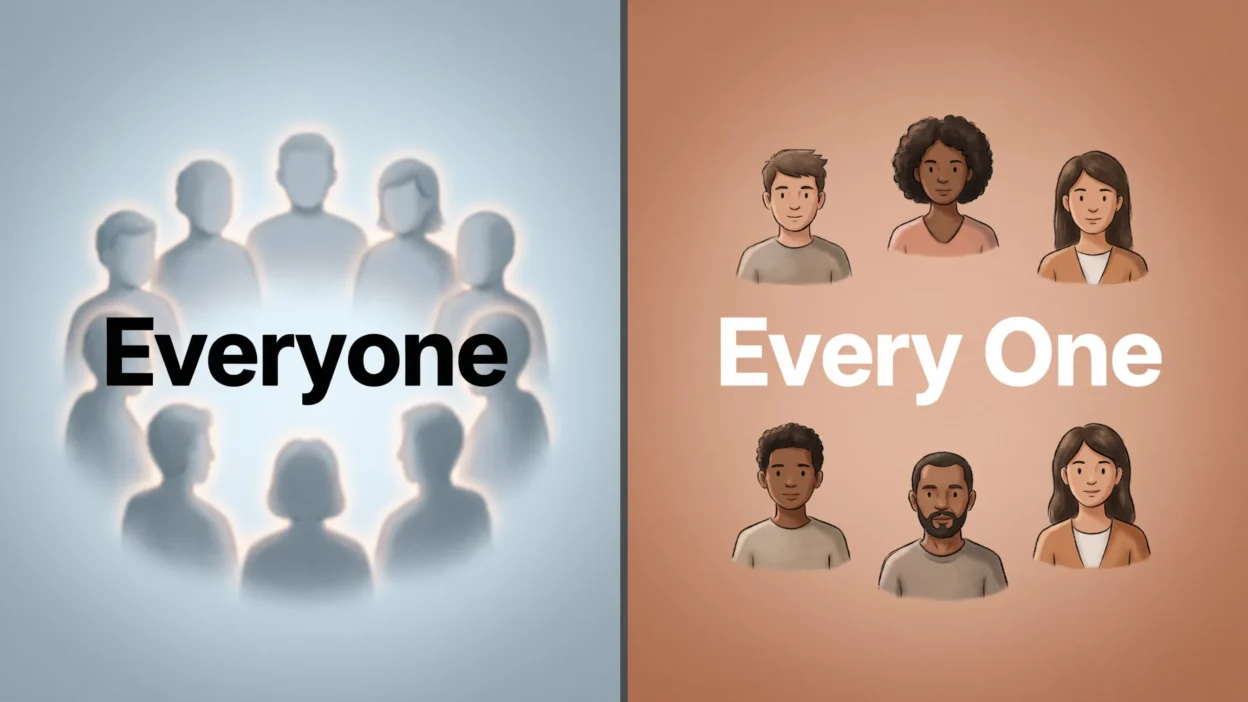
Many English learners feel confused about everyone and every one. They look almost the same. The only difference is a space. But that small space changes the meaning.
Because they look so similar, people often use the wrong one in writing. Even native speakers sometimes make mistakes.
Do not worry. In this guide, you will learn the difference in very simple English. After reading this article, you will understand it clearly and use both forms correctly.
Quick Answer: The Simple Difference
Here is the fast and easy answer:
- Everyone = all people
- Every one = each single thing (or person) in a group
Even shorter:
- If you mean all people, use everyone (one word).
- If you mean each item separately, use every one (two words).
Keep reading for full explanations and examples.
Simple Background: Why Are They Different?
English has many words that look similar but have different meanings.
- Everyone is a pronoun. It talks about people.
- Every one is not a single word. It is made of:
- every (means all, one by one)
- one (a single person or thing)
Over time, everyone became one word because it is used very often when talking about people.
But every one stayed as two words when we want to talk about separate things in a group.
That small space is important.
Clear Explanation of the Difference
Let’s understand each word carefully.
1. What Does “Everyone” Mean?
Everyone means all people.
It does not talk about things.
It only talks about people.
Examples:
- Everyone is happy.
- I invited everyone to my party.
- Everyone likes good news.
In all these sentences, we are talking about all people in a group.
Important:
Even though it talks about many people, everyone is singular in grammar.
So we say:
- Everyone is ready. ✅
Not: Everyone are ready. ❌
2. What Does “Every One” Mean?
Every one means each single item or person in a group.
We often use it when we talk about things.
It is usually followed by of.
Examples:
- Every one of the books is new.
- I checked every one of the answers.
- She thanked every one of her friends.
In these sentences, we are thinking about each item one by one.
That is the key idea: one by one.
Comparison Table: Everyone vs Every One
| Feature | Everyone | Every one |
| Number of words | One word | Two words |
| Talks about | People only | Things or people |
| Meaning | All people | Each single one |
| Often followed by “of”? | No | Yes |
| Example | Everyone is here. | Every one of the chairs is broken. |
This table helps you see the difference quickly.
Which One Should You Use?
Here is an easy way to decide.
Use “Everyone” When:
- You mean all people
- You are not talking about objects
- You can replace it with “everybody”
Example test:
Everyone enjoyed the movie.
(You can say: Everybody enjoyed the movie.)
So this is correct.
Use “Every One” When:
- You mean each item separately
- You are talking about things
- You see the phrase “of the”
Example test:
Every one of the cookies is gone.
We are talking about cookies (things).
So this is correct.
Common Mistakes People Make
Let’s look at common errors.
Mistake 1: Using “everyone” for objects
Incorrect:
- Everyone of the books is heavy. ❌
Correct:
- Every one of the books is heavy. ✅
Why? Because books are things, not people.
Mistake 2: Forgetting “of” with “every one”
Incorrect:
- Every one the students passed. ❌
Correct:
- Every one of the students passed. ✅
Mistake 3: Using “are” with “everyone”
Incorrect:
- Everyone are ready. ❌
Correct:
- Everyone is ready. ✅
Remember: “everyone” is singular in grammar.
Mistake 4: Adding “of” after “everyone”
Incorrect:
- Everyone of my friends came. ❌
Correct:
- Every one of my friends came. ✅
or - All of my friends came. ✅
Everyday Real Life Examples
Now let’s see how these words are used in daily life.
1. In Emails
- Hello everyone,
(Common way to start a group email.) - I hope everyone is doing well.
- I checked every one of your documents.
2. In School
- Everyone finished the test.
- The teacher read every one of the essays.
- Everyone in the class was excited.
3. On Social Media
- Thank you, everyone, for your support!
- I replied to every one of your comments.
- Everyone loves this new song.
4. At Work
- Everyone needs to attend the meeting.
- The manager reviewed every one of the reports.
- Everyone is responsible for their task.
5. In Daily Conversation
- Is everyone here?
- I tasted every one of the dishes.
- Everyone enjoyed the party.
Notice the pattern:
- Talking about people → everyone
- Talking about items → every one
Short Learning Section for Students and Beginners
Here is a simple learning trick.
Memory Tip
Ask yourself:
Am I talking about people in general?
If yes → use everyone
Am I talking about items one by one?
If yes → use every one
Practice Exercise
Choose the correct answer:
- ________ is welcome to join.
- I cleaned ________ of the rooms.
- ________ enjoyed the game.
- She answered ________ of the questions.
Answers:
- Everyone
- Every one
- Everyone
- Every one
Practice like this often, and it will become easy.
Frequently Asked Questions (FAQ)
1. Is “everyone” singular or plural?
It is singular in grammar.
We say: Everyone is happy.
Not: Everyone are happy.
2. Can “everyone” talk about objects?
No. It only talks about people.
3. Can “every one” talk about people?
Yes, but it means each person separately.
Example:
Every one of the students passed.
4. Is “everyone” the same as “everybody”?
Yes. They mean the same thing.
Both talk about all people.
5. Why do we use “of” with “every one”?
Because we are talking about a group.
Example:
Every one of the apples is red.
6. Which one is more common?
“Everyone” is more common in daily speaking because we often talk about people in general.
7. Can I start a message with “Hi every one”?
No. That is incorrect.
It should be:
Hi everyone. ✅
8. How can I quickly check if I am right?
Try replacing the word:
- If you can use “everybody,” then use everyone.
- If you mean “each one,” then use every one.
Conclusion
The difference between everyone and every one is small but important.
Remember these two simple rules:
- Everyone = all people
- Every one = each single item in a group
Also remember:
- Everyone is always singular.
- Every one is often followed by “of”.
- Everyone talks only about people.
- Every one can talk about things or people.
The space between the words changes the meaning.
Now that you understand the difference clearly, you can use both forms with confidence in emails, school writing, exams, and daily conversations.
Keep practicing, and soon it will feel natural. 😊