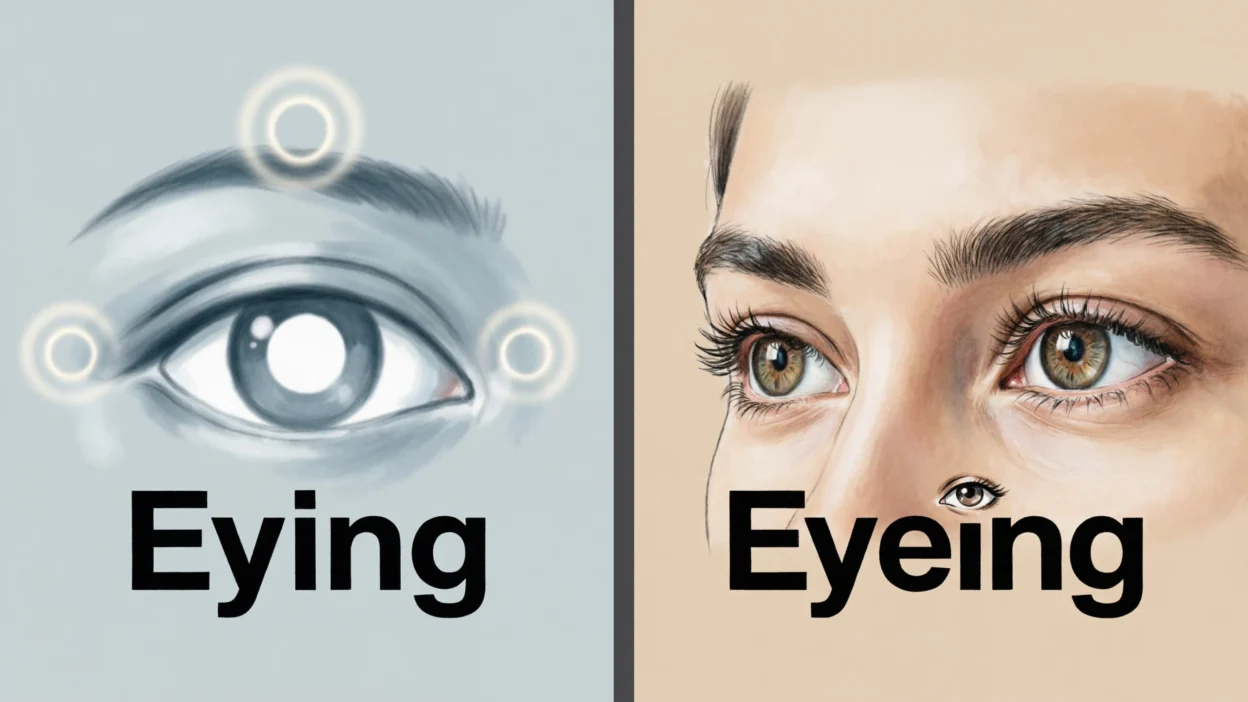
Many people feel confused when they see eying and eyeing.
They look almost the same.
They sound the same when spoken.
And spellcheck does not always help.
The good news is simple:
Only one of these spellings is correct in modern English.
This article will explain everything step by step, using very simple English, so you can understand it clearly on your first read.
Quick Answer
Here is the clear answer:
- Eyeing ✅ is the correct spelling
- Eying ❌ is usually incorrect in modern English
If you want to say someone is looking at something with interest, always use eyeing.
Example:
- She is eyeing the last piece of cake.
Simple Background: Where Does the Word Come From?
The word eyeing comes from the noun eye.
- Eye = the part of the body we use to see
- To eye = to look at something closely or with interest
When we change eye into a verb ending with -ing, the spelling becomes:
- eye + ing = eyeing
English spelling rules sometimes look strange, but this one follows a clear pattern.
Clear Explanation of the Difference
Let’s break it down in a very simple way.
Eyeing (Correct)
- Comes from the word eye
- Means looking at something carefully
- Used in daily English, books, news, emails, and messages
- This is the spelling you should use
Example:
- The company is eyeing a new office in the city.
Eying (Incorrect or Rare)
- Looks like a word, but it is not standard
- Not commonly accepted in modern English
- Often seen because people remove the extra e by mistake
- Should be avoided in normal writing
Think of it like this:
If the word comes from eye, keep the e.
Simple Comparison Table
| Feature | Eyeing | Eying |
| Correct spelling | Yes | No |
| Used in modern English | Yes | No |
| Comes from the word “eye” | Yes | No |
| Safe to use in writing | Yes | No |
| Used in exams and school | Yes | No |
Which One Should You Use and When?
This part is very easy.
Always Use Eyeing When:
- Someone is looking at something with interest
- Someone wants to buy, take, or choose something
- Someone is watching something closely
Examples:
- She is eyeing the blue dress.
- He is eyeing a job in another country.
- The cat is eyeing the bird.
Never Use Eying In Normal Writing
- It may look shorter, but it is not correct
- Teachers, exams, and readers may mark it as wrong
- Stick with eyeing every time
Common Mistakes People Make
Many learners make the same mistakes again and again. Let’s fix them.
Mistake 1: Removing the Extra “E”
People think:
- “Eye + ing should be eying”
But English keeps the e here.
Correct:
- eyeing
Incorrect:
- eying
Mistake 2: Trusting Spellcheck Too Much
Some spellcheck tools:
- Do not clearly warn about eying
- Accept it as a rare form
Always trust the rule, not the tool.
Mistake 3: Thinking Both Are Correct
Some learners think:
- “Both spellings must be okay”
They are not.
In modern, clear English:
- Only eyeing is correct
Everyday Real-Life Examples
Let’s see how eyeing is used in real life.
Emails
- I am eyeing the Monday meeting for our discussion.
- She is eyeing a transfer to another team.
News
- The company is eyeing new markets in Asia.
- The government is eyeing changes to the law.
Social Media
- I’m eyeing those shoes everyone is talking about.
- Still eyeing that phone, but it’s expensive!
Daily Speech
- He keeps eyeing my food.
- She’s eyeing the window seat.
Learning Section for Students and Beginners
If you are a student or new learner, remember this simple trick:
Easy Memory Trick
- If you can see the word eye, keep the e
- Eye → eyeing
Say it slowly:
- eye-ing
- eye-ing
You can also remember:
“If you use your eye, you keep the e.”
Simple Practice
Fill in the blank:
- She is ____ the last cookie.
Correct answer:
- eyeing
Frequently Asked Questions (FAQ)
1. Is “eying” ever correct?
In modern English, no.
Always use eyeing.
2. Why does “eyeing” keep the extra “e”?
Because the word comes from eye, and English keeps the full word before adding -ing.
3. Do native English speakers make this mistake?
Yes, many do.
That is why this confusion is very common.
4. Will exams mark “eying” as wrong?
Yes.
Most teachers and exams expect eyeing.
5. Is “eyeing” formal or informal?
It works in both:
- Formal writing
- Informal speech
6. Can “eyeing” mean wanting something?
Yes.
It often means:
- Looking with interest
- Thinking about getting something
7. Does pronunciation change?
No.
Eyeing and eying sound the same, but only one is correct.
8. What is the safest choice?
Always choose eyeing.
Simple and Clear Conclusion
Let’s finish with the main idea:
- Eyeing is the correct spelling
- Eying is not used in modern English
- The word comes from eye, so keep the e
- Use eyeing in school, exams, emails, and daily life
Once you remember this rule, you will never feel confused again.
If you are ever unsure, just ask yourself:
“Does this word come from eye?”
If yes, the answer is always eyeing.

Steven Mark is a writer, researcher, and contributor at Meanefy.com, a platform dedicated to exploring word meanings, language nuances, and everyday linguistic curiosities. With a passion for words and clear communication, Steven focuses on making language simple, engaging, and accessible to all readers.