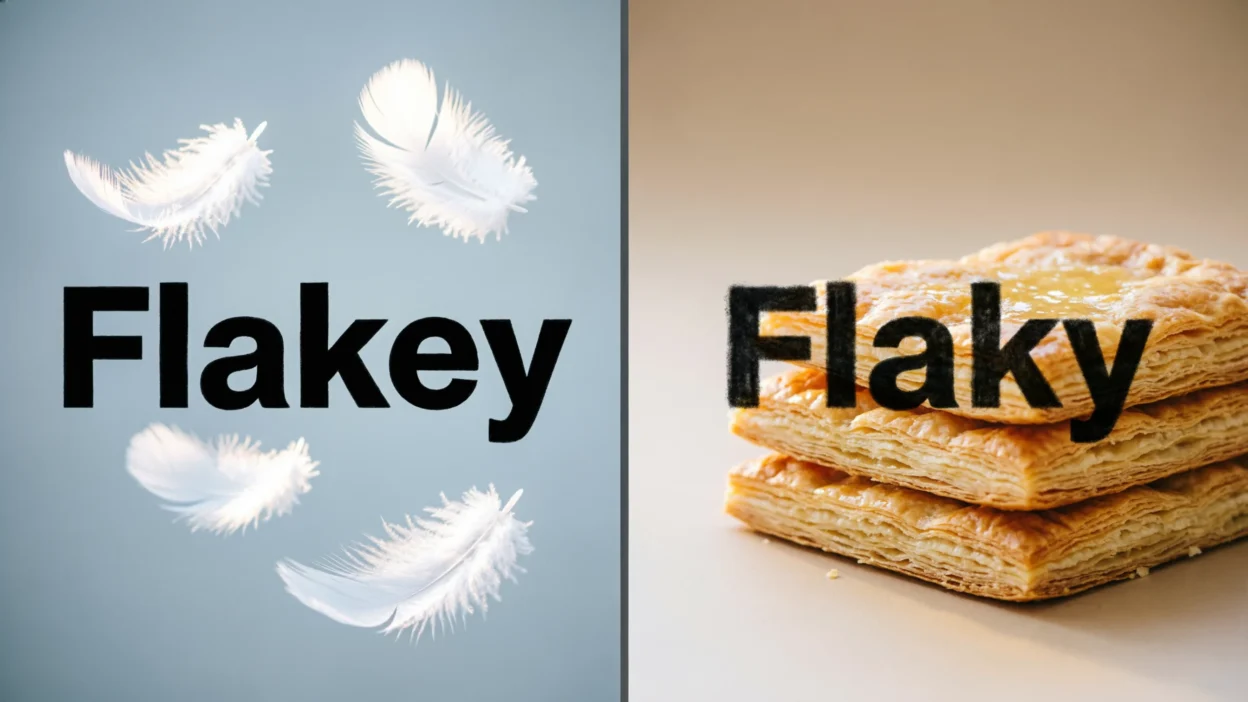
Many people feel confused when they see the words flakey and flaky. They look almost the same. They sound exactly the same. So which one is correct?
If you are a student, a learner, or someone who simply wants to write correct English, this guide will make everything clear.
By the end, you will know which spelling to use and you will not feel confused again.
Let’s make it simple.
Quick Answer
Here is the short and clear answer:
- ✅ Flaky is the correct and standard spelling.
- ⚠️ Flakey is usually considered a spelling mistake.
- 📚 In formal writing (school, exams, work), always use flaky.
- 💬 In casual writing, some people write flakey, but it is not preferred.
If you remember only one thing from this article, remember this:
“Flaky” is correct. “Flakey” is not standard.
Where Do These Words Come From?
To understand the difference, it helps to look at the base word.
The word flaky comes from the noun flake.
A flake is:
- A small, thin piece that breaks off from something
(like snow, dry skin, or pastry)
For example:
- A snowflake is a small piece of snow.
- When bread breaks into small pieces, those are flakes.
Over time, English added the letter -y to make the adjective flaky.
This follows a common English pattern:
- flake → flaky
- smoke → smoky
- shine → shiny
Notice something important:
When a word ends in -e, we often remove the e before adding -y.
That is why:
- flake + y → flaky
NOT flakey
This is the main reason why flaky is correct.
What Does “Flaky” Mean?
The word flaky has two main meanings.
1. Literal Meaning (Physical)
It describes something that breaks into small thin pieces.
Examples:
- The pastry is flaky.
- My skin gets flaky in winter.
- The paint on the wall is flaky.
Here, “flaky” describes texture.
2. Informal Meaning (Personality)
It also describes a person who:
- Often changes plans
- Does not show up
- Is unreliable
- Forgets important things
Example:
- He said he would come, but he didn’t. He is flaky.
- She is smart, but sometimes flaky about meetings.
In this meaning, it describes behavior.
What About “Flakey”?
“Flakey” is simply a different spelling that some people use. However:
- Most dictionaries list flaky as the correct spelling.
- Teachers usually mark flakey as incorrect.
- In formal writing, flakey is not accepted.
You may sometimes see “flakey” online or in casual posts, but that does not make it standard.
If you want to be safe and correct, use flaky.
Clear Difference Between Flakey and Flaky
Let’s make this very simple.
There is no difference in meaning.
The only difference is spelling — and one spelling is correct.
- ✔ Flaky = correct and standard
- ✘ Flakey = non-standard spelling
Think of it like this:
Some people spell “color” incorrectly as “colourr.”
It looks similar, but it is wrong.
In the same way:
- “Flakey” looks similar,
- but “flaky” is the proper spelling.
Comparison Table
Here is an easy table to help you remember:
| Feature | Flaky | Flakey |
| Correct spelling | ✅ Yes | ❌ No (not standard) |
| Used in dictionaries | ✅ Yes | Rare or not preferred |
| Good for exams | ✅ Yes | ❌ No |
| Good for formal writing | ✅ Yes | ❌ No |
| Meaning | Same | Same |
| Recommended to use | ✅ Always | ❌ Avoid |
This makes the answer very clear.
Which One Should You Use and When?
Use flaky:
- In school essays
- In exams
- In business emails
- In professional writing
- In news articles
- In formal letters
Avoid flakey:
- Do not use it in assignments.
- Do not use it in official communication.
- Do not use it if you want to look professional.
Even in casual writing, it is better to choose flaky.
When in doubt → choose flaky.
Common Mistakes People Make
Here are some common errors learners make:
1. Adding the “e” because of the base word
People think:
- flake → so maybe flakey?
But remember the spelling rule:
Drop the e before adding y.
So:
- flake → flaky
- not flakey
2. Thinking Both Are Equally Correct
Some people believe both spellings are fine. That is not true in standard English.
Only flaky is widely accepted.
3. Using “Flaky” Incorrectly in Meaning
Another mistake is confusing the personality meaning.
Incorrect:
- The cake is flaky because it forgot my birthday. ❌
Correct:
- The cake is flaky because it breaks into layers. ✅
- My friend is flaky because he forgets plans. ✅
Make sure you use the right meaning.
Everyday Real Life Examples
Let’s look at how this word appears in real life.
1. In Emails
Correct:
Hi Sara,
The internet connection is flaky today. I may lose connection.
Correct:
I’m sorry I missed the meeting. I know that makes me look flaky.
Incorrect:
The internet is flakey today. ❌
2. On Social Media
You might see posts like:
- “Why am I so flaky with plans?”
- “This croissant is so flaky and delicious!”
Sometimes people write:
- “flakey” — but that is still not the standard spelling.
3. In News or Articles
- “The pastry has a flaky crust.”
- “Voters think the candidate seems flaky.”
In professional writing, you will almost always see flaky, not flakey.
4. In Daily Conversation
You may hear:
- “Don’t be flaky!”
- “This pie crust is nice and flaky.”
Even though it sounds like “flakey,” the correct spelling is still flaky.
Learning Section for Students and Beginners
Here is a simple way to remember:
Memory Trick
Look at the word:
Flaky
Notice:
It has only one “e” — inside “flake.”
When we add “y,” we remove the final “e.”
So:
flake → flaky
Just like:
- bake → baky? ❌ No → baky is wrong
- bake → baky doesn’t work
Actually: bake → baking
English often removes the “e” when adding endings.
Simple Practice Exercise
Choose the correct spelling:
- The cookie is very _______.
→ flaky ✅ - He is a little _______ about deadlines.
→ flaky ✅ - The paint is peeling and _______.
→ flaky ✅
If you wrote “flakey,” now you know why it’s not correct.
Frequently Asked Questions (FAQ)
1. Is “flakey” ever correct?
In standard English, no. It is considered a spelling mistake.
2. Why do people write “flakey”?
Because they see the base word “flake” and think the “e” should stay. But English spelling rules usually remove the “e” before adding “y.”
3. Do dictionaries accept “flakey”?
Most major dictionaries list flaky as the correct form. “Flakey” is usually not preferred.
4. Is “flaky” formal or informal?
It can be both.
- Literal meaning (food, skin) → neutral
- Personality meaning (unreliable person) → informal
5. Can I use “flaky” in exams?
Yes. “Flaky” is correct and safe to use.
Do not use “flakey” in exams.
6. Does “flaky” always mean unreliable?
No.
It has two meanings:
- Breaking into thin layers
- Unreliable person (informal)
You must understand the context.
7. Is “flaky” a negative word?
Sometimes.
If you call a person flaky, it usually means they are not dependable. That can sound negative.
But when describing food, it is often positive:
- “This pastry is flaky and delicious.”
8. How can I remember the correct spelling?
Remember this sentence:
“Flaky is the only safe way.”
If you use flaky, you will never be wrong.
Conclusion
The confusion between flakey and flaky is very common. They sound the same, and they look almost the same. But the truth is simple:
- Flaky is the correct and standard spelling.
- Flakey is not standard and should be avoided.
The word comes from “flake,” and English spelling rules remove the final “e” before adding “y.”
Whether you are describing:
- A flaky croissant
- Flaky winter skin
- Or a flaky friend
The spelling stays the same.
If you remember just one thing, let it be this:
Always choose flaky. It is correct, clear, and accepted everywhere.
Now you can write with confidence no more confusion.

Steven Mark is a writer, researcher, and contributor at Meanefy.com, a platform dedicated to exploring word meanings, language nuances, and everyday linguistic curiosities. With a passion for words and clear communication, Steven focuses on making language simple, engaging, and accessible to all readers.