Many people get confused between “in tact” and “intact.” Even native English speakers sometimes make this mistake.
The confusion happens because the two phrases sound almost the same when spoken. But only “intact” is correct in standard English.
This article will explain everything clearly so you never mix them up again.
Quick Introduction: Why People Get Confused
Some people write “in tact” because it seems logical. They think “in” + “tact” makes sense, like saying something is “in good shape.” However, in English, “intact” is just one word, and it means something is whole, complete, or not damaged.
Here’s a simple tip: If you mean “whole” or “undamaged,” always use “intact.”
Quick Answer: The Difference in Simple Words
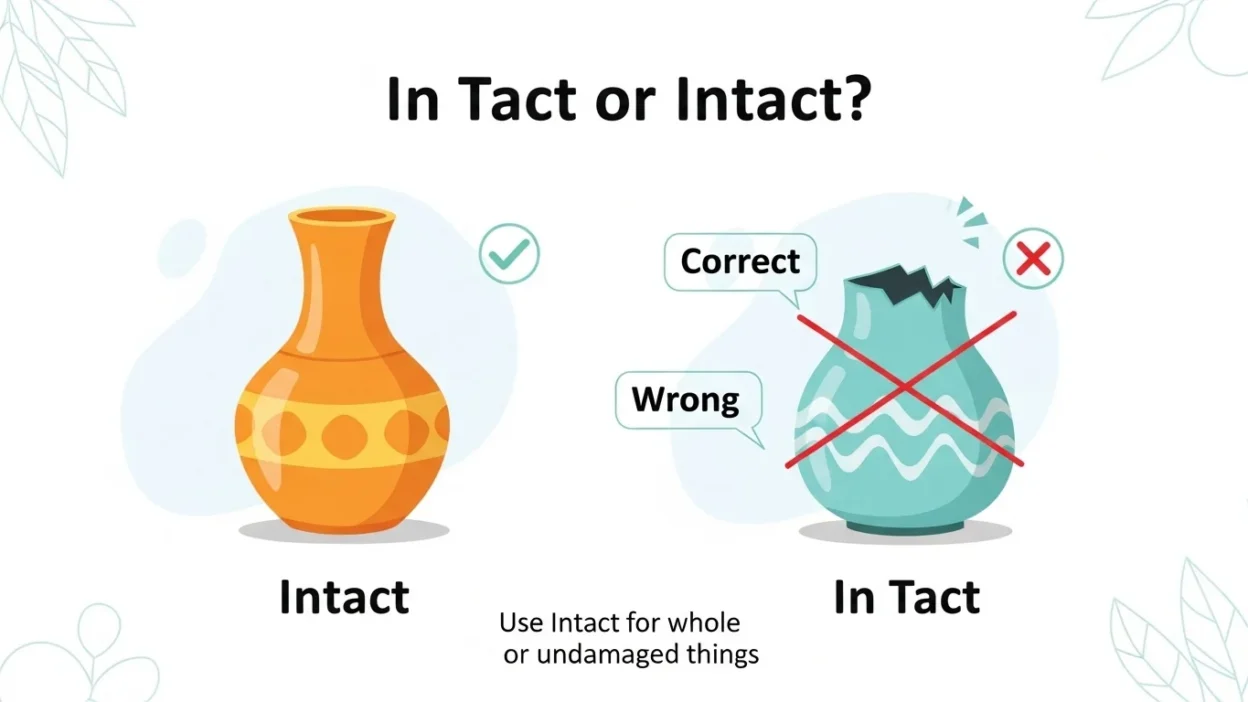
- ✅ Intact – Correct spelling. Means something is whole, complete, or not broken.
- ❌ In tact – Incorrect. There is no English word or phrase spelled this way in standard writing.
Example:
- Correct: The vase survived the fall and remained intact.
- Incorrect: The vase survived the fall and remained in tact.
Origin and Background
The word “intact” comes from Latin:
- Latin root: intactus
- Meaning: untouched, whole, unharmed
- “In” = not, “tactus” = touched
So, intact literally means “not touched.”
English borrowed it in the 1600s, and it has been used to describe things that are complete or undamaged.
Important: There is no historical or modern use of “in tact” in English. It is always a misspelling.
Clear Explanation of the Difference
| Feature | Intact | In Tact |
| Spelling | One word | Two words (wrong) |
| Meaning | Whole, complete, not damaged | None (incorrect) |
| Usage | Correct in writing and speaking | Always wrong |
| Example | The documents were intact after the flood. | ❌ The documents were in tact after the flood. |
Remember: “Intact” is an adjective. You use it to describe something that has not been harmed or broken.
Which One to Use and When
Use intact in all situations where you want to say something is whole or unharmed:
- Objects: The old book was still intact.
- Buildings: The house remained intact after the storm.
- Ideas: Her reputation stayed intact despite the rumors.
Never use “in tact.” It is always considered a spelling mistake.
Common Mistakes People Make
- Writing “in tact” in emails, essays, or messages.
- Thinking “in tact” is two words like “in place” or “in order.”
- Pronouncing it differently but still writing it wrong.
Tip: If you hear someone say “in tact,” they probably mean “intact.”
Everyday Real Life Examples
Emails:
- Correct: “I checked the files, and everything is intact.”
- Wrong: “I checked the files, and everything is in tact.”
News:
- Correct: “The historic statue survived the earthquake intact.”
Social Media:
- Correct: “My phone fell from the table, but luckily it is still intact.”
Daily Use:
- Correct: “After moving the furniture, the vase remained intact.”
Remember: Always use one word.
Learning Section for Students and Beginners
- Rule: If you want to say “whole, complete, or not broken,” spell it intact.
- Mnemonic: Think of “in” + “tact” = incorrect, and “intact” = intact and whole.
- Practice:
- Sentence 1: The package arrived ________. → Answer: intact
- Sentence 2: The castle remained ______ after the war. → Answer: intact
Short exercises like this help remember the correct spelling.
FAQ Section
1. Can I write “in tact” instead of “intact”?
- No, “in tact” is always wrong. Use “intact.”
2. What does “intact” mean?
- It means whole, complete, or undamaged.
3. Is “intact” only for objects?
- No, it can describe ideas, reputation, or anything that remains whole.
4. Why do people write “in tact”?
- Because it sounds like two words and seems logical, but it’s incorrect.
5. How do I pronounce “intact”?
- It is pronounced in-takt (stress on the second part).
6. Is “intact” formal or informal?
- It is neutral. You can use it in emails, essays, or casual speech.
7. Can I use “intact” in news or social media?
- Yes, it is correct everywhere.
8. Are there any synonyms for “intact”?
- Yes: whole, complete, undamaged, unharmed.
Conclusion
To sum up: “intact” is the correct word, and “in tact” is always wrong. It is simple to remember if you focus on the meaning: intact = whole, complete, and unharmed.
Use it for objects, ideas, or anything that remains untouched. Once you start practicing, you will never confuse them again. Whenever in doubt, think of it as one word: intact.