
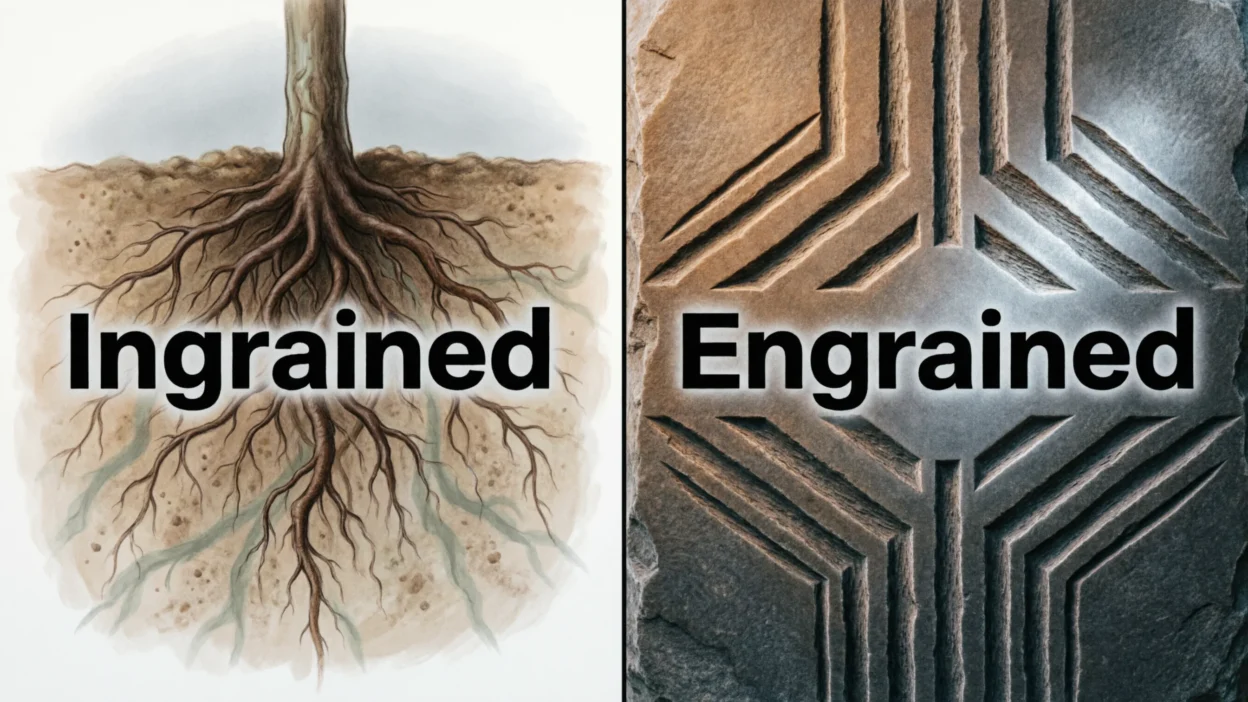
Many people feel confused about ingrained and engrained. They look almost the same. They sound almost the same. When you say them aloud, it is hard to hear any difference.
So which one is correct?
Is one wrong? Are both correct? When should you use each word?
In this simple guide, you will understand the difference clearly. By the end, you will not feel confused anymore.
Quick Answer
Here is the short and simple answer:
- ✅ Ingrained is the standard and correct spelling.
- ⚠️ Engrained is sometimes used, but it is much less common.
- 🟢 In modern English, you should usually use ingrained.
- 📚 Both words mean the same thing: something deeply fixed or firmly established.
If you want to be safe, choose ingrained.
Where Did These Words Come From?
To understand the difference, let’s look at the background in very simple terms.
The word ingrained comes from an old idea about cloth and dye.
Long ago, when people colored fabric, they wanted the color to go deep into the material. When the color went all the way into the fabric, it stayed there. It did not wash out easily.
That deep color was called “ingrained.”
Over time, the meaning changed. It no longer only described cloth. It began to describe:
- Habits
- Beliefs
- Attitudes
- Feelings
If something is “ingrained,” it is deeply fixed inside someone.
The word engrained appeared later as a spelling variation. It developed because of the word “engrave,” which means to cut something deeply into a surface. Since both ideas involve something going deep, people started spelling it “engrained.”
But today, ingrained is the standard spelling in modern English.
What Does “Ingrained” Mean?
Ingrained means:
Something that is deeply fixed and very hard to change.
It can describe:
- Habits
- Ways of thinking
- Cultural traditions
- Strong beliefs
- Deep fears
When something is ingrained, it feels natural. It feels like part of a person.
Simple examples:
- Good manners are ingrained in her.
- Fear of failure is ingrained in many students.
- The habit of waking up early is ingrained in him.
In all these examples, the idea is the same: the thing is deeply rooted and hard to remove.
What About “Engrained”?
Engrained means the same thing as ingrained.
However:
- It is much less common.
- Many teachers prefer “ingrained.”
- Some people may think “engrained” is a spelling mistake.
In modern writing, especially in school or professional settings, ingrained is the safer choice.
The Clear Difference
Here is the simple truth:
There is no difference in meaning.
The only real difference is:
- Ingrained = standard and widely accepted
- Engrained = less common spelling
Think of it like this:
| Word | Meaning | Common Today? | Safe to Use? |
| Ingrained | Deeply fixed | Yes | Yes |
| Engrained | Deeply fixed | Rare | Not recommended |
If you want to avoid mistakes, always choose ingrained.
Comparison Table
Here is an easy table to help you remember:
| Feature | Ingrained | Engrained |
| Spelling type | Standard spelling | Variant spelling |
| Meaning | Deeply rooted or fixed | Deeply rooted or fixed |
| Used in books and news | Very common | Rare |
| Preferred in school writing | Yes | Usually no |
| Risk of being marked wrong | No | Possibly yes |
This table makes it clear: use ingrained.
When Should You Use “Ingrained”?
Use ingrained when you talk about:
1. Habits
- Smoking is an ingrained habit.
- Checking my phone is ingrained in my daily routine.
2. Beliefs
- Respect for elders is ingrained in their culture.
- The idea of hard work is ingrained in her family.
3. Behavior
- Politeness is ingrained in him.
- Competition is ingrained in the team.
4. Feelings
- Fear of public speaking is ingrained in many people.
If something feels deeply planted inside a person or group, use ingrained.
Common Mistakes People Make
Let’s look at common mistakes.
❌ Mistake 1: Thinking They Have Different Meanings
Some people believe:
- “Ingrained” is emotional.
- “Engrained” is physical.
This is not true. They mean the same thing.
❌ Mistake 2: Mixing It With “Engraved”
“Engraved” means cut into something.
Example:
- The message was engraved on the stone.
“Engrained” is not the same as “engraved.”
Even though they look similar, they are different words.
❌ Mistake 3: Using “Engrained” in Formal Writing
In school essays, exams, or job applications, it is safer to use ingrained.
Some teachers may mark “engrained” as incorrect.
❌ Mistake 4: Spelling Errors
Some learners write:
- ingrane
- ingraned
- engrane
Correct spellings:
- ingrained
- engrained
Everyday Real-Life Examples
Let’s see how this word appears in daily life.
1. In Emails
- “Teamwork is ingrained in our company culture.”
- “Honesty is ingrained in our values.”
2. In News Articles
- “Corruption has become ingrained in the system.”
- “The tradition is deeply ingrained in the community.”
3. On Social Media
- “Coffee is ingrained in my morning routine.”
- “Gym time is ingrained in my lifestyle now.”
4. In School Writing
- “Respect for teachers is ingrained in many societies.”
- “The habit of reading should be ingrained from childhood.”
In all these examples, “ingrained” shows something strong and lasting.
Learning Section for Students and Beginners
Here is an easy way to remember:
Step 1: Remember the Prefix “In-”
“In-” often means “into” or “inside.”
Ingrained = grown deep inside.
Step 2: Connect It to Habits
If it is a habit you cannot easily change, it is ingrained.
Example:
- Brushing teeth every night is ingrained.
Step 3: Use This Simple Memory Trick
Think:
Ingrained = In your brain
If something is ingrained, it feels like it is inside your brain.
This trick is not perfect, but it helps you remember the spelling.
Practice Sentences
Try to choose the correct word:
- Good manners are ______ in her.
- The belief is deeply ______ in society.
- Hard work is ______ in his personality.
Answer: ingrained for all three.
FAQ Section
1. Is “engrained” wrong?
Not completely wrong, but it is uncommon. Most people use ingrained.
2. Do they have different meanings?
No. They mean the same thing.
3. Which one should I use in an exam?
Use ingrained.
4. Is “engrained” a spelling mistake?
Some teachers may treat it as a mistake because it is rare today.
5. Can I use “ingrained” for good things?
Yes.
Example:
- Kindness is ingrained in her nature.
6. Can I use it for bad things?
Yes.
Example:
- Violence became ingrained in the culture.
7. Is it only about habits?
No. It can describe habits, beliefs, traditions, attitudes, and feelings.
8. Is it formal or informal?
It works in both formal and informal English.
Conclusion
Now the confusion should be gone.
Here is the final clear answer:
- Ingrained is the correct and standard spelling.
- Engrained exists but is rare.
- Both mean something deeply fixed and hard to change.
- In modern English, always choose ingrained to be safe.
If something is deeply rooted in a person, culture, or system, it is ingrained.
Keep this simple rule in mind, and you will never mix them up again.

Daniel Matthew is a language enthusiast, writer, and contributor at Meanefy.com, where he explores the meanings, origins, and nuances of words and phrases. With a deep passion for language, Daniel aims to make complex concepts simple, engaging, and easy to understand for readers of all ages.