Many students and English learners get confused between the words “inquire” and “enquire.” They look similar, sound similar, and both mean asking questions.
But there are small differences in how they are used. This article will explain everything in very simple words so you can understand it at the first read.
Why People Get Confused
English has many words that are almost the same. Inquire and enquire are two of them. Both words mean to ask for information, but their use depends on the type of English and sometimes the formality.
People often mix them because:
- They sound almost the same.
- Some dictionaries show them as interchangeable.
- Different countries prefer different versions.
Don’t worry! By the end of this article, you will know exactly which one to use.
Quick Answer
Here’s the simple way to remember:
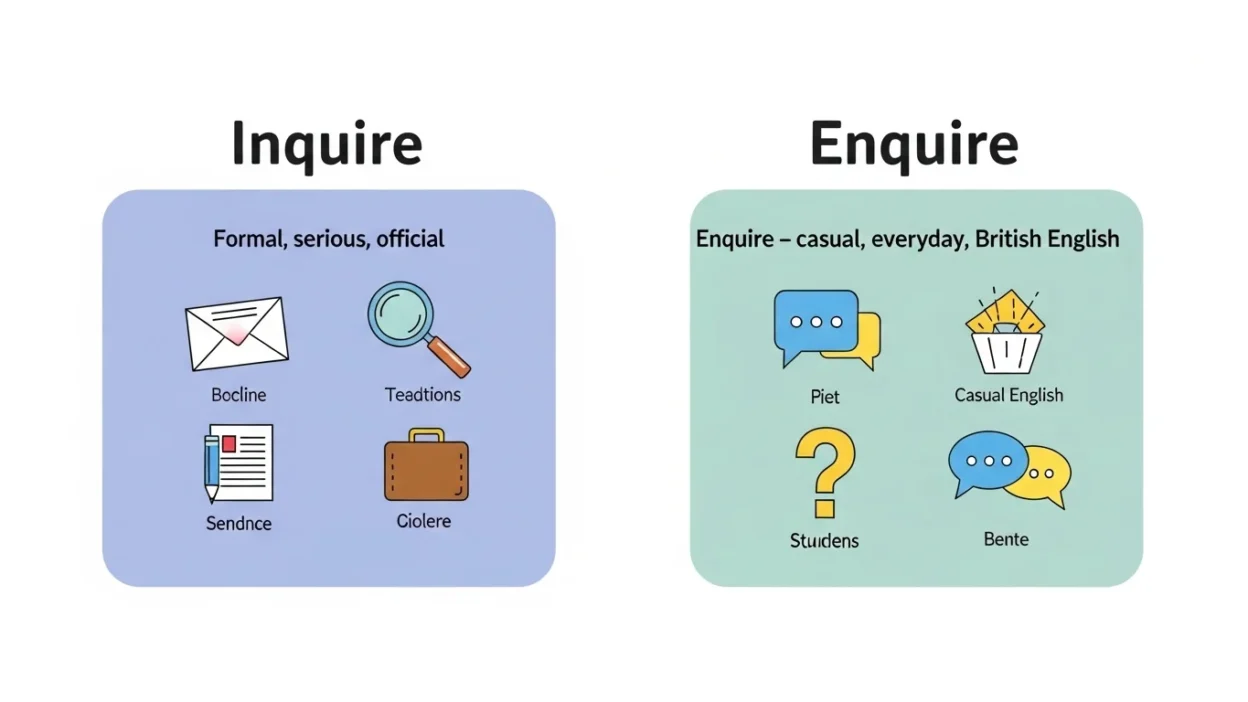
- Inquire → more formal, used in official situations or serious questions.
- Enquire → more common in British English, used for everyday questions.
- Both mean “to ask” or “to seek information.”
- In American English, inquire is preferred almost all the time.
- In British English, both are correct, but enquire is more casual.
Where Do These Words Come From?
The origin of these words helps explain why they are different.
- Both words come from the Latin word “inquirere”, which means to search for or seek.
- In Old English, the word became enqueren.
- Over time, British English kept enquire for general use and started using inquire for formal use.
- American English simplified it and mainly uses inquire for everything.
So, both words have the same root, but their modern usage depends on formality and region.
The Difference Explained Clearly
Let’s make it very simple:
| Word | Use in English | Formality | Region Focus |
| Inquire | Asking for information, usually serious or official | Formal / official | American English, also British English formal writing |
| Enquire | Asking for information, usually casual or everyday | Informal / everyday | British English |
Example sentences:
- Inquire (formal): I would like to inquire about the job vacancy.
- Enquire (casual): She called to enquire about the bus schedule.
Comparison Table: Easy to Scan
| Feature | Inquire | Enquire |
| Meaning | To ask or seek information | To ask or seek information |
| Tone | Formal, serious | Casual, everyday |
| Region | US mainly, also formal UK | UK mostly, casual use |
| Use in letters/emails | Professional letters, official forms | Casual messages, personal emails |
| Example | “We will inquire about the matter.” | “I will enquire about the party.” |
Which One Should You Use and When
- Use Inquire:
- When writing a formal email, letter, or report.
- When the question is serious, important, or official.
- Example: The company inquired about the missing shipment.
- Use Enquire:
- When asking a simple or casual question.
- When using British English in everyday situations.
- Example: I enquired at the shop if they had milk.
- American English tip: Just use inquire for everything.
Common Mistakes People Make
- Using “enquire” in American English formal writing.
- Wrong: We will enquire about your application.
- Correct: We will inquire about your application.
- Using “inquire” in casual messages in British English.
- Not wrong, but sounds too formal.
- Better: I enquired about the train times.
- Confusing spelling and pronunciation.
- Pronunciation is almost the same: /ɪnˈkwaɪər/
- Assuming both words are always interchangeable.
- In formal writing or American English, prefer inquire.
Everyday Real Life Examples
Here are some examples to see how these words are used daily:
Emails
- Formal email (inquire):
Dear Sir, I am writing to inquire about the availability of your course. - Casual email (enquire):
Hi, I just wanted to enquire if you are free tomorrow.
News
- The police are inquiring into the accident. (formal, serious)
- Fans enquired about the singer’s next concert. (casual, everyday)
Social Media
- I enquired if the cafe was open today.
- She inquired about the new regulations on her city’s website.
Daily Use
- Asking directions: I enquired where the nearest bus stop is.
- Asking for official info: We inquired about the visa process at the embassy.
Short Learning Section for Students
- Think of inquire as “important question.”
- Think of enquire as “everyday question.”
- American English → always use inquire.
- British English → use enquire for casual, inquire for formal.
Tip: If you are unsure, using inquire is always safe in writing.
FAQ (Frequently Asked Questions)
Q: Can I use inquire and enquire interchangeably?
A: Yes, in British English for general use. But in formal or American English, prefer inquire.
Q: Which one is more formal?
A: Inquire is more formal and official.
Q: Is enquire correct in American English?
A: It is very rare. Americans mostly use inquire.
Q: Do they have different pronunciations?
A: No, they are pronounced almost the same: /ɪnˈkwaɪər/.
Q: Which one should I use in emails?
A: Use inquire for professional emails. Use enquire for casual emails in British English.
Q: Can I use enquire in a job application?
A: It’s better to use inquire because it sounds formal and professional.
Q: Why does British English use both words?
A: British English keeps enquire for everyday use and inquire for formal situations.
Q: Is one word wrong?
A: No, both are correct. It depends on region and formality.
Conclusion
To summarize in simple words:
- Inquire = formal, serious, official
- Enquire = casual, everyday, mainly British English
- American English → mostly inquire
- British English → enquire casual, inquire formal
Remembering this simple rule will help you write and speak correctly without confusion. Use the examples and tables above, and soon you will never mix these two words again.

Steven Mark is a writer, researcher, and contributor at Meanefy.com, a platform dedicated to exploring word meanings, language nuances, and everyday linguistic curiosities. With a passion for words and clear communication, Steven focuses on making language simple, engaging, and accessible to all readers.