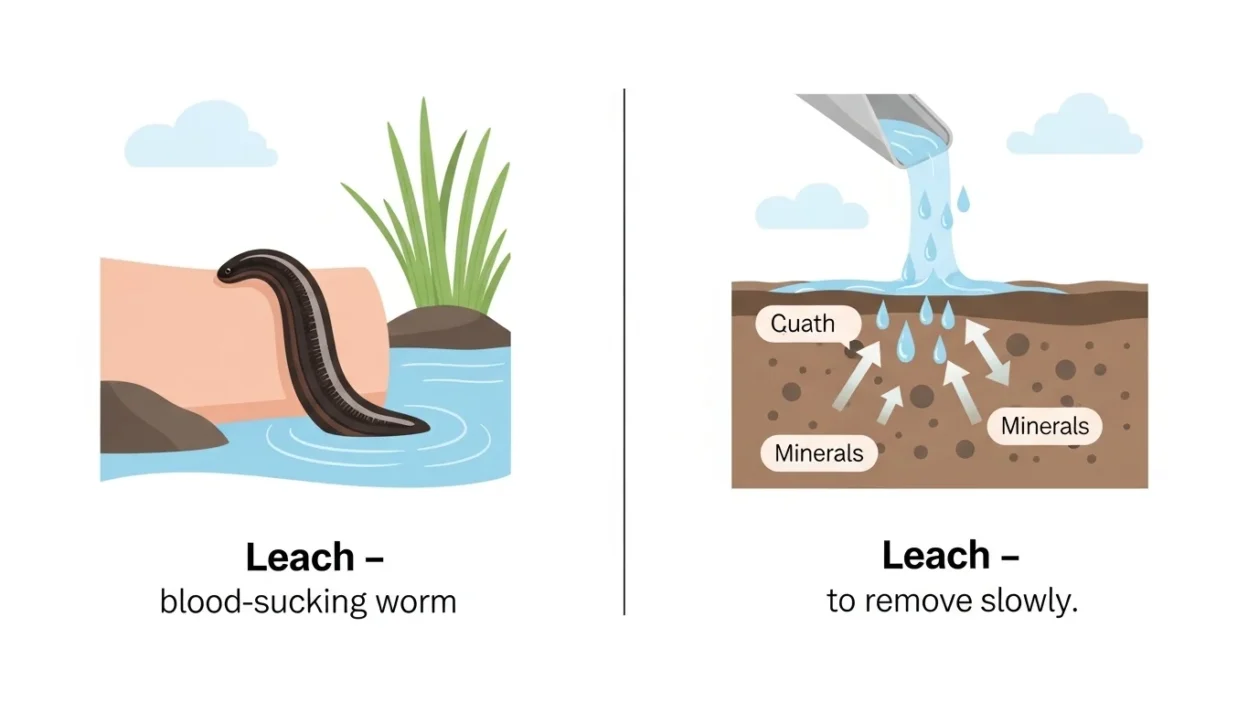
Many people mix up “leach” and “leech” because they look and sound almost the same. When you speak, they sound identical. When you write, just one letter changes the meaning completely.
This small difference can cause big confusion, especially for students, learners and beginners. But don’t worry this guide will make everything clear in a simple way.
Quick Answer
Here is the easiest way to remember:
- Leech (correct word in most cases):
- A type of animal (a worm that sucks blood)
- A person who takes advantage of others
- Leach (rare and technical use):
- Means to remove something slowly (like chemicals from soil)
👉 In daily life, “leech” is the word you will use most of the time.
Simple Background: Where Do These Words Come From?
Both words come from old English, but they developed in different ways.
- Leech comes from an old word meaning a blood sucking worm. Long ago, people even used leeches in medicine.
- Leach comes from a word meaning “to drain” or “to remove something slowly.”
Over time:
- Leech became common in everyday language.
- Leach stayed mostly in science and technical writing.
Clear Explanation of the Difference
Let’s break it down in the simplest way possible.
What is “Leech”?
Leech can be used in two main ways:
- As an animal
- A small worm that sticks to skin and sucks blood.
- Found in water or wet places.
- As a person (informal meaning)
- Someone who depends on others and takes without giving back.
- Often used in a negative way.
👉 Think: “Leech = takes from others.”
What is “Leach”?
Leach is a verb (an action word).
It means:
- To remove something slowly, usually with water or liquid.
Examples:
- Chemicals can leach into soil.
- Water can leach minerals from rocks.
👉 Think: “Leach = slowly remove or drain.”
Comparison Table
| Feature | Leech | Leach |
| Type of word | Noun (mostly), sometimes verb | Verb |
| Common use | Very common | Less common |
| Meaning | Blood sucking worm or dependent person | Remove something slowly (liquid process) |
| Everyday use | Yes | Rare |
| Example | “He is a leech.” | “Water can leach chemicals.” |
| Easy memory tip | “Leech = takes” | “Leach = drains” |
Which One to Use and When
Use “Leech” when:
- Talking about the animal
- “A leech stuck to his leg.”
- Talking about a person who depends on others
- “He is acting like a leech.”
- Writing informal or daily English
- Social media, chats, emails
Use “Leach” when:
- Talking about science or nature
- “Rain can leach nutrients from soil.”
- Writing technical or academic content
- Environmental studies, chemistry, geology
👉 Simple rule:
If you are unsure, you probably mean “leech.”
Common Mistakes People Make
Here are mistakes many learners make:
1. Using “leach” instead of “leech”
❌ “He is such a leach.”
✔ “He is such a leech.”
2. Confusing meaning because of spelling
❌ “The leech polluted the water.”
✔ “The chemicals leached into the water.”
3. Thinking both words are the same
They are NOT the same:
- One is about taking from others
- The other is about removing slowly
4. Using “leach” in daily conversation
Most people don’t use “leach” in normal talk. It sounds too technical.
Everyday Real Life Examples
Let’s look at how these words appear in real life.
In Emails
- “I don’t want to work with someone who acts like a leech.”
- “The material may leach harmful chemicals over time.”
In News
- “The company was accused of letting toxic waste leach into the ground.”
- “Some critics called him a political leech.”
On Social Media
- “Stop being a leech and do your own work!”
- “Plastic can leach into food if heated.”
In Daily Conversation
- “I found a leech while hiking!”
- “This soil can leach nutrients after heavy rain.”
Learning Section for Students and Beginners
Here are some simple tips to help you remember:
1. Memory Trick
- Leech → “ee” → eats (takes from others)
- Leach → “ea” → escapes (something leaves slowly)
2. Practice Sentences
Fill in the blanks:
- He is acting like a ______.
- Chemicals can ______ into water.
- A ______ stuck to my skin.
Answers:
- leech
- leach
- leech
3. Speak It Out
Say these sentences aloud:
- “A leech takes from others.”
- “Water can leach minerals.”
This helps your brain remember faster.
FAQ Section
1. Are “leach” and “leech” the same?
No. They have different meanings and uses.
2. Which word is more common?
Leech is much more common in daily English.
3. Can “leech” be a verb?
Yes, sometimes.
Example: “He is leeching off his friends.”
4. Is “leach” used in daily conversation?
Not usually. It is mostly used in science or technical topics.
5. How can I remember the difference easily?
- Leech = takes from others
- Leach = removes slowly
6. Is “leech” always negative?
- The animal meaning is neutral
- The person meaning is usually negative
7. Can I use “leach” instead of “leech”?
No. That would be incorrect in most cases.
8. Which word should beginners focus on?
Focus on “leech” first because it is more useful in everyday English.
Conclusion
Understanding the difference between “leach” and “leech” is actually simple once you break it down.
- Leech is the common word:
- A blood sucking worm
- A person who takes from others
- Leach is a technical word:
- It means to remove something slowly with liquid
If you remember just one thing, remember this:
👉 “Leech takes. Leach drains.”
With this simple idea, you will never confuse these words again.

Daniel Matthew is a language enthusiast, writer, and contributor at Meanefy.com, where he explores the meanings, origins, and nuances of words and phrases. With a deep passion for language, Daniel aims to make complex concepts simple, engaging, and easy to understand for readers of all ages.