English can be tricky, especially when words look similar but mean very different things. Two words that often confuse students, beginners, and even native speakers are “lose” and “loose.”
This guide will explain them in a very simple way so you can understand and remember the difference forever.
Why People Get Confused
Many learners mix up lose and loose because they sound almost the same. A small change in spelling changes the meaning completely. Using the wrong word can make your sentence wrong or confusing. Don’t worry—after reading this guide, you’ll always know which one to use.
Quick Answer
Here’s a simple way to remember:
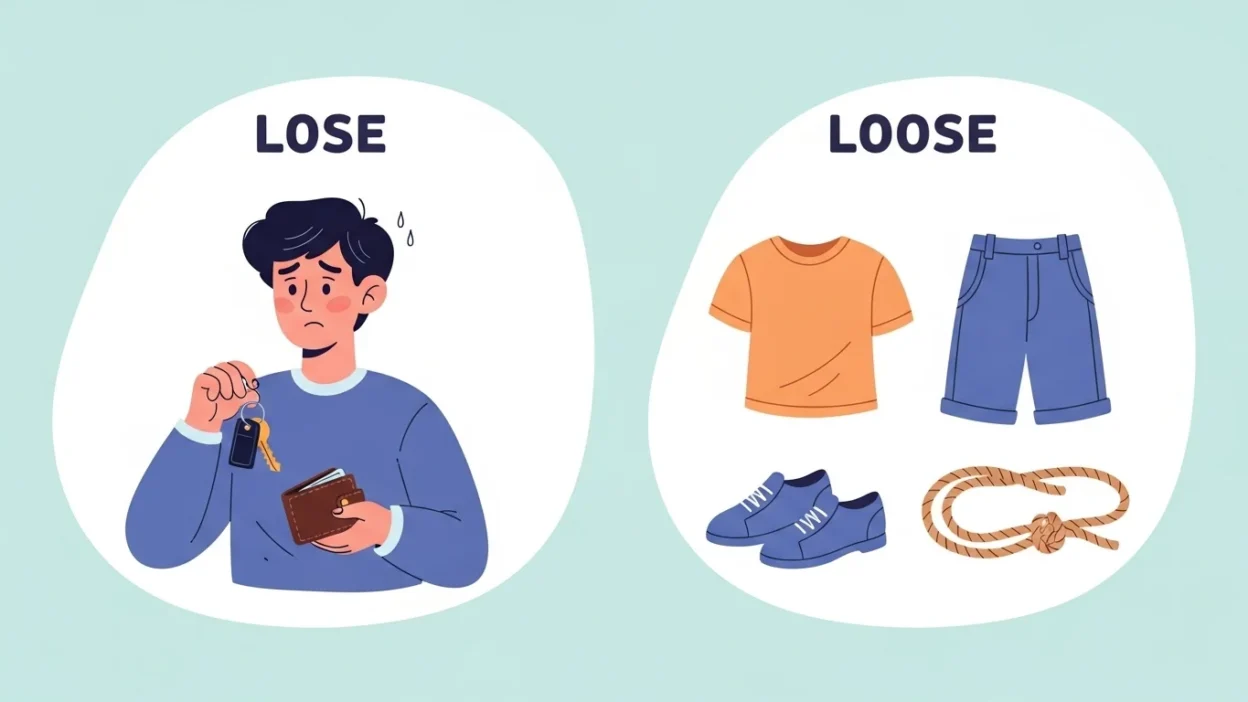
- Lose (verb) → means to not have something anymore
- Example: I don’t want to lose my keys.
- Loose (adjective) → means not tight or free
- Example: My shoes are too loose.
Origin and Background
Understanding where these words come from can help:
- Lose comes from Old English “losian”, meaning to be destroyed, perish, or fail. Over time, it came to mean not having something anymore.
- Loose comes from Old English “los”, meaning free, detached, or not tight.
Notice: lose is an action (verb), while loose describes something (adjective).
Clear Explanation of the Difference
- Lose – Verb (action)
- Used when you misplace something or fail to win.
- Example meanings:
- To not win a game: “We might lose the match.”
- To misplace: “I always lose my pen.”
- Loose – Adjective (describes)
- Used to describe something not tight or free-moving.
- Example meanings:
- Not tight: “The shirt is too loose.”
- Free or detached: “The dog got loose from the fence.”
Tip: If you can replace the word with “free” or “not tight,” it’s probably loose. If it’s an action, it’s lose.
Comparison Table
| Word | Type | Meaning | Example Sentence |
| Lose | Verb | To not have something anymore | I don’t want to lose my wallet. |
| Loose | Adjective | Not tight, free, or relaxed | My pants are too loose. |
Which One to Use and When
- Use lose when talking about:
- Misplacing objects: keys, wallet, phone
- Failing at something: a game, a race, a chance
- Use loose when talking about:
- Clothes that are not tight
- Something that is free or can move around
- A screw, rope, or part that is not fixed
Common Mistakes People Make
- Writing loose instead of lose:
- ❌ “I don’t want to loose my keys.”
- ✅ “I don’t want to lose my keys.”
- Writing lose instead of loose:
- ❌ “My shoes are too lose.”
- ✅ “My shoes are too loose.”
- Confusing meaning in expressions:
- “Loose your mind” is wrong. Correct: “Lose your mind.”
Everyday Real Life Examples
Emails:
- “Please don’t lose the document I sent you.”
- “The folder on your desk looks a bit loose.”
News Headlines:
- “Team A may lose the championship this year.”
- “Loose cables on the street caused a small accident.”
Social Media:
- “Can’t believe I lose again in this game 😅”
- “My bracelet is too loose, might fall off!”
Daily Life:
- Misplacing keys → “I lose my keys every morning.”
- Clothes too big → “This jacket is loose on me.”
Short Learning Section for Students and Beginners
- Remember: Lose = action, Loose = description.
- Trick:
- Lose has one “o” → think of losing one thing.
- Loose has two “o’s” → think of something open or big.
- Practice sentence:
- “I hope I don’t lose my hat, because it is a bit loose on my head.”
FAQ
1. Can I use “loose” as a verb?
No. “Loose” is only an adjective. The verb form is “loosen,” which means to make something less tight.
2. Is “lose” ever an adjective?
No. “Lose” is always a verb.
3. How do I remember the difference easily?
Think:
- Lose → you lose things (action)
- Loose → clothes are loose (describing)
4. Can “loose” describe people?
Yes, sometimes. For example, “He has a loose grip on the rules,” meaning not strict.
5. Can “lose” be used in sports?
Absolutely. “Our team will lose if we don’t practice.”
6. Is “loose” used in grammar?
It’s not about grammar; it’s about describing objects, clothes, or something not tight.
7. Can “lose” be used with opportunities?
Yes. “Don’t lose your chance to apply.”
8. Are there other tricky similar words?
Yes, words like loosen and loss are related, but now you understand the basics.
Conclusion
The difference between lose and loose is simple once you know it:
- Lose → action, to misplace or not win.
- Loose → adjective, not tight or free.
Remember the little tricks, use them in daily life, and you’ll never mix them up again. With practice, spelling and meaning will become easy and automatic.
Now, every time you see lose or loose, you’ll know exactly which one to use!

Daniel Matthew is a language enthusiast, writer, and contributor at Meanefy.com, where he explores the meanings, origins, and nuances of words and phrases. With a deep passion for language, Daniel aims to make complex concepts simple, engaging, and easy to understand for readers of all ages.