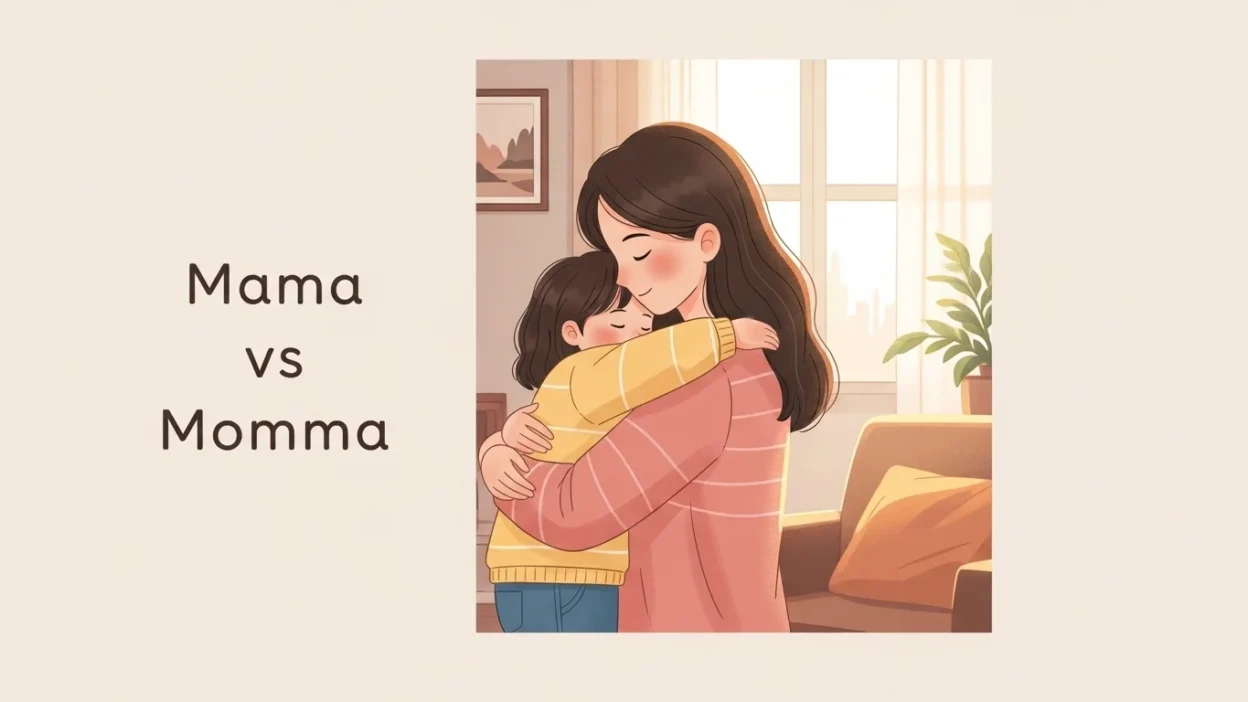
Many people feel confused when they see the words “mama” and “momma.” They look very similar. They sound almost the same. But are they the same word? Do they mean the same thing? And which one should you use?
This confusion is very common, especially for students and English learners. The good news is that the difference is simple once you understand it.
This guide will explain everything in very easy English so you can feel confident using both words.
Quick Answer
- “Mama” is the more common and standard spelling.
- “Momma” is a more informal spelling, often used in speech or certain regions.
- Both words mean mother, especially in a loving or emotional way.
- “Mama” is safer to use in writing.
- “Momma” is often used in casual or personal situations.
Simple Background
The word “mama” is very old. It comes from the simple sounds that babies make when they learn to speak. Many languages around the world use similar sounds for “mother,” like mama, amma, or ma.
Over time, English kept the word “mama” as a loving and informal way to say “mother.”
The spelling “momma” came later. It is mostly based on how people say the word in everyday speech, especially in some parts of the United States. People write it the way it sounds to them.
Clear Explanation of the Difference
The difference between “mama” and “momma” is mainly about spelling style and tone, not meaning.
1. Meaning
Both words mean the same thing:
👉 A mother, often in a loving, warm, or emotional way.
Example:
- I love my mama.
- I love my momma.
Both sentences mean the same thing.
2. Spelling Style
- Mama
- Standard and widely accepted spelling
- Used in books, learning materials, and formal writing
- Easy to understand for everyone
- Momma
- Non-standard spelling
- Based on pronunciation
- More common in casual writing or storytelling
3. Tone (Feeling)
- Mama
- Soft, simple, and neutral
- Works in both casual and slightly formal situations
- Momma
- More emotional and personal
- Feels warm, expressive, and sometimes regional
4. Usage in Different Places
- “Mama” is used all over the world.
- “Momma” is more common in American English, especially in informal speech.
Comparison Table
| Feature | Mama | Momma |
| Meaning | Mother | Mother |
| Spelling type | Standard | Informal |
| Usage | Common everywhere | Mostly casual use |
| Tone | Neutral and soft | Emotional and warm |
| Writing style | Safe for all situations | Best for informal writing |
| Popularity | More widely accepted | Less common |
Which One Should You Use and When
Use “Mama” when:
- You are writing for school
- You want to be clear and correct
- You are unsure which one to choose
- You are writing for a wide audience
Example:
- My mama helps me with my homework.
Use “Momma” when:
- You are writing casually
- You want to show strong emotion
- You are copying spoken language
- You are writing stories or dialogues
Example:
- I miss you, momma.
Simple Tip
👉 If you are a student or learner, use “mama” most of the time. It is safer and more standard.
Common Mistakes People Make
1. Thinking they have different meanings
Some people think “mama” and “momma” mean different things.
❌ This is not true.
✅ They both mean “mother.”
2. Using “momma” in formal writing
“Momma” is too casual for school essays or formal work.
❌ Incorrect:
- My momma is a doctor. (in a formal essay)
✅ Better:
- My mama is a doctor.
3. Mixing both in the same text
Using both words together can look confusing.
❌ Example:
- My mama loves cooking, and my momma is very kind.
✅ Better:
- Choose one and stay consistent.
4. Thinking “momma” is wrong
“Momma” is not wrong—it is just informal.
Everyday Real-Life Examples
1. In Emails
- Dear Mama, I hope you are doing well.
- Hi Momma, I miss you so much.
2. In Social Media
- Happy birthday, mama! ❤️
- Love you forever, momma!
3. In Daily Speech
- Mama, can I go outside?
- Momma, I need your help.
4. In Stories
- The child ran to his mama.
- “Momma!” she cried as she hugged her tightly.
5. In News or Articles
- The word “mama” is often used to express love and care.
(“Momma” is less common in formal news writing.)
Learning Section for Students and Beginners
Here is a simple way to remember:
👉 Mama = Standard and safe
👉 Momma = Casual and emotional
Practice Sentences
Fill in the blank:
- I love my ______.
- ______, can you help me?
- She called her ______ before sleeping.
You can use either word, but think about the situation.
Easy Rule
- Writing for school? → Mama
- Writing a personal message? → Mama or Momma
FAQ Section
1. Are “mama” and “momma” the same?
Yes. They both mean “mother.”
2. Which spelling is correct?
Both are correct, but “mama” is more standard.
3. Is “momma” wrong?
No. It is just more informal and used in casual situations.
4. Which one should students use?
Students should usually use “mama” because it is safer in writing.
5. Is “momma” used in formal writing?
No. It is rarely used in formal writing.
6. Do both words sound the same?
Yes, they sound very similar in speech.
7. Is one more popular than the other?
Yes. “Mama” is more widely used around the world.
8. Can I use both in one sentence?
It is better to choose one and stay consistent.
Conclusion
The difference between “mama” and “momma” is simple once you understand it.
Both words mean the same thing: a loving way to say mother. The main difference is in style and usage. “Mama” is the standard, safe, and widely accepted spelling. “Momma” is more informal and often used to show emotion or reflect spoken language.
If you are unsure, choose “mama.” It works in almost every situation.
With this simple understanding, you can now use both words correctly and confidently in your writing and speech.

Anthony Charles is the founder and lead content creator at Meanefy.com, a platform dedicated to exploring word meanings, language nuances, and everyday curiosities. With a passion for language and a keen eye for detail, Anthony aims to make complex words and concepts simple and accessible for readers around the world.