Many English learners feel confused about the words man and men. They look very similar, and both refer to adult males. Because of this, students often mix them up when writing or speaking.
For example, someone might say:
- “Three man are waiting outside.” ❌
- “One men is calling you.” ❌
These sentences sound wrong in English, but beginners often make this mistake. The confusion usually happens because the words change form in a different way compared to many other English nouns.
The good news is that the difference is very simple. Once you understand the rule, it becomes easy to use these words correctly in daily conversation, writing, emails, or school work.
This guide will explain everything step by step in clear and simple English so you can understand it immediately.
Quick Answer
Here is the short and simple answer:
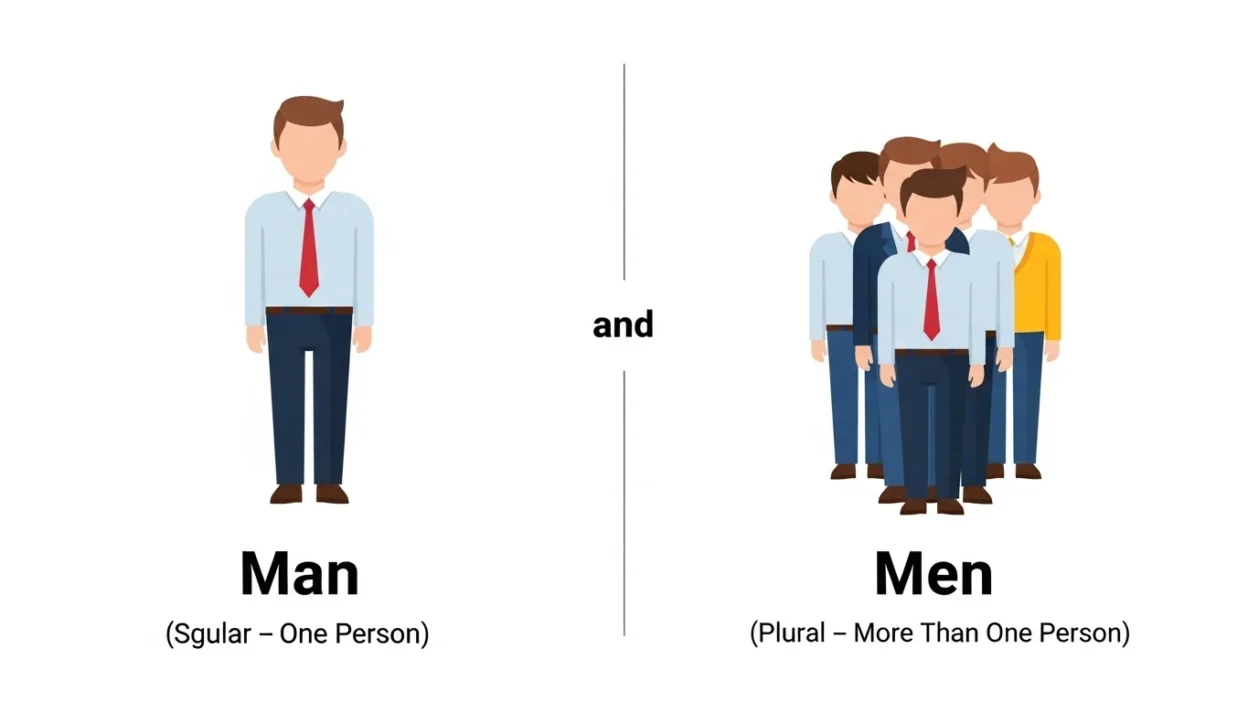
- Man = one adult male (singular)
- Men = more than one adult male (plural)
Examples:
- One man is standing near the door.
- Two men are talking in the park.
Think of it like this:
| Word | Meaning |
| Man | One male person |
| Men | More than one male person |
A quick memory tip:
- A → one person (man)
- E → many people (men)
Simple Origin and Background
The words man and men come from Old English, which was used in England more than 1,000 years ago.
In Old English:
- mann meant a person
- menn meant people
Over time, the meanings changed slightly:
- Man started to mean an adult male person
- Men became the plural form of man
Unlike many English nouns that simply add -s to make a plural form (like book → books), the word man changes its vowel.
Examples of similar word changes in English:
| Singular | Plural |
| Man | Men |
| Woman | Women |
| Foot | Feet |
| Tooth | Teeth |
These are called irregular plurals, which means they do not follow the normal add “s” rule.
The Clear Difference Between Man and Men
The difference between man and men is simply about number.
Man
Use man when you are talking about one adult male person.
Examples:
- The man is reading a newspaper.
- A man helped me carry my bag.
- That man is my teacher.
In each example, we are talking about only one person.
Men
Use men when you are talking about two or more adult male people.
Examples:
- Two men are waiting outside.
- The men are working on the road.
- Several men joined the meeting.
Here, the word refers to more than one person.
Comparison Table
This table makes the difference very clear.
| Feature | Man | Men |
| Number | Singular | Plural |
| Meaning | One adult male | More than one adult male |
| Example sentence | A man is sitting there. | Three men are sitting there. |
| Verb form | Usually singular verb | Usually plural verb |
| Example verb | The man is speaking. | The men are speaking. |
Which One to Use and When
Choosing the correct word becomes easy if you follow one simple rule.
Use Man When:
- You are talking about one person
- You see words like a, one, this, that
Examples:
- A man called you earlier.
- One man was late for the meeting.
- That man looks familiar.
Use Men When:
- You are talking about two or more people
- You see words like two, many, several, some
Examples:
- Two men are fixing the car.
- Many men attended the event.
- Some men are playing football.
Common Mistakes People Make
Many learners make small mistakes when using these words. Let’s look at the most common ones.
Mistake 1: Using “man” for plural
Wrong:
- Three man are standing outside.
Correct:
- Three men are standing outside.
Mistake 2: Using “men” for singular
Wrong:
- One men is speaking.
Correct:
- One man is speaking.
Mistake 3: Verb agreement errors
Wrong:
- The men is waiting.
Correct:
- The men are waiting.
Remember:
- Man → is / was
- Men → are / were
Everyday Real Life Examples
These words appear everywhere in daily English. Here are some examples from common situations.
In Emails
- A man from the delivery company called today.
- Two men will arrive tomorrow to repair the machine.
In News
- A man was rescued from the river.
- Three men were arrested by the police.
On Social Media
- I saw a man dancing in the street today.
- Two men helped an old woman cross the road.
In Daily Conversation
- The man at the shop was very helpful.
- The men in our office work very hard.
These examples show how often the words appear in normal English.
Learning Tips for Students and Beginners
If you are learning English, here are some simple ways to remember the difference.
1. Think of the numbers
- 1 person → man
- 2 or more → men
2. Practice with short sentences
Try saying sentences like:
- One man is running.
- Two men are running.
Practice helps your brain remember the pattern.
3. Notice the verb
Singular:
- The man is walking.
Plural:
- The men are walking.
This helps you quickly check if your sentence is correct.
4. Learn similar word pairs
English has other similar patterns:
| Singular | Plural |
| Man | Men |
| Woman | Women |
| Foot | Feet |
| Tooth | Teeth |
Learning them together makes them easier to remember.
Frequently Asked Questions (FAQ)
1. Is “man” singular or plural?
Man is singular. It refers to one adult male person.
Example:
A man is waiting outside.
2. Is “men” singular or plural?
Men is plural. It refers to two or more adult male people.
Example:
Two men are waiting outside.
3. Can I say “mans” instead of “men”?
No. “Mans” is incorrect in standard English. The correct plural of man is men.
4. Why does “man” change to “men”?
It comes from old English language patterns where some words changed their vowel sound instead of adding -s.
5. Do “man” and “men” always refer to adults?
Usually yes. They usually refer to adult males. For younger males, the word boy is more common.
6. What is the plural of “woman”?
The plural of woman is women.
Example:
- One woman
- Two women
7. Can “man” sometimes mean “human”?
Yes. In some older or general expressions, man can mean humankind. However, in everyday English it usually means an adult male.
8. How can I remember the difference easily?
Remember this simple rule:
- A → one person (man)
- E → many people (men)
Conclusion
The difference between man and men is actually very simple once you understand it.
- Man refers to one adult male person.
- Men refers to two or more adult male people.
The key idea is singular vs plural.
If you remember this rule and practice using the words in short sentences, you will quickly become comfortable with them.
Many English learners make mistakes at first, but that is normal. With a little practice, using man and men correctly will soon feel natural in conversations, writing, and everyday English.

Anthony Charles is the founder and lead content creator at Meanefy.com, a platform dedicated to exploring word meanings, language nuances, and everyday curiosities. With a passion for language and a keen eye for detail, Anthony aims to make complex words and concepts simple and accessible for readers around the world.