Many English learners and even native speakers often get confused between “meantime” and “mean time.” They sound almost the same, but they have different meanings.
Understanding the difference is important because using the wrong one can make your sentence unclear.
This guide will explain everything in a simple way so anyone can understand it easily.
Why People Get Confused
The confusion happens because:
- Both phrases sound very similar when spoken.
- They both include the word “mean,” which has many meanings in English.
- People often mix them in writing because they don’t know the exact meaning.
By the end of this article, you will know exactly when to use “meantime” and when to use “mean time.”
Quick Answer
Here’s the simple answer in bullet points:
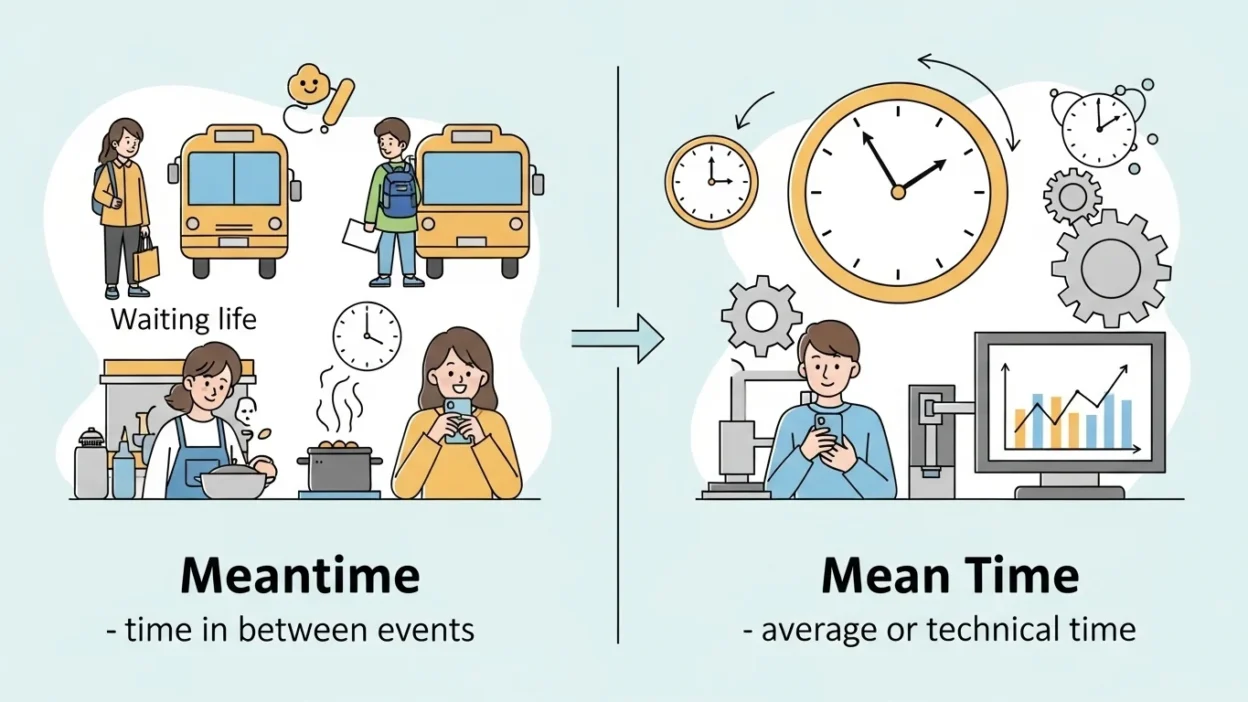
- Meantime (one word) → used to talk about the time between two events. It is often the same as “in the meantime.”
- Mean time (two words) → used in technical or scientific contexts, usually to talk about an average time.
Example:
- Meantime: “Dinner will be ready in 30 minutes. In the meantime, you can watch TV.”
- Mean time: “The mean time between failures of this machine is 5 hours.”
Origin and Background
Meantime
- Comes from old English and simply means “the time in between.”
- It has been used for hundreds of years in everyday speech.
Mean time
- Comes from science and mathematics.
- “Mean” here means average.
- Used in contexts like clocks, machines, or statistics.
Clear Explanation of the Difference
1. Meantime
- Always one word.
- Can often be replaced by “in the meantime”.
- Refers to the period of waiting or time between two events.
- Mostly used in everyday English.
Examples:
- “The bus arrives in 10 minutes. In the meantime, let’s sit down.”
- “He is studying at university. Meantime, she works part-time.”
2. Mean Time
- Always two words.
- “Mean” = average, “time” = period.
- Refers to average duration or a technical measurement of time.
- Mostly used in scientific, technical, or formal writing.
Examples:
- “The mean time between accidents has decreased this year.”
- “The mean time on this old clock is not accurate.”
Comparison Table
| Feature | Meantime | Mean Time |
| Spelling | One word | Two words |
| Meaning | Time in between events | Average time or technical measurement |
| Usage | Everyday English | Science, statistics, technical contexts |
| Replaceable with | “In the meantime” | Cannot be replaced with “in the meantime” |
| Example | “Dinner is ready in 30 minutes. Meantime, relax.” | “The mean time between failures is 2 hours.” |
Which One to Use and When
- Use meantime when talking about waiting or doing something while another event is happening.
- Use mean time when talking about averages, clocks, machines, or technical measurements.
Tip: If you can replace it with “in the meantime”, it should be meantime. If it talks about an average or formula, it should be mean time.
Common Mistakes People Make
- Writing mean time when they mean meantime.
- ❌ “Dinner is ready in 30 minutes. Mean time, watch TV.”
- ✅ “Dinner is ready in 30 minutes. Meantime, watch TV.”
- Writing meantime in a technical context.
- ❌ “The meantime between failures is 2 hours.”
- ✅ “The mean time between failures is 2 hours.”
- Confusing spoken English because they sound similar.
Everyday Real Life Examples
Emails:
- “The report will arrive tomorrow. In the meantime, please check your email for updates.”
News:
- “The new law will take effect next month. Meantime, citizens are encouraged to follow the old rules.”
Social Media:
- “Waiting for the concert to start? In the meantime, check out the band’s playlist!”
Daily Life:
- Cooking: “The cake needs 20 minutes in the oven. Meantime, wash the dishes.”
- Machines: “The mean time between engine repairs is 3,000 miles.”
Short Learning Section for Students and Beginners
- Meantime = in between → everyday situations → one word
- Mean time = average time → technical/science → two words
Mini Practice: Fill in the blanks:
- The movie starts in 10 minutes. ____, you can get popcorn.
- The __ between machine failures is 5 hours.
Answers:
- Meantime
- Mean time
FAQ
1. Can I use “mean time” instead of “meantime”?
- No. “Mean time” is for average or technical situations.
2. Can “meantime” appear at the start of a sentence?
- Yes. “Meantime, you can study while I cook.”
3. Is “in the meantime” the same as “meantime”?
- Yes. “In the meantime” is more formal; “meantime” is short and casual.
4. Is “mean time” used in everyday English?
- Rarely. Mostly technical or scientific contexts.
5. Can “meantime” be used in emails?
- Yes, very common.
6. How do I remember the difference?
- If you talk about waiting → meantime.
- If you talk about averages → mean time.
7. Are there synonyms for “meantime”?
- Yes: “in the meantime,” “while waiting.”
8. Are there synonyms for “mean time”?
- Yes: “average time,” “expected time.”
Conclusion
To sum up:
- Meantime (one word) = time between events → everyday English
- Mean time (two words) = average time → technical/scientific English
Remembering this simple rule can help you never confuse these two again.
When in doubt, check if it’s about waiting or averages. Use short examples in daily life to practice, and soon it will become second nature.