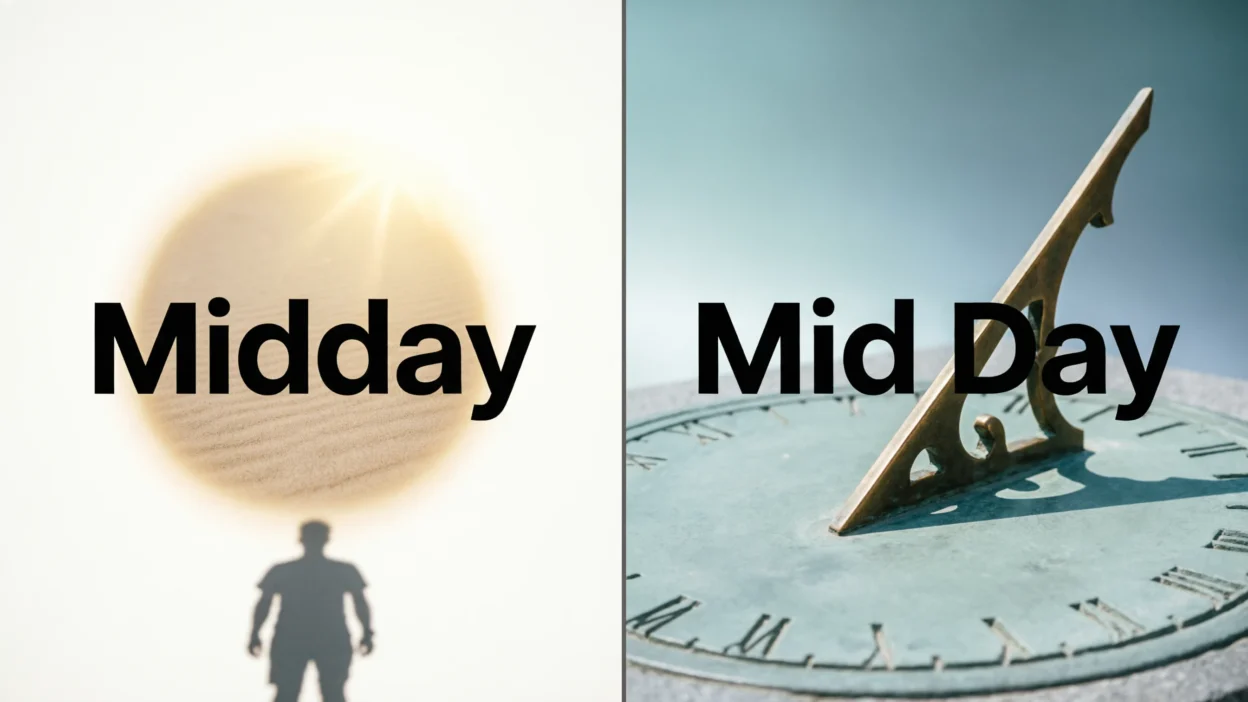
Many people feel confused when they see midday and mid day.
Are they the same?
Is one wrong?
Does the hyphen change the meaning?
If you are a student, an English learner, or someone who just wants to write correctly, this question can be frustrating. The good news is that the answer is simple. After reading this guide, you will clearly understand which one to use and why.
Let’s make it easy.
Quick Answer
- ✅ Midday (no hyphen) is the correct and modern spelling.
- ❌ Mid-day (with a hyphen) is old-fashioned and rarely used today.
- Both words mean 12:00 PM or the middle of the day.
- In almost all situations, you should write midday.
If you remember only one thing, remember this:
👉 Use “midday.” Avoid “mid-day.”
Simple Background: Where Did These Words Come From?
English words change over time.
A long time ago, many compound words (two words joined together) were written with a hyphen. For example:
- To-day → today
- To-night → tonight
- Mid-day → midday
Over time, English removed many hyphens. The two words slowly joined into one word.
That is why mid day was common in older writing. But today, modern English prefers midday as one single word.
Language becomes simpler over time. This is one example.
What Does “Midday” Mean?
Midday means:
- 12:00 PM
- The middle of the day
- Around noon
It refers to the time when the sun is usually highest in the sky.
Examples:
- I will call you at midday.
- The meeting starts at midday.
- It is very hot at midday.
It is a noun. That means it names a time of day.
What About “Mid Day”?
Mid day means the same thing as midday.
There is no difference in meaning.
The only difference is the hyphen.
But here is the important point:
👉 Mid day is considered outdated in modern English.
Most books, schools, teachers, and newspapers now use midday without the hyphen.
You might see mid-day in:
- Very old books
- Historical writing
- Some personal writing styles
But in normal modern writing, use midday.
Clear Explanation of the Difference
Let’s make this very simple.
There is:
- ❌ No difference in meaning
- ❌ No difference in pronunciation
- ❌ No difference in time
The only difference is spelling style.
English has moved toward simpler spelling. That is why midday is now standard.
If you want your writing to look modern and correct, choose midday.
Quick Comparison Table
| Feature | Midday | Mid-Day |
| Meaning | Middle of the day | Middle of the day |
| Time | Around 12 PM | Around 12 PM |
| Modern spelling | ✅ Yes | ❌ No |
| Used in schools today | ✅ Yes | ❌ Rare |
| Common in old texts | Sometimes | ✅ Yes |
| Recommended to use | ✅ Yes | ❌ No |
This table shows clearly: the only real difference is style and modern usage.
Which One Should You Use?
Here is a simple rule:
✅ Use midday in:
- School writing
- Essays
- Emails
- Business messages
- Social media
- News writing
- Everyday conversation (written)
❌ Avoid mid day unless:
- You are copying an old text
- You are writing historical fiction
- A style guide specifically asks for it
For almost everyone reading this article, the answer is simple:
👉 Always choose midday.
Common Mistakes People Make
Let’s look at mistakes that often happen.
1. Adding a hyphen because it “looks right”
Some people think compound words must have a hyphen.
But English does not always work that way. Many words that once had hyphens no longer do.
Wrong:
- The event begins at mid-day.
Better:
- The event begins at midday.
2. Confusing “midday” with “noon”
These words are very close in meaning, but not always exactly the same.
- Noon usually means exactly 12:00 PM.
- Midday can mean 12:00 PM or around that time.
Example:
- Let’s meet at noon. (Exactly 12:00)
- Let’s meet at midday. (Around 12:00)
In daily life, people use them almost the same way.
3. Writing it as two words: “mid day”
This is incorrect in modern English.
❌ mid day
❌ mid day (old style)
✅ midday
Always write it as one word.
4. Overthinking the hyphen
Many learners worry too much about small hyphens. That is normal. English spelling can be confusing.
But in this case, the rule is easy:
No hyphen.
Everyday Real Life Examples
Let’s see how “midday” appears in real life.
Emails
- I will respond to your message by midday.
- The package will arrive before midday.
- Please finish the report by midday tomorrow.
News Writing
- Temperatures may rise by midday.
- The protest ended at midday.
- Traffic was heavy around midday.
Social Media
- Feeling sleepy at midday 😴
- Lunch at midday is my favorite time.
- It’s so hot at midday!
School Use
- The exam begins at midday.
- Students have a break at midday.
- The teacher arrived just before midday.
Daily Conversation (Written)
- Let’s meet at midday.
- I usually eat at midday.
- Call me around midday.
In all of these examples, we use midday, not mid-day.
A Short Learning Section for Students and Beginners
If you are learning English, here is a simple way to remember:
Think of these words:
- Today
- Tonight
- Tomorrow
- Midday
Notice something?
They are all one word.
English often joins time words together.
Here is a memory trick:
👉 If you would not write “to day,” do not write “mid day.”
Modern English removes many hyphens.
Practice exercise:
Choose the correct word:
- The meeting is at ______.
- It is very bright at ______.
- Please call me before ______.
Answers:
- midday
- midday
- midday
Simple!
FAQ Section
1. Is “mid day” wrong?
It is not completely wrong, but it is old-fashioned. Modern English prefers midday.
2. Is “midday” one word or two words?
It is one word.
Correct: midday
Incorrect: mid day
3. Does “midday” mean exactly 12:00 PM?
Usually yes, but sometimes it means around 12:00 PM.
4. Is “midday” formal or informal?
It works in both formal and informal writing.
You can use it in:
- Essays
- Emails
- News
- Text messages
5. Why did English remove the hyphen?
Over time, common compound words become one word. English often becomes simpler in spelling.
6. Is “midday” the same as “afternoon”?
No.
- Midday is around 12:00 PM.
- Afternoon is the time after 12:00 PM.
7. Can I use “noon” instead of “midday”?
Yes, in many situations you can.
But:
- Noon = exactly 12:00 PM
- Midday = 12:00 PM or around that time
8. Do teachers prefer “midday”?
Yes. In modern writing, teachers expect midday without a hyphen.
Conclusion
The confusion between midday and mid day is simple once you understand it.
Both words mean the same thing: the middle of the day, around 12:00 PM.
The only difference is spelling style.
- Mid day is older and rarely used today.
- Midday is modern, correct, and recommended.
If you want your English to look clean, clear, and correct:
👉 Always choose midday.
Now you never have to feel confused about this word again.

Steven Mark is a writer, researcher, and contributor at Meanefy.com, a platform dedicated to exploring word meanings, language nuances, and everyday linguistic curiosities. With a passion for words and clear communication, Steven focuses on making language simple, engaging, and accessible to all readers.