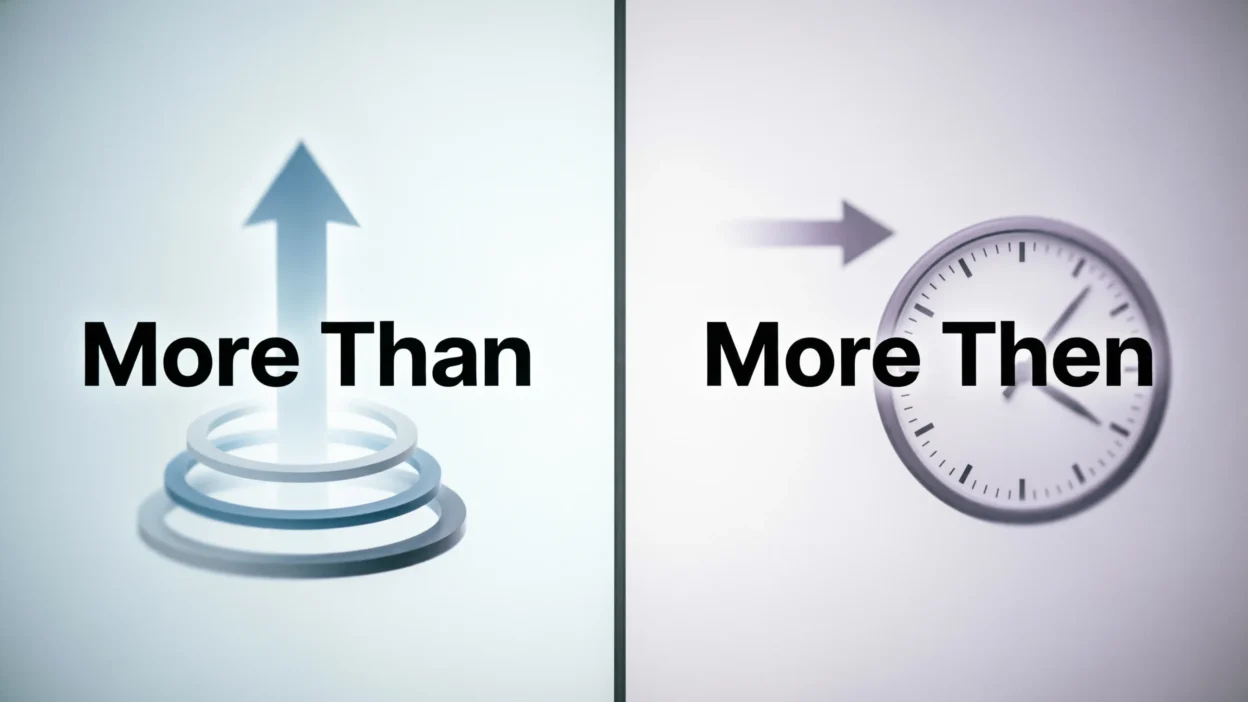
Many students and English learners feel confused about “more than” and “more then.” They look almost the same. They sound similar when we speak fast.
But one is correct in most cases, and the other is usually wrong.
If you have ever stopped while writing and asked yourself, “Is it more than or more then?” — this guide will help you understand it clearly and easily.
Let’s remove the confusion completely.
Quick Answer
Here is the simple truth:
- ✅ More than = correct (used for comparison, numbers, amounts)
- ❌ More then = usually incorrect
- ✅ Then is used for time or what happens next
- ✅ Than is used for comparison
Very simple rule:
- If you are comparing things, use than.
- If you are talking about time, use then.
A Simple Background Explanation
English has many words that look and sound similar. These words can confuse learners.
“Than” and “then” are two small words, but they have different meanings.
- Than is used when we compare.
- Then is used when we talk about time or order.
The confusion happens because:
- They look almost the same.
- They sound similar.
- Only one letter is different.
But once you understand their purpose, it becomes very easy.
Clear Explanation of the Difference
Let’s break it down in the simplest way.
What Does “More Than” Mean?
“More than” is used to show:
- A bigger number
- A larger amount
- A higher level
- A comparison between two things
Examples:
- She has more than 10 books.
- This phone is more than $300.
- I love you more than words can say.
- He is taller than his brother.
Notice something important:
When we compare, we use than, not then.
So:
- ✔ more than 5 people
- ✔ more than yesterday
- ✔ more than before
What Does “Then” Mean?
“Then” is about:
- Time
- Order
- What happens next
Examples:
- I finished my homework. Then I watched TV.
- First we eat, then we go home.
- Back then, life was simpler.
“Then” answers the question: When?
Comparison Table (Easy to Understand)
| Word | Meaning | Used For | Example |
| Than | Comparison | Comparing two things | She is taller than me. |
| Then | Time / Order | What happens next | We ate, then we left. |
| More than | Larger amount | Numbers, amounts, comparisons | He has more than 20 friends. |
| More then | Not correct | Usually a mistake | ❌ She has more then 20 friends. |
This table shows clearly:
More than = correct
More then = wrong (in almost all cases)
Which One Should You Use?
Here is a simple way to decide:
Ask yourself:
1. Am I comparing?
If yes → use than
- My house is bigger than yours.
- She runs faster than me.
- There are more than 100 students here.
2. Am I talking about time?
If yes → use then
- We met in 2020. Then we became friends.
- Finish your food, then you can play.
- Life was different back then.
Very easy trick:
- Than = comparison
- Then = time
Remember this small idea and you will not forget.
Common Mistakes People Make
Let’s look at mistakes many learners make.
❌ Mistake 1: Using “then” in comparisons
Wrong:
- She is smarter then me.
- There are more then 50 people.
Correct:
- She is smarter than me.
- There are more than 50 people.
❌ Mistake 2: Thinking they mean the same thing
Some people believe “than” and “then” are just spelling differences. They are not.
They have completely different meanings.
❌ Mistake 3: Writing fast without checking
When typing quickly (especially on phones), people often write:
- more then
- better then
- bigger then
Always pause and check:
Are you comparing?
If yes → it must be than.
Everyday Real Life Examples
Let’s see how this works in daily life.
📧 In Emails
Correct:
- We received more than 200 applications.
- Please finish the form, then send it to me.
Wrong:
- We received more then 200 applications. ❌
📰 In News
Correct:
- The city received more than 5 inches of rain.
- First the storm hit the coast, then it moved inland.
📱 On Social Media
Correct:
- I love this movie more than the last one!
- We met in school, and then we became best friends.
Wrong:
- I love this more then anything. ❌
🏠 In Daily Conversation
Correct:
- This bag costs more than $50.
- Eat your vegetables, then you can have dessert.
- He works harder than before.
A Small Learning Section for Students and Beginners
Here is a simple practice method you can use.
Step 1: Remember the Key Idea
- Comparison → than
- Time → then
Step 2: Use a Memory Trick
Look at the letters:
- Than has an “a”
Think: A = compare A to B - Then has an “e”
Think: E = events (things that happen in time)
This small memory trick helps many students.
Step 3: Practice Sentences
Fill in the blank:
- She is taller ___ her sister.
- We ate dinner and ___ watched a movie.
- There were more ___ 100 people.
- Finish your work, ___ go home.
Answers:
- than
- then
- than
- then
If you got them correct, great job!
FAQ Section
1. Is “more then” ever correct?
In almost all normal writing, no.
When you are comparing amounts or numbers, it must be more than.
2. Why do people confuse “than” and “then”?
Because:
- They look similar.
- They sound similar.
- Only one letter is different.
3. How can I remember the difference easily?
Simple rule:
- Comparison → than
- Time → then
Repeat this rule until it feels natural.
4. Which is correct: “better then” or “better than”?
Correct: better than
Because it is a comparison.
Example:
- This book is better than the last one.
5. Which is correct: “more then 10” or “more than 10”?
Correct: more than 10
Because you are talking about a number.
6. Can “then” ever be used in comparison?
No.
“Then” is not used for comparing. It is only about time or order.
7. Is this mistake common among native speakers?
Yes, it is common in fast typing, texting, and online posts.
But in correct writing, they are different.
8. What should I check before writing?
Ask yourself:
- Am I comparing? → Use than
- Am I talking about time? → Use then
That’s all.
Conclusion
Now the confusion should be gone.
Here is the final reminder:
- ✅ More than = correct (used for comparison, numbers, amounts)
- ❌ More then = usually wrong
- Than = comparison
- Then = time or what happens next
Whenever you feel unsure, stop and ask:
“Am I comparing something?”
If yes → use than.
If you are talking about time → use then.
Small words can cause big confusion.
But now you understand the difference clearly, simply, and confidently.
You are ready to use them correctly in emails, school writing, exams, and everyday life.

Steven Mark is a writer, researcher, and contributor at Meanefy.com, a platform dedicated to exploring word meanings, language nuances, and everyday linguistic curiosities. With a passion for words and clear communication, Steven focuses on making language simple, engaging, and accessible to all readers.