
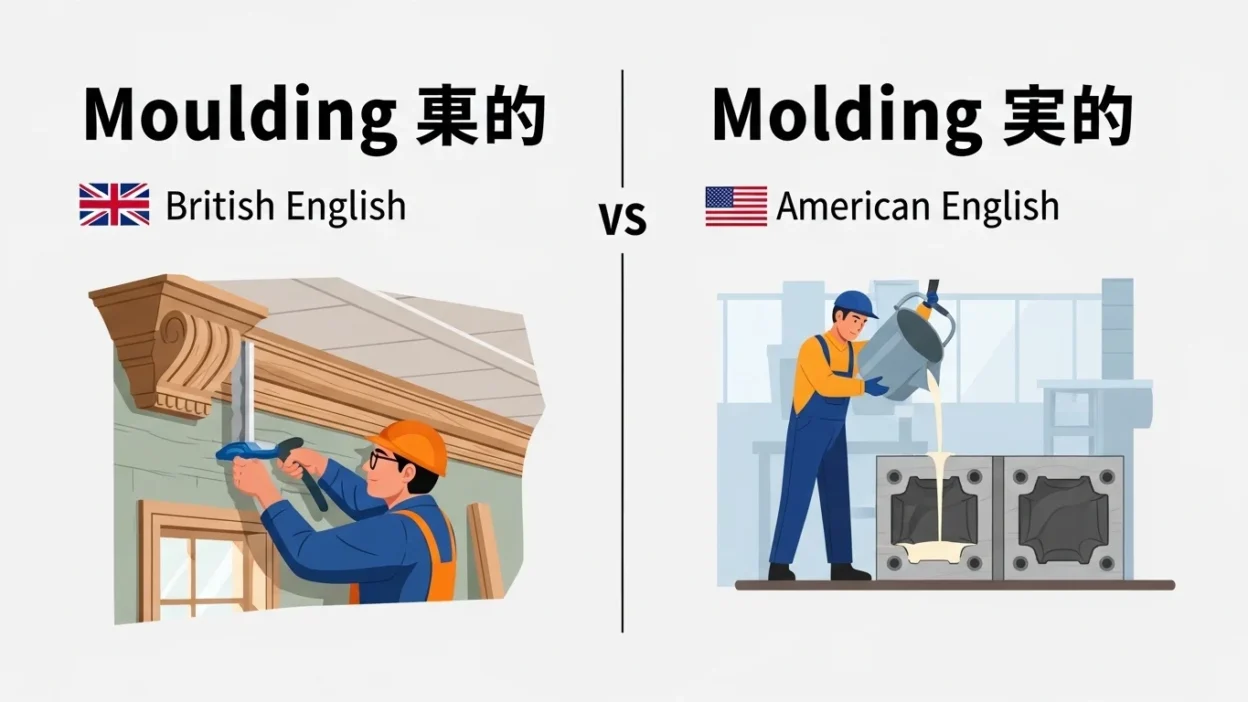
Many people get confused when they see the words moulding and molding. They look and sound almost the same, but which one is correct? Are they different? Or are they just spelling mistakes?
In this article, we will explain everything in very simple English so anyone can understand it quickly.
Quick Answer
Here is the easy answer:
- Moulding – British English spelling
- Molding – American English spelling
- Both words mean the same thing: the process of shaping something (like plastic, clay, or wood) using a mold.
- You can use either, but it depends on which type of English you are writing.
Where the Confusion Comes From
The confusion happens because English is used in many countries, and spelling can change.
- In the UK, people use moulding.
- In the US, people use molding.
- The pronunciation is almost the same, so when you hear it, you can’t tell the difference.
- Some dictionaries accept both spellings but note which English style they belong to.
This is why students, writers, and ESL learners often get puzzled.
Simple Origin / Background
The word comes from “mold”, which is a hollow container used to give shape to materials.
- Mould is the British spelling.
- Mold is the American spelling.
- The “-ing” form just makes it a verb or noun to describe the process:
- Moulding a statue = shaping a statue using a mold (British English)
- Molding a statue = shaping a statue using a mold (American English)
The root of the word comes from old English and Germanic languages, where “mold” meant a hollow form or earth used to make shapes.
Clear Explanation of the Difference
Now let’s make it simple:
| Feature | Moulding | Molding |
| Spelling | British English | American English |
| Usage | UK, Canada, Australia, India, etc. | US, Philippines, some international schools |
| Meaning | Process of shaping material with a mold | Same meaning: shaping material with a mold |
| Pronunciation | /ˈmoʊldɪŋ/ (same as US) | /ˈmoʊldɪŋ/ (same as UK) |
| Example Sentence | The carpenter is doing beautiful moulding on the door. | The carpenter is doing beautiful molding on the door. |
Key point: The meaning is identical. The only difference is the spelling depending on the English version.
Which One to Use and When
Here are some simple rules:
- Use moulding if you are writing in British English.
- Use molding if you are writing in American English.
- If you are unsure, see where your audience is from. For example:
- Writing for a US teacher → molding
- Writing for a UK teacher → moulding
- In scientific or technical writing, check the style guide. Some prefer one spelling consistently.
Common Mistakes People Make
- Mixing spellings – Writing “molding” in one sentence and “moulding” in another.
- Using the wrong English style – Using American spelling in British English assignments or vice versa.
- Confusing with “mold” meaning fungus – “Mold” can also mean the black or green fungus that grows on bread. Remember, context matters.
- Pronunciation stress – Some students think the pronunciation changes with spelling. It doesn’t.
Everyday Real Life Examples
- Emails:
- “Please check the moulding on the window frame.” (UK)
- “Please check the molding on the window frame.” (US)
- News articles:
- UK article: “The museum’s wooden moulding is 200 years old.”
- US article: “The museum’s wooden molding is 200 years old.”
- Social media:
- Instagram caption (UK user): “Love this kitchen’s ceiling moulding!”
- Instagram caption (US user): “Love this kitchen’s ceiling molding!”
- Daily life:
- Furniture, crafts, statues, chocolates, toys, and even soap are shaped using moulding/molding.
Short Learning Section for Students and Beginners
Let’s remember it easily:
- British English → Moulding
- American English → Molding
- Meaning → Same thing: shaping something with a mold
- Pronunciation → Same: /ˈmoʊldɪŋ/
Tip: If you are learning English for exams, always check which style is required.
FAQ
1. Are moulding and molding different things?
No, they mean exactly the same thing. Only the spelling is different.
2. Can I use molding in British English?
You can, but it looks like American English. For formal UK writing, use moulding.
3. Is the pronunciation different?
No, both are pronounced the same way: /ˈmoʊldɪŋ/.
4. Does this word relate to fungus?
Only “mold” can also mean fungus. The context decides the meaning.
5. Which one is older?
“Moulding” (British spelling) is the older form. “Molding” became common in the US.
6. Can I mix both spellings in one text?
It is better not to. Mixing can confuse readers.
7. Is it used in schools or work more often?
Both are used in schools, construction, art, and design. Just choose the correct spelling for your audience.
8. Are there other words with similar differences?
Yes, for example:
- Colour (UK) / Color (US)
- Centre (UK) / Center (US)
- Honour (UK) / Honor (US)
Conclusion
To sum up: moulding and molding are exactly the same in meaning. The only difference is spelling: British vs American English. Knowing this helps you write correctly and avoid confusion.
- British English → moulding
- American English → molding
- Meaning → shaping something using a mold
- Pronunciation → the same
Now you can confidently use the right spelling depending on your audience and style. Remember, the key is consistency and knowing which English your reader expects.

Daniel Matthew is a language enthusiast, writer, and contributor at Meanefy.com, where he explores the meanings, origins, and nuances of words and phrases. With a deep passion for language, Daniel aims to make complex concepts simple, engaging, and easy to understand for readers of all ages.