Many English learners feel confused when they see the words “offense” and “offence.” They look almost the same and sound exactly the same when spoken. Because of this, people often wonder:
- Are they different words?
- Do they have different meanings?
- Is one correct and the other wrong?
The truth is much simpler than many people think. Both words mean the same thing. The only real difference is where the spelling is used.
In this guide, you will learn the difference in very clear and simple English. By the end, you will know exactly when to use offense and when to use offence without feeling confused again.
Quick Answer
Here is the short and simple answer:
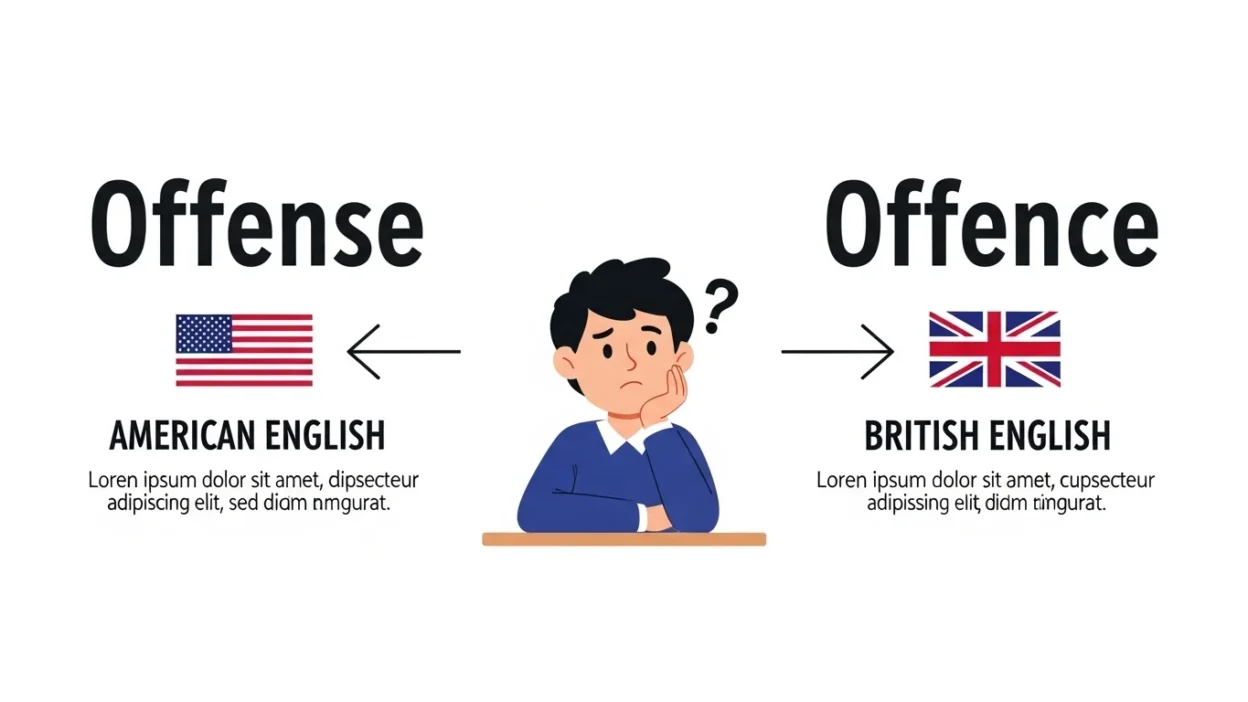
- Offense → Used in American English
- Offence → Used in British English
- Both words mean the same thing
- Both are correct spellings
- The pronunciation is the same
So the difference is only spelling, not meaning.
Simple Origin and Background
To understand why two spellings exist, we need to look at the history of English.
A long time ago, English spelling was not very fixed. Many words had different spellings. Over time, English developed two main spelling styles:
- American English
- British English
American English often prefers simpler spellings. Because of this, many words that end with “-ce” in British English changed to “-se” in American English.
Examples:
| British English | American English |
| defence | defense |
| licence | license |
| offence | offense |
So the word offence became offense in American English.
Both versions stayed in use, depending on the country.
What Does “Offense/Offence” Mean?
The word offense/offence has a few common meanings.
1. Something that breaks a law
It can mean a crime or illegal action.
Example:
- Stealing a car is a serious offense.
2. Something that hurts someone’s feelings
It can also mean something rude or disrespectful.
Example:
- His comment caused offence.
3. A sports term
In sports like football or basketball, it means the team that is trying to score.
Example:
- The team’s offense played very well today.
The meaning stays the same whether you write offense or offence.
The Real Difference Explained Simply
The only real difference is spelling style based on location.
Offense
- Used mainly in American English
- Common in the United States
Offence
- Used mainly in British English
- Common in:
- United Kingdom
- Canada
- Australia
- New Zealand
Both are correct. The key is to stay consistent with the style you are using.
Quick Comparison Table
| Feature | Offense | Offence |
| Meaning | Same meaning | Same meaning |
| Pronunciation | Same | Same |
| Spelling style | American English | British English |
| Used in | United States | UK, Australia, Canada |
| Correct spelling | Yes | Yes |
As you can see, the difference is very small.
Which One Should You Use?
The best choice depends on where your English style comes from.
Use “Offense” if you follow American English
Examples:
- American schools
- American writing style
- Writing for a U.S. audience
Example sentence:
- The player committed a serious offense during the game.
Use “Offence” if you follow British English
Examples:
- UK schools
- British textbooks
- Writing for international audiences using British style
Example sentence:
- The judge said the crime was a serious offence.
Simple tip
Ask yourself:
Am I using American English or British English?
Then choose the spelling that matches.
Common Mistakes People Make
Many learners make small mistakes with these words. Here are the most common ones.
1. Thinking one spelling is wrong
Some people think offence is incorrect or offense is incorrect.
This is not true.
Both are correct depending on the English style.
2. Mixing spelling styles
Sometimes people write both in the same article.
Example mistake:
- The player made a serious offence.
- The coach said the offense was poor.
This mixes British and American spelling. It is better to choose one style and stay with it.
3. Confusing it with “defense/defence”
Because these words look similar, learners sometimes mix them.
Examples:
- defense / defence
- offense / offence
Remember:
American English → “se”
British English → “ce”
Everyday Real Life Examples
Let’s look at how the word appears in normal daily situations.
Example in an email
American English:
I hope my message did not cause any offense.
British English:
I hope my message did not cause any offence.
Example in news
American style:
The man was arrested for a serious offense.
British style:
The man was arrested for a serious offence.
Example in sports
American sports report:
The team’s offense scored three touchdowns.
Example on social media
American user:
No offense, but I think you are wrong.
British user:
No offence, but I think you are wrong.
Example in everyday conversation
- “I didn’t mean to cause offense.”
- “Please don’t take offence at my comment.”
Both sentences mean exactly the same thing.
Learning Tips for Students and Beginners
If you are learning English, here are easy ways to remember the difference.
Tip 1: Remember the “S”
Offense → United States
Both have the letter S.
Tip 2: Remember the “C”
Offence → British English
Many British spellings end with -ce.
Tip 3: Follow your textbook
If your school uses American English, write:
- offense
- defense
- license
If your school uses British English, write:
- offence
- defence
- licence
Tip 4: Consistency is important
The most important rule is simple:
Do not mix spelling styles in the same piece of writing.
Frequently Asked Questions (FAQ)
1. Is offense correct?
Yes. Offense is correct in American English.
2. Is offence correct?
Yes. Offence is correct in British English.
3. Do they have different meanings?
No. Both words mean exactly the same thing.
4. Are they pronounced differently?
No. They are pronounced the same way.
5. Which spelling is more common?
It depends on the country.
- United States → offense
- United Kingdom → offence
6. Can I use both in the same essay?
It is better not to mix them. Choose one spelling style and use it consistently.
7. Do exams care about the spelling?
Sometimes yes.
If the exam uses American English, write offense.
If it uses British English, write offence.
8. Is one spelling more formal?
No. Both spellings are equally correct and acceptable.
Conclusion
The difference between offense and offence is actually very simple.
Both words:
- Have the same meaning
- Are pronounced the same
- Are correct spellings
The only difference is spelling style.
- Offense → American English
- Offence → British English
If you remember this small rule, the confusion disappears. Just choose the spelling that matches the type of English you are using and stay consistent.
Once you understand this, you will never be confused by offense vs offence again.