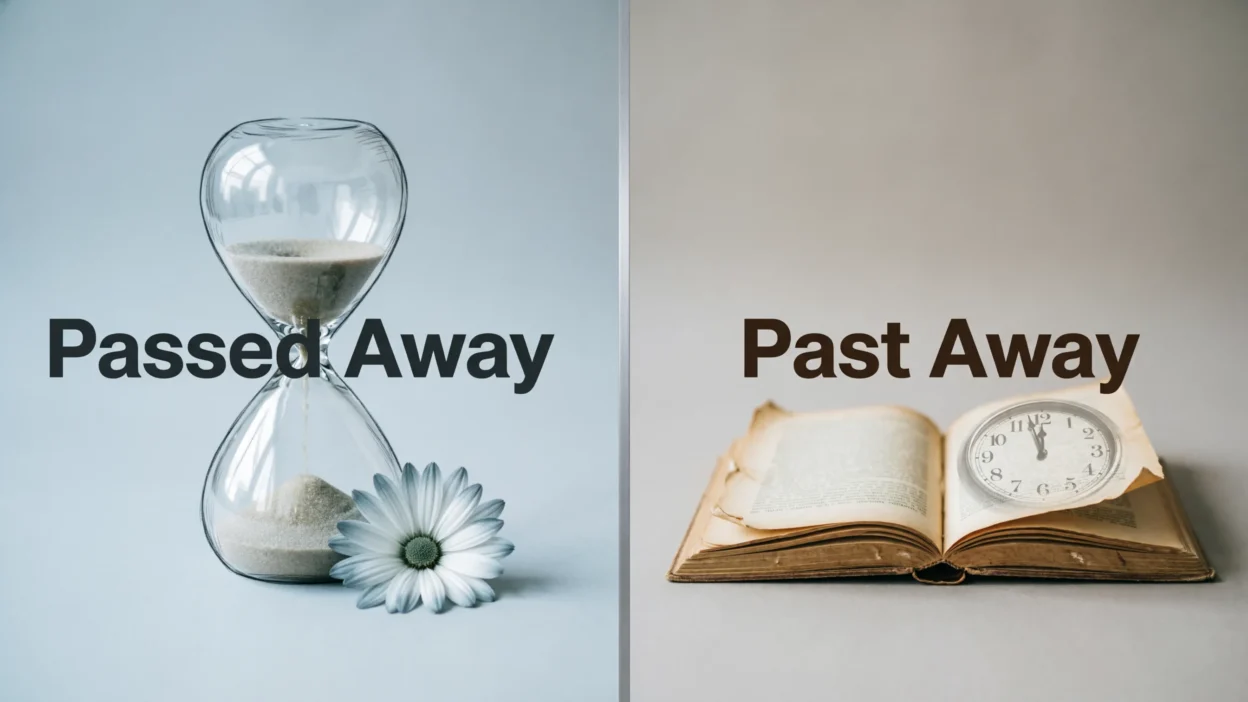
Many people feel confused about the phrases “passed away” and “past away.” They look very similar. They sound almost the same when spoken.
Because of this, many students and English learners mix them up.
But here is the good news: the difference is very simple.
In this article, you will clearly understand which one is correct, why people make mistakes, and how to use the right phrase with confidence.
Let’s make it easy.
Quick Answer
- ✅ “Passed away” is correct. It means someone died.
- ❌ “Past away” is incorrect. It is not proper English.
- “Passed” is a verb (an action word).
- “Past” is usually not a verb.
If you remember only one thing, remember this:
👉 Always use “passed away” when talking about someone’s death.
Simple Background Explanation
To understand the difference, we need to look at two words:
- Passed
- Past
They look almost the same, but they are different in grammar.
What does “pass” mean?
The word “pass” is a verb. It means:
- To move from one place to another
- To go by
- To finish something
- To move forward
The past tense (finished form) of “pass” is “passed.”
Example:
- She passed the ball.
- Time passed quickly.
What does “past” mean?
“Past” is usually:
- A noun (the past)
- An adjective (past year)
- A preposition (walk past the store)
But “past” is not a verb.
That is why “past away” does not work.
Clear Explanation of the Difference
Now let’s look at the phrase “passed away.”
What does “passed away” mean?
“Passed away” is a polite and soft way to say someone died.
Instead of saying:
- “My grandfather died.”
People often say:
- “My grandfather passed away.”
It sounds gentler and more respectful.
Here’s how it works:
- “Passed” = past tense of the verb “pass”
- “Away” = shows movement
Together, it gives the idea of someone moving on from this life.
Why “past away” is wrong
“Past” is not a verb.
You cannot say:
- ❌ He past away.
It breaks grammar rules because there is no action word.
So remember:
- “Passed” = correct verb
- “Past” = wrong in this phrase
Comparison Table
Here is a simple table to help you see the difference quickly:
| Feature | Passed Away | Past Away |
| Is it correct? | ✅ Yes | ❌ No |
| Meaning | Someone died | No real meaning |
| Grammar type | Verb phrase | Incorrect form |
| Used in formal writing? | Yes | No |
| Used in speech? | Yes | No |
This table makes it clear: only “passed away” is correct.
Which One Should You Use and When?
Always use “passed away” when talking about death in a polite way.
Use it in:
- Conversations about family
- News reports
- Social media messages
- Condolence messages
- Formal writing
Examples:
- Her mother passed away last night.
- We are sad to say that our teacher passed away.
- The famous singer passed away peacefully.
Do not use “past away” in any situation.
Common Mistakes People Make
Here are the most common errors:
1. Spelling mistake
❌ He past away yesterday.
✅ He passed away yesterday.
Many people type “past” because it sounds similar. But the spelling must be “passed.”
2. Mixing up “past” and “passed”
This is a very common English problem.
Look at these examples:
- I walked past the school. (correct)
- Time passed slowly. (correct)
Both are correct — but they are different words.
3. Using “passed” without “away”
Sometimes people say:
- He passed last night.
This is sometimes understood, but it is clearer to say:
- He passed away last night.
Everyday Real Life Examples
Let’s see how people use “passed away” in real situations.
1. In an Email
Dear Sarah,
I am very sorry to tell you that my uncle passed away this morning.
I will not be able to attend class this week.
2. In the News
The well-known actor passed away at the age of 82.
3. On Social Media
We are heartbroken. Our beloved dog passed away today. Thank you for all your love and support.
4. In Daily Conversation
Friend: Why are you sad?
You: My neighbor passed away yesterday.
5. At Work
We are sorry to inform you that our former manager passed away peacefully.
In all these examples, “passed away” is used correctly and respectfully.
Short Learning Section for Students and Beginners
Here is a simple trick to remember the correct word:
Memory Trick
If you can replace the word with another verb, use passed.
Example:
- He passed the test. (verb)
- She passed away. (verb)
Both use an action word.
But you cannot say:
- ❌ He past the test.
So if it is an action, use passed.
Practice Exercise
Choose the correct word:
- My aunt ______ away last year.
- The car drove ______ my house.
- Time ______ very quickly.
Answers:
- passed
- past
- passed
This shows how the two words work differently.
FAQ Section
1. Is “past away” ever correct?
No. It is always incorrect in standard English.
2. Why do people write “past away”?
Because it sounds similar to “passed away.” It is a spelling mistake.
3. Is “passed away” formal or informal?
It can be both. It is polite and respectful, so it is often used in formal writing.
4. Can I just say “died” instead?
Yes. “Died” is correct. But “passed away” sounds softer and kinder.
Example:
- He died. (direct)
- He passed away. (gentle)
5. Is “passed on” the same as “passed away”?
Yes, “passed on” is another polite way to say someone died.
Example:
- She passed on peacefully.
6. Is it okay to use “passed away” for pets?
Yes. Many people say:
- Our dog passed away.
- My cat passed away.
7. How do I remember the spelling?
Remember:
- “Passed” has -ed, like most past tense verbs.
- Death already happened, so we use past tense: passed.
8. Can “past” ever be a verb?
No. “Past” is not used as a verb in modern English.
Conclusion
The difference between “passed away” and “past away” is simple once you understand it.
- ✅ Passed away is correct.
- ❌ Past away is wrong.
- “Passed” is a verb.
- “Past” is not a verb.
People often make this mistake because the words sound alike. But now you know the truth.
Whenever you talk about someone’s death in a polite and respectful way, always use:
“Passed away.”
With this clear explanation, you should never feel confused again.