English learners often get confused between people and peoples. Even native speakers sometimes make mistakes.
This guide will help you understand the difference easily. By the end of this article, you will know exactly when to use each word.
The words people and peoples look almost the same, but they mean different things. Most students, learners and beginners get confused because:
- They sound similar.
- Both are related to groups of humans.
- English rules are not always simple.
Don’t worry! With this guide, you will learn the difference in a clear and simple way.
Quick Answer
Here’s a quick and simple explanation:
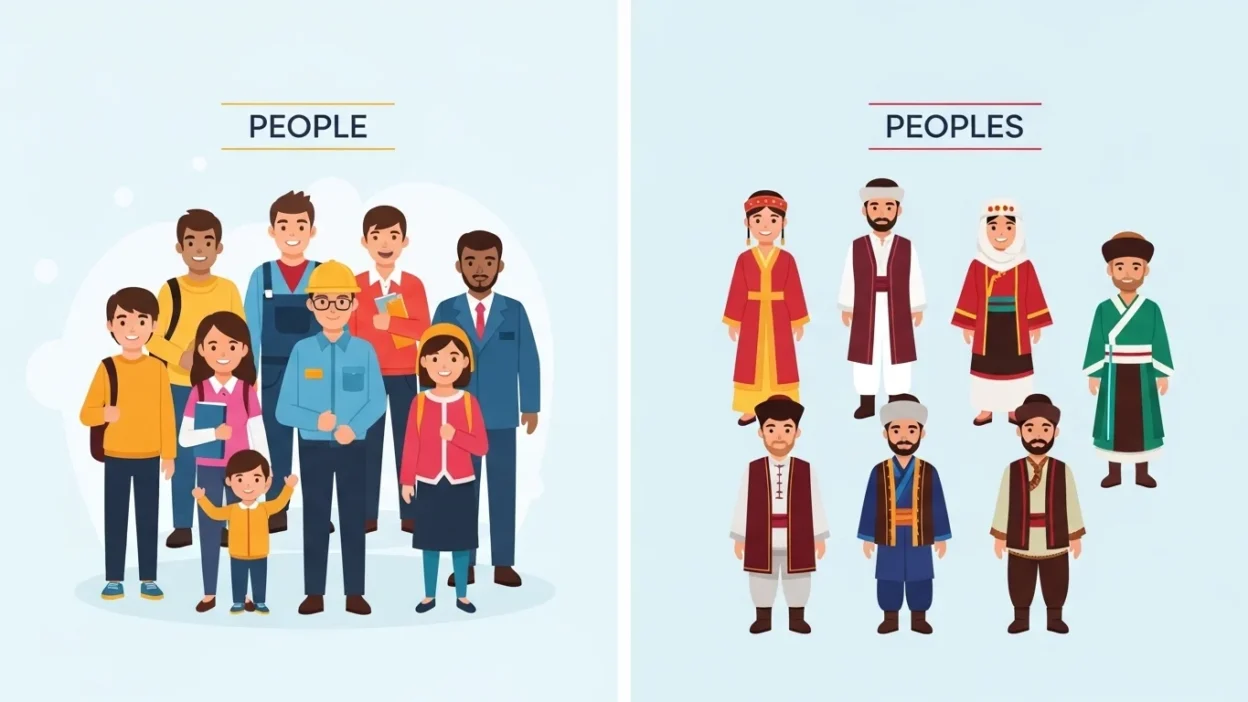
- People – Used when talking about a group of humans in general.
- Peoples – Used when talking about different ethnic groups, nations, or communities.
Example:
- There are many people in the park today. ✅
- The world has many peoples with different languages. ✅
Origin or Background
Understanding where these words come from helps make sense of them:
- People comes from the Latin word populus, meaning a group of humans.
- Peoples is just the plural of “people” in a special sense. It is used to refer to different groups or nations, not just “more humans.”
In old English, “people” could mean both singular and plural, but modern English separates them.
Clear Explanation of the Difference
- People
- Refers to humans in general.
- Can mean a large number of humans, like “crowd” or “population.”
- Does not need an extra “s” for plural in general use.
- Examples:
- People like chocolate.
- There were 50 people at the meeting.
- Peoples
- Refers to different groups, nations, crews, or communities.
- Used when talking about identity, culture, or ethnicity.
- Always plural.
- Examples:
- The indigenous peoples of North America have rich traditions.
- Many peoples live in Europe.
Comparison Table
| Word | Use | Meaning | Example Sentence |
| People | General humans | Any group of humans | People are waiting for the bus. |
| Peoples | Different groups | Various nations, crews, or communities | The festival celebrates the peoples of Asia. |
Which One to Use and When
- Use people when you mean “humans in general” or a crowd.
- Use peoples when talking about different ethnic groups, nations, or communities.
- If unsure, check: “Am I talking about humans in general or different communities?”
Common Mistakes People Make
- Adding “s” to “people” when it is not needed.
- ❌ I saw many peoples at the park.
- ✅ I saw many people at the park.
- Using “people” instead of “peoples” for ethnic or cultural groups.
- ❌ The people of the world have different languages.
- ✅ The peoples of the world have different languages.
- Thinking “peoples” is just a fancy plural of “people.”
- Remember: “peoples” has a special meaning.
Everyday Real Life Examples
Emails
- Dear all, please remind the people in your team about the meeting. ✅
- The conference will include speakers from different peoples around the world. ✅
News
- Thousands of people protested in the city today. ✅
- The United Nations supports the rights of indigenous peoples. ✅
Social Media
- People are loving this new song! ✅
- Peoples from all over the globe celebrated Earth Day. ✅
Daily Use
- People in my class are friendly. ✅
- The museum shows the traditions of many peoples. ✅
Short Learning Section for Students and Beginners
- Tip 1: If you are talking about humans in general, use people.
- Tip 2: If you are talking about different groups, crews, or nations, use peoples.
- Tip 3: Remember: people = general humans, peoples = special plural for groups.
Practice:
- ___ are learning English. → People
- The festival shows the art of different ___. → Peoples
FAQ Section
- Can we say “peoples” for two friends?
- No. Use people for friends, family, or any small group.
- Is “people” singular or plural?
- People is plural. The singular is person.
- Can “peoples” mean more than one person?
- Yes, but only when talking about groups or nations, not individual humans.
- Do we say “two peoples” or “two people”?
- Two people = two humans
- Two peoples = two distinct ethnic or national groups
- Is “people” always informal?
- No, it is used in formal and informal English.
- Can “peoples” be used in daily conversation?
- Less often. Mostly used in formal writing, history, or news about culture.
- Can I say “the peoples of my city”?
- Only if you are talking about different communities or cultures within the city.
- How do I remember the difference?
- People = humans in general
- Peoples = groups or nations
Conclusion
Now you can see clearly:
- People is for humans in general.
- Peoples is for different groups, crews, or nations.
Remember these rules, and you will never mix them up again. A small difference, but knowing it makes your English much stronger.