Many students, learners and beginners often get confused between the words “push” and “pull.” These two words are very common in English, but they can feel tricky because both involve moving something.
In this article, we will explain push and pull in the simplest way possible. By the end, you will understand the difference and know how to use them in real life.
Quick Answer: Push vs Pull
Here is a simple way to remember:
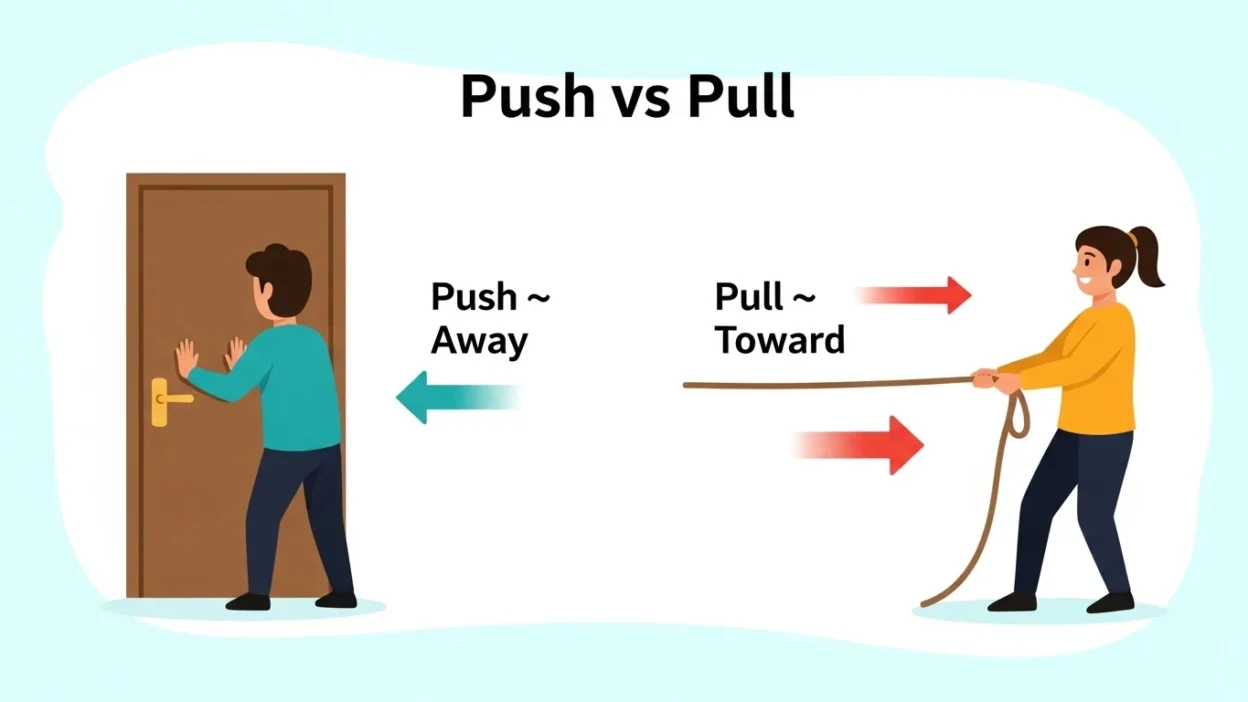
- Push: To move something away from you.
- Pull: To move something toward you.
Examples:
- Push a door → you move the door away from yourself.
- Pull a rope → you bring the rope closer to yourself.
Where These Words Come From
Both words have very old origins in English:
- Push comes from the Old English word “pūsan”, which means “to press or move.”
- Pull comes from the Old English word “pullian”, which means “to drag or tug.”
These simple roots show why the words are about moving things—but in different directions.
Clear Explanation of the Difference
The main difference between push and pull is direction:
- Push = move away
- You use your hands, feet, or body to make something go forward or outward.
- Example: You push a shopping cart in a supermarket.
- Pull = move toward
- You use your hands, rope, or body to bring something closer to you.
- Example: You pull a chair toward the table.
Think of it like this:
- Push → “Go away!”
- Pull → “Come here!”
Push vs Pull Comparison Table
| Feature | Push | Pull |
| Direction | Away from you | Toward you |
| Body movement | Hands or body pushing | Hands or body pulling |
| Common examples | Push door, push cart | Pull door, pull rope |
| Feeling | Force goes outward | Force comes inward |
| Everyday objects | Cart, box, button | Chair, rope, drawer |
Which One to Use and When
- Push: Use when you want to move something away from yourself.
- Pull: Use when you want to bring something closer to yourself.
Tips:
- Think about the direction first.
- If you are not sure, imagine your hands moving the object.
Common Mistakes People Make
Many beginners confuse push and pull. Here are common mistakes:
- Pushing a door that says “Pull” – the door will not open.
- Pulling a shopping cart – it is meant to be pushed.
- Pulling something already moving away – your effort might fail.
- Using “push” and “pull” in the wrong email or message, like “Please push the meeting closer” instead of “pull.”
Everyday Real Life Examples
- At home: Pull the drawer to open it, push the door to close it.
- At school: Push a chair under the desk, pull a friend in a game of tug-of-war.
- Emails: “Please pull the document from the server” means to download it.
- News and social media: Headlines like “Police push back the crowd” show moving away; “Volunteers pull people out of danger” shows moving toward safety.
- Daily life: Push buttons, pull ropes, push carts, pull luggage.
Short Learning Section for Students and Beginners
- Imagine your hands:
- Push → away
- Pull → toward
- Try with objects:
- Take a box, push it across the floor.
- Take a rope, pull it toward you.
- Practice with signs:
- Look for doors labeled “Push” or “Pull.”
FAQ
Q: Can you push and pull at the same time?
A: Yes, but usually one direction is stronger. Example: Tug-of-war needs pulling.
Q: Is push only with hands?
A: No, you can push with feet, body, or objects.
Q: Can “pull” be used for computers?
A: Yes, like “pull a file” means to get it from somewhere.
Q: Are push and pull opposites?
A: Yes, they are opposite directions of movement.
Q: How to remember easily?
A: Push → away, Pull → toward.
Q: Is “push” polite to use in instructions?
A: Yes, it is simple and clear.
Q: Can “pull” be used in sports?
A: Yes, like pulling a rope, pulling someone in a game.
Q: Are there idioms with push and pull?
A: Yes, “push your luck” or “pull strings,” but these are different from the physical meaning.
Conclusion
Now you know the difference:
- Push moves something away from you.
- Pull moves something toward you.
With practice, using push and pull becomes easy. Try it in daily life: doors, carts, ropes, and even in language like emails or social media. Remember: push → away, pull → toward. That simple rule will remove all confusion.

Steven Mark is a writer, researcher, and contributor at Meanefy.com, a platform dedicated to exploring word meanings, language nuances, and everyday linguistic curiosities. With a passion for words and clear communication, Steven focuses on making language simple, engaging, and accessible to all readers.