Many English learners feel confused when they see the words quiet and quite. They look almost the same. They sound similar when spoken quickly. Because of this, people often mix them up when writing or speaking.
For example, someone may write:
- “The room is quite.”
- “The movie was quiet interesting.”
Both sentences are incorrect, but the mistake happens very often.
The truth is that quiet and quite have very different meanings. One describes silence, and the other describes degree or level.
The good news is that once you understand the difference, it becomes very easy to use them correctly. This guide explains everything in simple English so you can understand it the first time you read it.
Quick Answer
Here is the simple difference:
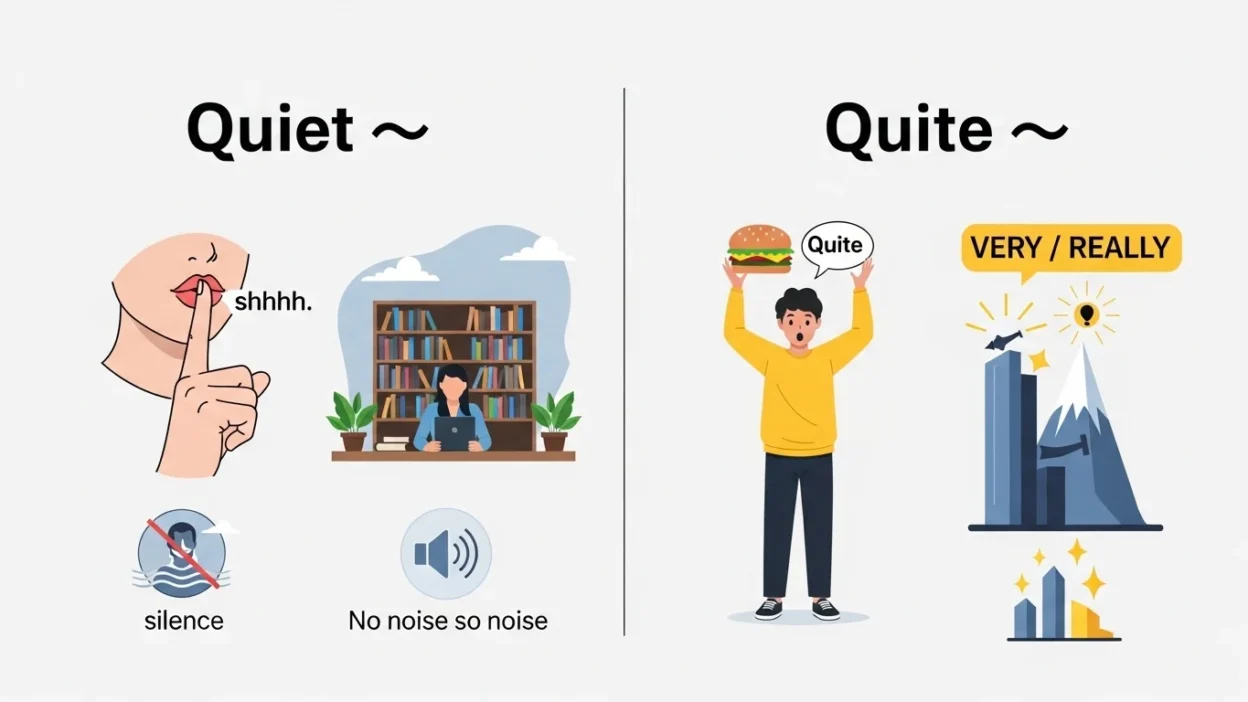
- Quiet = little or no noise
- Quite = very / fairly / completely (used to change the strength of an idea)
Examples:
- The library is quiet.
- The movie was quite good.
Another way to remember:
- Quiet → about sound
- Quite → about how much
Simple Background of the Words
Understanding where words come from can help make their meaning clearer.
Quiet
The word quiet has been used in English for hundreds of years. It comes from older European languages where it meant rest, calmness, or silence.
Over time, the meaning stayed almost the same. Today we use quiet to describe:
- places without noise
- people who do not talk much
- situations that are calm
Examples:
- a quiet street
- a quiet child
- a quiet evening
Quite
The word quite developed as a way to increase or change the strength of an idea. It acts like words such as:
- very
- fairly
- completely
It does not describe sound. Instead, it tells us how strong something is.
Examples:
- The test was quite easy.
- She is quite happy with the result.
The Clear Difference
The easiest way to understand the difference is this:
Quiet is an adjective that describes silence or calm.
Quite is an adverb that changes the strength of another word.
Let’s look at them separately.
Quiet = No Noise
Use quiet when talking about sound or silence.
Examples:
- Please be quiet in the classroom.
- The neighborhood is very quiet at night.
- The baby finally became quiet.
It can describe:
Places
- a quiet library
- a quiet park
People
- a quiet student
- a quiet neighbor
Moments
- a quiet morning
- a quiet dinner
Quite = Very or Fairly
Use quite to make another word stronger.
Examples:
- The movie was quite good.
- This problem is quite difficult.
- The food was quite delicious.
It usually comes before an adjective or adverb.
Example structure:
quite + adjective
- quite small
- quite happy
- quite interesting
Quick Comparison Table
| Word | Meaning | Type of Word | Example |
| Quiet | Little or no noise | Adjective | The classroom is quiet. |
| Quite | Very / fairly | Adverb | The lesson is quite easy. |
| Quiet | Describes calm places or people | Adjective | He is a quiet student. |
| Quite | Changes strength of another word | Adverb | The story is quite interesting. |
Which One Should You Use?
A simple question can help you decide.
Ask yourself: “Am I talking about noise?”
If yes, use quiet.
Examples:
- The street is quiet today.
- Please stay quiet during the exam.
Ask yourself: “Am I describing how strong something is?”
If yes, use quite.
Examples:
- The homework is quite difficult.
- The weather is quite cold today.
Memory Trick
A helpful trick:
Quiet → silence
Quite → intensity
Another tip:
- Quiet ends with “et” like “silent” feeling
- Quite ends with “te” like “very”
Small tricks like this can help you remember.
Common Mistakes People Make
Many learners mix these words because they look very similar. Here are some common mistakes.
Mistake 1: Using “quiet” instead of “quite”
Incorrect:
- The movie was quiet interesting.
Correct:
- The movie was quite interesting.
Why? Because we are describing how interesting the movie was, not sound.
Mistake 2: Using “quite” instead of “quiet”
Incorrect:
- Please be quite in the library.
Correct:
- Please be quiet in the library.
Why? Because we are talking about noise.
Mistake 3: Forgetting what “quite” modifies
“Quite” must be used with another describing word.
Incorrect:
- The day was quite.
Correct:
- The day was quite beautiful.
Mistake 4: Confusing pronunciation
Some learners pronounce them the same way. Practicing pronunciation helps avoid confusion.
- Quiet → /kwai-et/ (two parts)
- Quite → /kwait/ (one strong sound)
Everyday Real Life Examples
Let’s see how these words appear in daily situations.
In Emails
Correct examples:
- “The meeting room was quiet, so we finished our work quickly.”
- “Your presentation was quite impressive.”
On Social Media
People often write sentences like:
- “This place is quiet and peaceful.”
- “That movie was quite funny.”
In News or Reports
Examples:
- “The town remained quiet during the night.”
- “The results were quite surprising.”
In Daily Conversation
Friends might say:
- “The restaurant is quiet today.”
- “That cake is quite delicious.”
Family conversations:
- “Please be quiet, the baby is sleeping.”
- “This soup is quite good.”
Learning Tips for Students and Beginners
If you are learning English, small practice steps help a lot.
Tip 1: Connect Meaning with Situation
Think about the situation.
If the situation is about noise, use quiet.
If it is about degree or level, use quite.
Tip 2: Practice with Simple Sentences
Try writing your own examples.
Examples:
Quiet:
- The room is quiet.
- The park is quiet.
Quite:
- The park is quite beautiful.
- The test is quite hard.
Tip 3: Read and Notice
When reading English books or articles, pay attention when you see these words.
Ask yourself:
- Why did the writer choose quiet?
- Why did they use quite?
This builds strong understanding.
Tip 4: Say the Words Aloud
Speaking helps memory.
Practice:
- quiet
- quite
Hearing the difference improves your confidence.
Frequently Asked Questions (FAQ)
1. Are “quiet” and “quite” the same?
No.
They have different meanings.
- Quiet = no noise
- Quite = very or fairly
2. Is “quiet” a describing word?
Yes.
It is an adjective that describes people, places, or situations.
Example:
- The street is quiet.
3. What type of word is “quite”?
Quite is an adverb.
It changes the strength of another word.
Example:
- The movie is quite interesting.
4. Can “quite” be used alone?
Usually no.
It normally comes before another describing word.
Example:
- quite happy
- quite difficult
5. Which word is used in “Please be quiet”?
The correct word is quiet because the sentence talks about silence.
Correct sentence:
- Please be quiet.
6. Why do people confuse these words?
People confuse them because:
- they look very similar
- they sound similar when spoken quickly
- only one letter is different
7. Is “quite good” the same as “very good”?
Sometimes yes, but quite good can also mean fairly good depending on context.
Example:
- The movie was quite good.
8. Can “quiet” describe a person?
Yes.
Example:
- She is a quiet person.
This means she does not talk much or behaves calmly.
Conclusion
The difference between quiet and quite is simple once you understand their roles.
- Quiet is about silence or calmness.
- Quite is about degree or level, meaning very or fairly.
Remember these easy ideas:
- Quiet → no noise
- Quite → how much
When writing or speaking, ask yourself one question:
Am I talking about sound, or am I describing how strong something is?
This small check will help you choose the correct word every time.
With a little practice, you will soon feel quite confident using these words—and your writing will become clearer and more accurate.

Daniel Matthew is a language enthusiast, writer, and contributor at Meanefy.com, where he explores the meanings, origins, and nuances of words and phrases. With a deep passion for language, Daniel aims to make complex concepts simple, engaging, and easy to understand for readers of all ages.