Many English learners feel confused when they see the words “saviour” and “savior.” Both words look almost the same. The only difference is one extra letter: “u.”
So people often ask:
- Are these two different words?
- Do they have different meanings?
- Which one is correct?
The good news is that this confusion is very easy to solve. Once you understand a small rule about British and American spelling, everything becomes clear.
This article will explain the difference in very simple English. By the end, you will know exactly when to use “saviour” and when to use “savior.”
Quick Answer
Here is the short and simple answer:
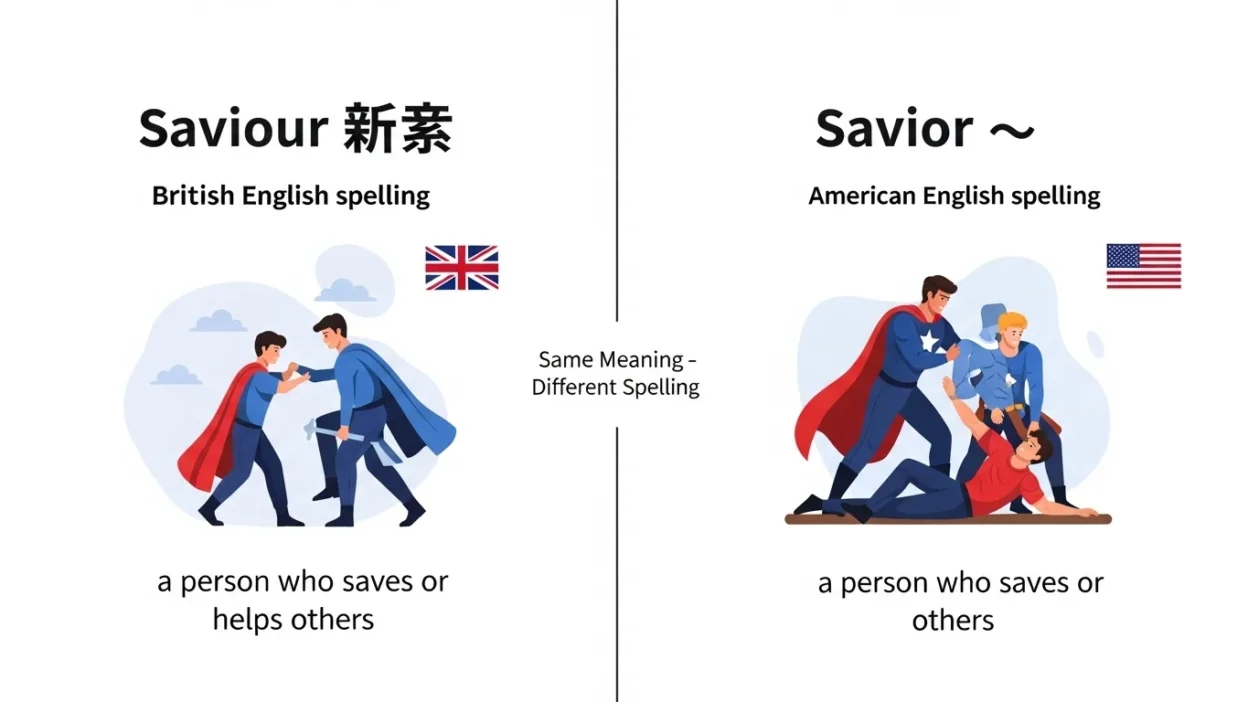
- Saviour → Used in British English
- Savior → Used in American English
- Both words have the same meaning
- The only difference is spelling
- Choose the spelling based on the type of English you are using
Example:
- British English: She was the saviour of the team.
- American English: She was the savior of the team.
Both sentences mean exactly the same thing.
Simple Background: Why Two Spellings Exist
To understand this difference, we need to look at the history of English spelling.
Long ago, English spelling was not fully standardized. Different countries developed their own spelling styles.
British English
British English kept many traditional spellings, including words with “ou.”
Examples:
- colour
- favour
- honour
- saviour
American English
American English later simplified many words by removing the letter “u.”
Examples:
- color
- favor
- honor
- savior
So the difference between saviour and savior follows the same spelling pattern as many other English words.
The meaning did not change. Only the spelling changed.
What Does “Saviour / Savior” Mean?
Both words have the same meaning.
A saviour (or savior) is:
- Someone who rescues or saves another person
- Someone who helps during a difficult situation
- Someone who solves a serious problem
It can also be used in religious meaning to describe a person who saves people spiritually.
Simple meaning:
A saviour/savior is someone who saves others from danger or trouble.
Clear Explanation of the Difference
Let’s make the difference very clear.
Saviour
- Spelling used in British English
- Common in the UK, Australia, Canada, and many other countries
- Contains the letter “u”
Example:
The firefighter became the saviour of the family.
Savior
- Spelling used in American English
- Common in the United States
- Does not include the letter “u”
Example:
The firefighter became the savior of the family.
Important Point
The meaning is exactly the same.
The difference is only spelling style.
Quick Comparison Table
| Feature | Saviour | Savior |
| Type of English | British English | American English |
| Spelling | Includes u | No u |
| Meaning | Someone who saves or rescues | Someone who saves or rescues |
| Where commonly used | UK, Australia, some international writing | United States |
| Correctness | Correct | Correct |
Both spellings are correct. The choice depends on the English style you follow.
Which One Should You Use?
The best choice depends on where you are writing.
Use “Saviour” when:
- Writing in British English
- Writing for UK readers
- Your school follows British spelling
- Your document already uses British spelling
Example:
The doctor was the saviour of the patient.
Use “Savior” when:
- Writing in American English
- Writing for US readers
- Your school uses American spelling
- Your text already follows American spelling
Example:
The doctor was the savior of the patient.
Important Tip
The most important rule is consistency.
Do not mix both spellings in the same document.
Correct example:
- color
- honor
- savior
Incorrect mixed example:
- colour
- honor
- saviour
Choose one spelling style and stay with it.
Common Mistakes People Make
Many learners make small mistakes when using these words.
Let’s look at the most common ones.
1. Thinking They Have Different Meanings
Some learners think:
- saviour = religious meaning
- savior = normal meaning
This is not true.
Both words can be used in any situation.
2. Mixing British and American Spelling
Example mistake:
He became the saviour of the team and earned great honor.
This mixes British and American spelling.
Better versions:
British style:
He became the saviour of the team and earned great honour.
American style:
He became the savior of the team and earned great honor.
3. Thinking One Is More Correct
Some people think one spelling is “better.”
This is not correct.
Both spellings are standard and accepted.
4. Forgetting the Pattern
Many learners forget the spelling rule.
Remember this easy trick:
British English → “our” words
- colour
- favour
- honour
- saviour
American English → “or” words
- color
- favor
- honor
- savior
Everyday Real Life Examples
Let’s see how the word appears in daily situations.
Example in News
British style:
The young boy became the saviour of his sister after helping her during the accident.
American style:
The young boy became the savior of his sister after helping her during the accident.
Example in Emails
Thank you for fixing the computer so quickly. You are my savior today!
or
Thank you for fixing the computer so quickly. You are my saviour today!
Both are correct depending on the spelling style.
Example on Social Media
Coffee is my savior during long study nights.
or
Coffee is my saviour during long study nights.
Example in Daily Conversation
The mechanic was the savior of our trip after fixing the car.
or
The mechanic was the saviour of our trip after fixing the car.
Simple Learning Section for Students
If you are a student or beginner, here is an easy way to remember the difference.
Step 1: Learn the Pattern
British spelling → our
American spelling → or
Examples:
| British | American |
| colour | color |
| favour | favor |
| honour | honor |
| saviour | savior |
Step 2: Choose One Style
Your teacher or school may prefer:
- British English
or - American English
Follow the style your class uses.
Step 3: Stay Consistent
Once you choose a style, use it everywhere in the same text.
Consistency makes your writing look clean and professional.
Frequently Asked Questions (FAQ)
1. Is saviour or savior correct?
Both are correct.
“Saviour” is British spelling, and “savior” is American spelling.
2. Do they have different meanings?
No. They mean the same thing: someone who saves or rescues others.
3. Which spelling is used in the United States?
The United States mainly uses “savior.”
4. Which spelling is used in the United Kingdom?
The United Kingdom mainly uses “saviour.”
5. Can I use both in the same article?
It is better not to mix them. Choose one spelling style and use it consistently.
6. Is one spelling more formal?
No. Both spellings are standard and acceptable.
7. Which spelling should students learn?
Students should learn both, but use the spelling style required by their school or exam system.
8. Is the pronunciation different?
No. Both words are pronounced the same way.
Conclusion
The difference between “saviour” and “savior” is very simple.
Both words:
- Have the same meaning
- Are pronounced the same
- Are correct English words
The only difference is spelling style.
Remember the key rule:
- Saviour → British English
- Savior → American English
If you keep your spelling style consistent, you will avoid confusion and write clearly.
Once you understand this small spelling difference, the question “saviour or savior?” becomes very easy to answer.

Steven Mark is a writer, researcher, and contributor at Meanefy.com, a platform dedicated to exploring word meanings, language nuances, and everyday linguistic curiosities. With a passion for words and clear communication, Steven focuses on making language simple, engaging, and accessible to all readers.