Many English learners and even native speakers feel confused about “thankyou” and “thank you.” When people type quickly on phones, write messages online, or post on social media, they often write “thankyou” as one word.
Because of this, many students start wondering:
- Is thankyou correct?
- Should it be written as two words?
- Do both forms mean the same thing?
The confusion usually happens because English has many words that started as two words and later became one word (for example: goodbye, maybe, and today). So learners sometimes think thankyou might also be correct.
The good news is that the answer is simple. Once you understand the difference, you will not feel confused again.
Quick Answer
Here is the simple and clear answer:
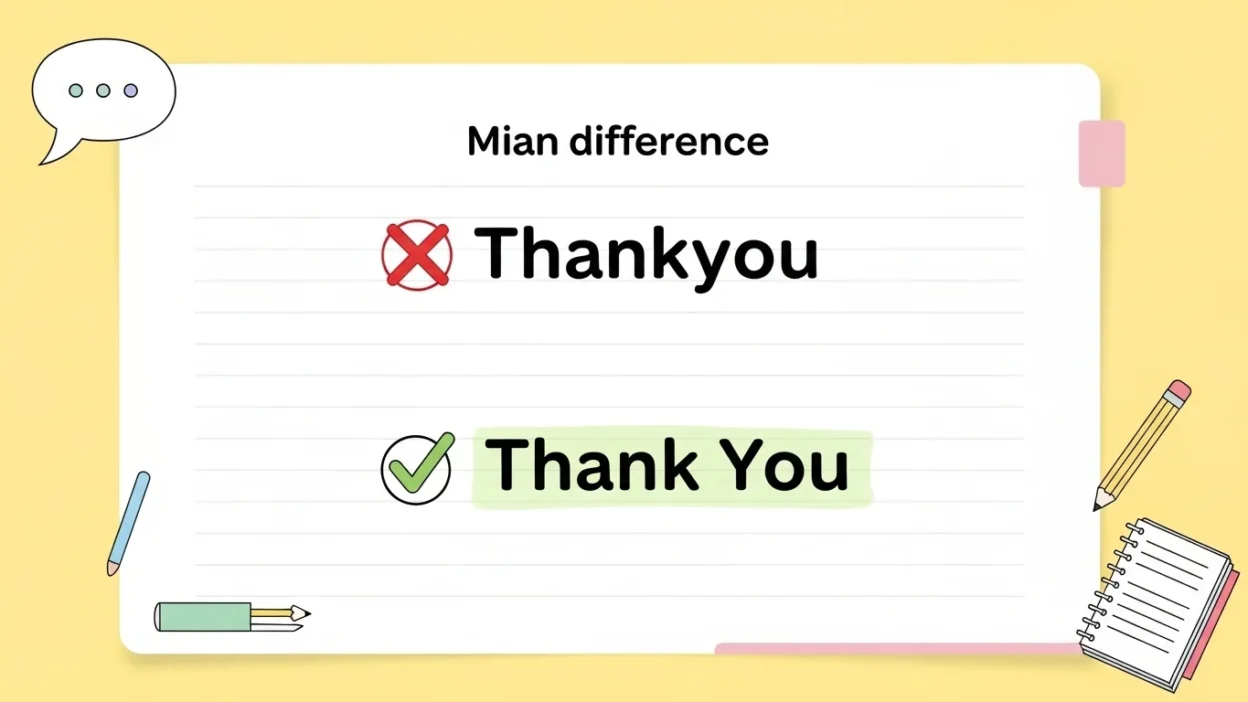
- ✅ Thank you → Correct form (two words)
- ❌ Thankyou → Incorrect in standard English
- Thank you is used to show gratitude or appreciation
- It is used in speaking, writing, emails, messages, and daily conversation
Example:
- Thank you for your help. ✔️
- Thankyou for your help. ❌
In almost all formal and standard writing, “thank you” must be written as two words.
Simple Background: Where “Thank You” Comes From
To understand this better, it helps to know a little about the history of the phrase.
The phrase “thank you” comes from two separate words:
- Thank – a verb that means to show gratitude
- You – the person who receives the thanks
So when someone says “thank you,” it literally means:
“I thank you.”
In older English, people often used full sentences like:
- I thank you for your kindness.
- I thank you for your help.
Over time, the shorter form “thank you” became common in daily conversation.
Because the words have different meanings and roles in a sentence, they stay as two separate words.
The Clear Difference Between “Thankyou” and “Thank You”
Now let’s clearly explain the difference.
1. Thank You (Correct Form)
“Thank you” is a polite phrase used to show appreciation.
People say it when someone:
- helps them
- gives them something
- does something kind
- provides information
Examples:
- Thank you for helping me.
- Thank you for the gift.
- Thank you for your time.
- Thank you very much.
It is one of the most common polite expressions in English.
2. Thankyou (Incorrect Form)
“Thankyou” written as one word is not accepted in standard English.
Sometimes you might see it in:
- casual texting
- social media comments
- informal chats
But it is considered a spelling mistake, especially in:
- school writing
- emails
- essays
- business communication
So students and learners should avoid using “thankyou.”
Comparison Table
| Feature | Thank You | Thankyou |
| Correct spelling | ✔ Yes | ❌ No |
| Number of words | Two words | One word |
| Used in formal writing | ✔ Yes | ❌ No |
| Used in school essays | ✔ Yes | ❌ No |
| Used in emails | ✔ Yes | ❌ No |
| Standard English | ✔ Yes | ❌ No |
This table makes the rule simple: Always write “thank you.”
Which One Should You Use?
The answer is very simple.
You should always use “thank you.”
Use it in:
1. Conversations
Example:
- Thank you for coming.
- Thank you for explaining.
2. Emails
Example:
- Thank you for your message.
- Thank you for your support.
3. School Writing
Example:
- Thank you for giving me this opportunity.
4. Messages and Social Media
Example:
- Thank you everyone for the birthday wishes.
Even in casual situations, “thank you” is still the correct spelling.
Common Mistakes People Make
Many learners make small mistakes when writing thank you. Let’s look at the most common ones.
1. Writing It as One Word
❌ Thankyou for your help.
✔ Thank you for your help.
2. Forgetting Space When Typing Fast
When typing quickly, people sometimes join the words.
❌ Thankyou so much!
✔ Thank you so much!
3. Using It Incorrectly in Sentences
Some students forget the structure.
❌ Thank you to helping me.
✔ Thank you for helping me.
4. Mixing Formal and Informal Forms
In very casual chat, people sometimes shorten the phrase.
Examples:
- thx
- ty
These are informal and should not be used in school or professional writing.
Everyday Real Life Examples
To understand better, let’s look at how people use “thank you” in daily life.
1. Emails
Example:
Thank you for your quick response.
I appreciate your help.
Another example:
Thank you for sending the document.
2. At School
Students often say:
- Thank you, teacher.
- Thank you for explaining the lesson.
3. At a Store
A common conversation:
Customer: Can I get this bag please?
Shopkeeper: Sure.
Customer: Thank you.
4. On Social Media
People often write:
- Thank you everyone for your support.
- Thank you for the kind comments.
5. In News or Public Speeches
Speakers often say:
- Thank you for joining us today.
- Thank you for your attention.
Learning Tip for Students and Beginners
Here is a very easy trick to remember the rule.
Think of the full sentence:
I thank you.
Since thank and you are separate words in the sentence, they stay separate in the short form too.
So always remember:
Thank + You = Thank you (two words)
Another simple tip:
If you ever write thankyou, stop and add a space.
Frequently Asked Questions (FAQ)
1. Is “thankyou” ever correct?
No. In standard English, “thankyou” is not correct. The correct form is “thank you.”
2. Why do people write “thankyou” online?
People sometimes type quickly in chats or social media. It is usually a typing habit, not correct spelling.
3. Is “thank you” formal or informal?
It can be both.
You can use it in:
- casual conversation
- formal emails
- professional situations
4. Can I use “thanks” instead?
Yes. “Thanks” is a shorter and more casual way to express gratitude.
Example:
- Thanks for your help.
But “thank you” sounds more polite and complete.
5. Is “thank you very much” correct?
Yes. This phrase adds extra appreciation.
Example:
- Thank you very much for your support.
6. Should I write “thank you” with a hyphen?
Usually no.
However, a hyphen sometimes appears when the phrase is used like an adjective or noun.
Example:
- a thank you note
But the normal phrase is still thank you.
7. Is “thank you so much” correct?
Yes. It is a very common and friendly way to show strong appreciation.
Example:
- Thank you so much for helping me today.
8. What is the most polite way to say thank you?
You can say:
- Thank you very much.
- Thank you so much.
- I really appreciate it.
All of these are polite and natural.
Conclusion
The difference between “thankyou” and “thank you” is actually very simple.
The correct form is thank you, written as two separate words. It is the standard spelling used in English everywhere—from everyday conversations to emails, school writing, and professional communication.
The form “thankyou” is not considered correct in standard English. It usually appears only because of fast typing or informal internet habits.
If you remember one simple rule, you will never be confused again:
Always write “thank you” with a space between the two words.

Steven Mark is a writer, researcher, and contributor at Meanefy.com, a platform dedicated to exploring word meanings, language nuances, and everyday linguistic curiosities. With a passion for words and clear communication, Steven focuses on making language simple, engaging, and accessible to all readers.