Many people feel confused when they see the words till and til. Both look similar, and both seem to mean the same thing. You might see them in text messages, social media posts, or casual writing.
But are they both correct?
Some teachers say one is wrong. Some writers use both. Because of this, students and English learners often ask the same question:
Should I write “till” or “til”?
The good news is that the answer is simple. Once you understand the small difference between these two words, the confusion disappears.
This guide will explain everything in very clear and simple English so you can understand it easily and use the correct form with confidence.
Quick Answer
Here is the simple truth:
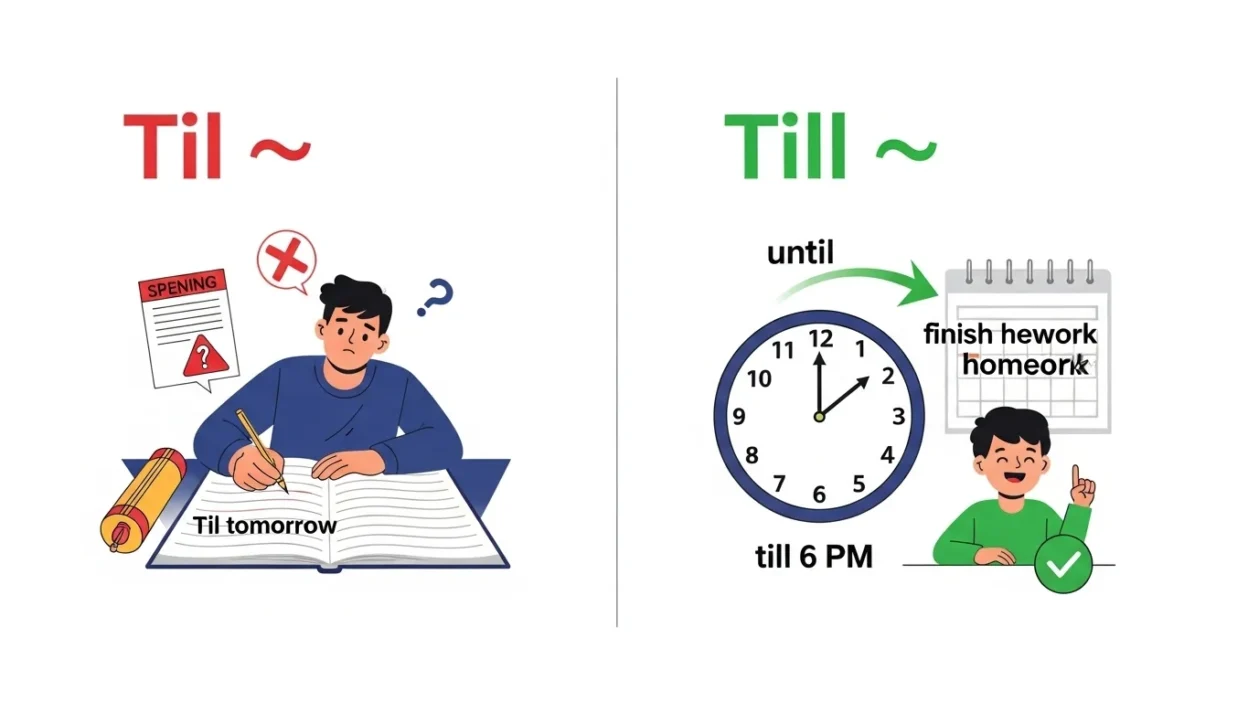
- Till is a real and correct word in English.
- Till means the same as until.
- Til is not the standard spelling.
- If you shorten until, the correct short form is ’til (with an apostrophe).
- In formal writing, it is safest to use until.
Simple rule:
- Formal writing → until
- Casual writing → till
- Short informal writing → ’til
Avoid writing til without the apostrophe.
Where Do These Words Come From?
Many people think till is just a short form of until. But this idea is not correct.
The word till is actually older than until.
Long ago in early English, people already used till to mean “up to a certain time.” Later, the word until appeared. It likely came from combining “un” + “till.”
So the timeline looks like this:
- Till appeared first in English.
- Later, until developed.
- Much later, people started writing ’til as a short form of until.
Because of this history:
- Till is a full, correct word.
- ’Til is a shortened version.
This surprises many learners because they expect the shorter word to come later.
The Main Difference Between Till and Til
The main difference is correct spelling and usage.
Till
- Correct English word
- Same meaning as until
- Used in both spoken and written English
- Acceptable in informal and many normal situations
Example:
- Wait here till I come back.
Til
- Usually considered incorrect spelling
- Often appears in informal online writing
- Missing the apostrophe
Example:
- Wait here til I come back. ❌
’Til
This is the true short form of until.
Example:
- I won’t sleep ’til the work is done.
However, many writers still prefer till instead of ’til because it looks cleaner.
Easy Comparison Table
| Feature | Till | Til | ’Til |
| Is it a real word? | Yes | Usually no | Yes |
| Meaning | Same as “until” | Same meaning | Same meaning |
| Correct spelling | Yes | Usually incorrect | Yes |
| Formal writing | Sometimes | No | Rare |
| Informal writing | Yes | Common but not recommended | Yes |
| Example | Wait till tomorrow | Wait til tomorrow | Wait ’til tomorrow |
Which One Should You Use?
The best choice depends on the situation.
Use until when:
- Writing school essays
- Writing formal emails
- Writing reports
- Writing academic work
Example:
- The meeting will continue until 5 PM.
Use till when:
- Speaking in everyday English
- Writing messages
- Writing stories
- Writing informal content
Example:
- Let’s stay here till sunset.
Use ’til when:
- Writing informal text
- You want a shortened style
Example:
- I’ll wait ’til you arrive.
Avoid til
Even though many people write it, teachers and editors usually consider it incorrect.
Common Mistakes People Make
Many English learners make small mistakes with these words. Let’s look at the most common ones.
Mistake 1: Thinking “till” is wrong
Some people believe till is incorrect. That is not true.
Example:
- Stay here till I return.
This sentence is correct.
Mistake 2: Writing “til” instead of “’til”
Because typing an apostrophe takes extra effort, many people write til.
Example:
- I’ll call you til tomorrow.
This should be:
- I’ll call you ’til tomorrow.
Or simply:
- I’ll call you till tomorrow.
Mistake 3: Using “till” in very formal writing
In formal writing, many teachers prefer until.
Example:
Less formal:
- The store will remain closed till Monday.
More formal:
- The store will remain closed until Monday.
Mistake 4: Using both words together
Sometimes people accidentally write:
- until till tomorrow
This is incorrect because both words mean the same thing.
Correct version:
- until tomorrow
or
- till tomorrow
Everyday Real Life Examples
To understand better, let’s look at how these words appear in real life.
In Emails
Informal email:
- Please wait till I send the final document.
Formal email:
- Please wait until the final document is sent.
In Text Messages
- I’ll be busy till evening.
- Let’s talk ’til midnight.
On Social Media
People often write:
- Can’t sleep til 3 AM.
But the correct versions are:
- Can’t sleep till 3 AM.
- Can’t sleep ’til 3 AM.
In Daily Conversations
You might hear sentences like:
- Stay here till I come back.
- Wait till the rain stops.
- We talked ’til late at night.
These are natural and common in everyday speech.
A Short Learning Section for Students
If you are learning English, remember this simple rule.
Step 1: Learn the safest word
The safest word is:
until
Example:
- Study until the test begins.
Step 2: Learn the common spoken form
People often say:
till
Example:
- Wait till tomorrow.
Step 3: Understand the short version
The short form is:
’til
Example:
- Stay ’til the end.
Simple Memory Tip
Think like this:
- until → formal and safe
- till → everyday and natural
- ’til → short informal form
Avoid til without the apostrophe.
Frequently Asked Questions (FAQ)
1. Is “till” correct English?
Yes. Till is a correct English word. It has been used for hundreds of years and means the same as until.
2. Is “til” wrong?
In most cases, yes. Til without an apostrophe is usually considered incorrect spelling.
The correct short form is ’til.
3. Is “till” older than “until”?
Yes. Till existed before until. Many people are surprised by this fact.
4. Which word is best for formal writing?
The best choice for formal writing is:
until
Example:
- The project will continue until next week.
5. Can I use “till” in essays?
Some teachers allow it, but many prefer until in academic writing.
To be safe, use until in essays.
6. Is “’til” common in books?
Yes, but mostly in dialogue or informal writing. Writers use it to show natural speech.
7. Do native speakers say “till”?
Yes. Native speakers often say till in everyday conversations.
Example:
- Stay here till I return.
8. Which spelling should beginners use?
Beginners should mostly use:
until
It is clear, correct, and safe in every situation.
Final Thoughts
The confusion between till and til is very common, but the answer is actually simple.
Remember these key points:
- Till is a correct word and means the same as until.
- Until is the safest choice for formal writing.
- ’Til is the true short form of until.
- Til without an apostrophe is usually considered incorrect.
If you follow this easy rule, you will never feel confused again:
Use “until” for formal writing, “till” for everyday use, and avoid writing “til.”
With this understanding, you can now use these words confidently in messages, emails, conversations, and writing.

Anthony Charles is the founder and lead content creator at Meanefy.com, a platform dedicated to exploring word meanings, language nuances, and everyday curiosities. With a passion for language and a keen eye for detail, Anthony aims to make complex words and concepts simple and accessible for readers around the world.