Many students and English learners get confused between “to” and “too.” They sound exactly the same when we speak, so it is easy to mix them up when writing.
But here is the good news: the difference is actually very simple. Once you understand a few basic rules, you will never be confused again.
This guide will explain everything in clear, easy English so you can understand it on your first read.
Quick Answer
Here is a fast and simple way to remember:
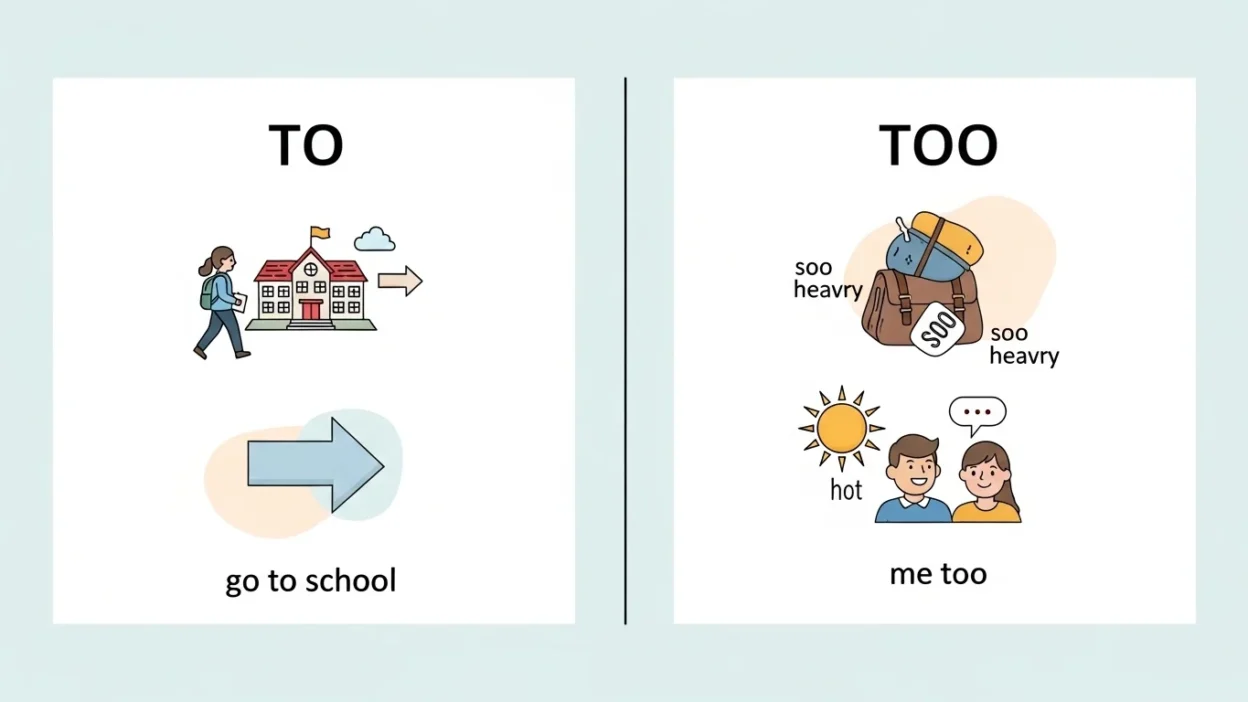
- To
- Shows direction: go to school
- Shows purpose: want to eat
- Connects verbs: like to read
- Too
- Means also: I want ice cream too
- Means more than needed: too hot, too fast
Simple Background
Both “to” and “too” sound the same. This is why they confuse many people.
- “To” is used very often in English. It has many uses.
- “Too” is used less often and has only two main meanings.
Think of it this way:
- “To” = action or direction
- “Too” = extra or also
Clear Explanation of the Difference
Let’s break it down step by step.
What Does “To” Mean?
“To” is used in three main ways:
1. Showing Direction
It tells where something is going.
- I am going to the market.
- She walked to the park.
2. Showing Purpose
It explains why something happens.
- I study to learn.
- He works to earn money.
3. Before a Verb
It connects verbs.
- I want to sleep.
- They like to play.
What Does “Too” Mean?
“Too” has only two main meanings.
1. Meaning “Also”
It means in addition or as well.
- I like tea, and I like coffee too.
- She is coming too.
2. Meaning “More Than Needed”
It shows something is more than enough or more than good.
- This bag is too heavy.
- The room is too cold.
Comparison Table
| Feature | To | Too |
| Meaning | Direction, purpose, action | Also / extra |
| Usage | Very common | Less common |
| Before verbs | Yes (to eat, to go) | No |
| Example | I want to learn | I want to learn too |
| Extra meaning | No | Yes (too much, too fast) |
Which One to Use and When
Use this simple trick:
Use “To” when:
- You are talking about movement
→ go to school - You are talking about purpose
→ study to pass - You use a verb after it
→ want to eat
Use “Too” when:
- You mean “also”
→ I am coming too - You mean “more than needed”
→ too big, too loud
Easy Memory Tip
- “Too” has two “o” letters → think of “extra”
- “To” has one “o” → simple and basic
Common Mistakes People Make
Here are mistakes many learners make:
Mistake 1: Using “to” instead of “too”
❌ I am happy to.
✔ I am happy too.
Mistake 2: Using “too” before verbs
❌ I want too eat.
✔ I want to eat.
Mistake 3: Forgetting the meaning of “too”
❌ This bag is to heavy.
✔ This bag is too heavy.
Mistake 4: Overusing “too”
❌ I too go to school every day.
✔ I go to school every day too.
Everyday Real Life Examples
In Emails
- I will send the file to you.
- Please reply to this message.
- I will join the meeting too.
In News
- The president went to another country.
- Prices are too high this year.
On Social Media
- I want to travel the world.
- This video is too funny!
- I love this song too.
In Daily Conversations
- Let’s go to the park.
- I am coming too.
- It is too hot today.
Learning Section for Students and Beginners
Here are some easy steps to help you learn:
Step 1: Practice Short Sentences
- I want to read.
- I want to read too.
Step 2: Ask Yourself a Question
If you are confused, ask:
- Does it mean “also”? → use too
- Does it show action or direction? → use to
Step 3: Try Fill in the Blanks
- I am going ___ school. → to
- This box is ___ heavy. → too
- She wants ___ learn. → to
- I like pizza ___ → too
Step 4: Read and Notice
Pay attention when reading books, messages, or posts. Notice how “to” and “too” are used.
FAQ Section
1. What is the main difference between “to” and “too”?
“To” shows direction or action. “Too” means “also” or “more than needed.”
2. Can “too” come before a verb?
No. You cannot say too eat. You must say to eat.
3. When does “too” mean “also”?
When you want to say “in addition.”
Example: I want ice cream too.
4. How do I know if I should use “too”?
Ask: does it mean “also” or “very much”? If yes, use “too.”
5. Is “to” used more often than “too”?
Yes. “To” is used very often in English.
6. Can “too” start a sentence?
Yes, but it is less common.
Example: Too many people came.
7. What is a simple trick to remember “too”?
“Too” has two “o” letters, so think of “extra.”
8. Are “to” and “too” pronounced the same?
Yes. They sound the same when spoken.
Conclusion
The difference between “to” and “too” is simple once you understand the basics.
- Use “to” for direction, purpose, and actions.
- Use “too” for “also” or “more than needed.”
Remember the easy trick:
- “Too” = extra (two o’s)
- “To” = simple use
With a little practice, you will stop making mistakes and feel more confident in your writing. Keep reading, keep practicing, and soon it will feel natural.

Daniel Matthew is a language enthusiast, writer, and contributor at Meanefy.com, where he explores the meanings, origins, and nuances of words and phrases. With a deep passion for language, Daniel aims to make complex concepts simple, engaging, and easy to understand for readers of all ages.