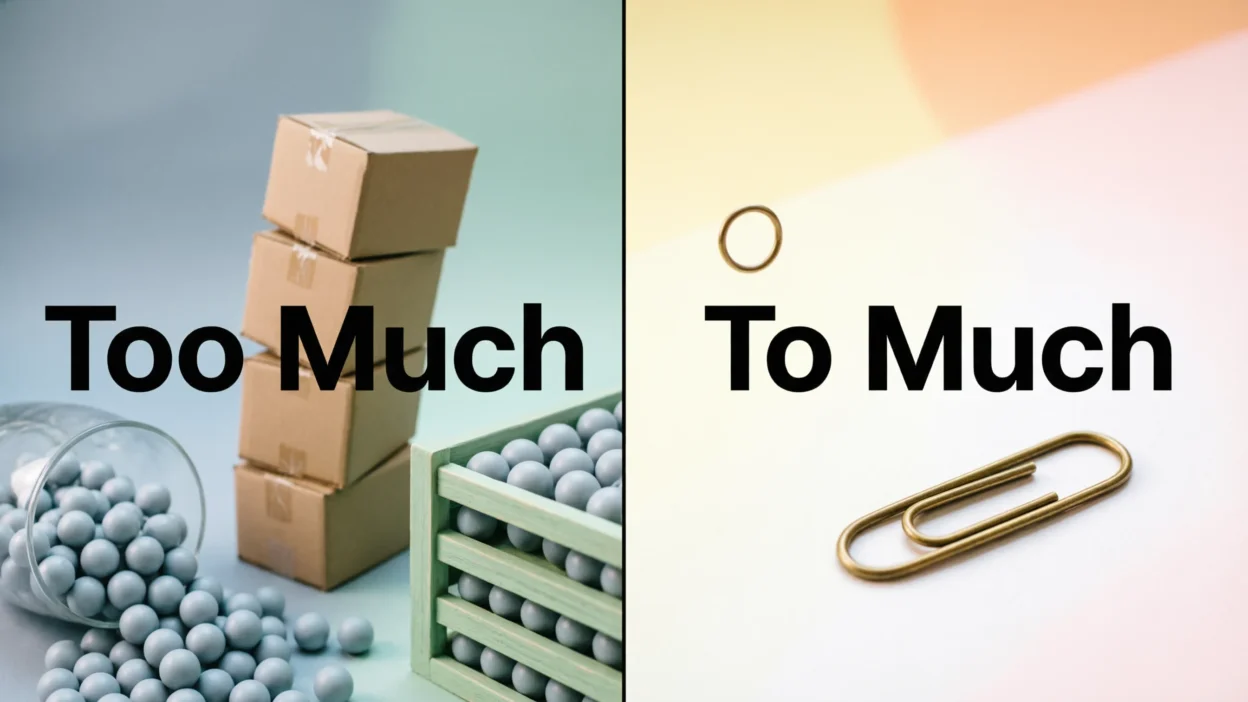
Many students and English learners feel confused about “too much” and “to much.” They look almost the same. The only difference is one small letter: “o.” But that small letter changes everything.
The good news is this:
Once you understand one simple rule, you will never feel confused again.
Let’s make it very clear and easy.
Quick Answer
Here is the short and simple truth:
- ✅ Too much = correct
- ❌ To much = wrong (almost always incorrect)
Why?
- “Too” means more than needed or more than good.
- “To” is used for direction or before a verb.
- “To much” does not follow English grammar rules.
If you remember only this, you are already 90% correct.
Simple Background Explanation
English has many small words that look similar. Words like:
- to
- too
- two
They sound the same when we speak. These are called homophones (words that sound the same but have different meanings).
Because they sound the same, people often spell them wrong when writing.
“Too much” uses too, not to.
Why?
Because “too” has a special meaning.
Clear Explanation of the Difference
Let’s break it down very simply.
1. What Does “Too” Mean?
“Too” can mean:
- More than enough
- More than needed
- More than is good
Examples:
- This coffee is too hot.
- I ate too much food.
- It is too late to call.
Notice something important:
When we use too, it usually shows a problem. It means something is more than we want.
2. What Does “Much” Mean?
“Much” is used with things we cannot count.
For example:
- water
- sugar
- money
- time
- food
We cannot say “one water” or “two money.” So we use “much.”
Example:
- I don’t have much time.
- There isn’t much sugar left.
3. What Does “Too Much” Mean?
When we combine them:
Too much = more than needed
Examples:
- I drank too much water.
- She spends too much money.
- There is too much noise here.
It always shows excess.
4. Why Is “To Much” Wrong?
“To” is used for:
- Direction → I am going to school.
- Showing purpose → I want to learn.
- Giving something → Give this to her.
But “to” does NOT mean “more than needed.”
So when someone writes:
❌ I ate to much.
It is incorrect because “to” does not show excess.
The correct sentence is:
✅ I ate too much.
Comparison Table
Here is a simple table to make it very clear:
| Word | Meaning | Correct? | Example |
| Too much | More than needed | ✅ Yes | I ate too much cake. |
| To much | No correct meaning | ❌ No | I ate to much cake. |
Very simple rule:
If you mean more than needed, always use too much.
Which One Should You Use and When?
Use “Too Much” When:
- Something is more than needed
- Something causes a problem
- You want to show excess
Examples:
- This bag is too much for me to carry.
- He talks too much in class.
- There is too much traffic today.
- She worries too much.
Never Use “To Much”
There is no situation where “to much” is correct in normal English sentences.
If you see it, it is a spelling mistake.
Common Mistakes People Make
Let’s look at common errors and fix them.
Mistake 1: Forgetting the Extra “O”
❌ I have to much homework.
✅ I have too much homework.
People forget that “too” has two O’s.
Helpful memory trick:
👉 Too has too many O’s.
Two O’s = excess.
Mistake 2: Confusing Sound With Spelling
When we speak, “to” and “too” sound the same.
So learners write what they hear.
But spelling is important in writing.
Mistake 3: Mixing It in Fast Typing
Many people type quickly on their phones and write:
“to much”
This is common on social media.
But it is still incorrect in formal writing like:
- School essays
- Emails
- Job applications
- Exams
Everyday Real-Life Examples
Let’s see how “too much” is used in daily life.
1. In Emails
- I am sorry if I asked too much from you.
- There was too much information in the meeting.
2. On Social Media
- This drama is too much!
- He posts too much about his life.
3. In News or Articles
- The city has too much pollution.
- There is too much traffic during rush hour.
4. In Daily Conversation
- Don’t eat too much sugar.
- You watch too much TV.
- I think you worry too much.
You can see it is very common in daily English.
Short Learning Section for Students and Beginners
Here is a simple way to practice.
Step 1: Ask Yourself a Question
Are you talking about something that is more than needed?
If yes → use too much
Step 2: Try These Practice Sentences
Fill in the blank:
- I spent ______ money.
- There is ______ noise in this room.
- She eats ______ fast food.
- He talks ______ in meetings.
Answers:
- too much
- too much
- too much
- too much
Step 3: Memory Trick
Remember:
- “Too” has two O’s
- When something is extra, it needs extra O
Too = extra
Two O’s = extra letter
Very easy!
Frequently Asked Questions (FAQ)
1. Is “to much” ever correct?
No. It is almost always wrong in English writing.
2. Why do so many people write “to much”?
Because “to” and “too” sound the same when we speak.
3. How can I remember the correct spelling?
Remember: Too has two O’s.
More than needed = more letters.
4. Can I say “very much” instead of “too much”?
Yes, but the meaning changes.
- “Very much” = a lot (positive or neutral)
- “Too much” = more than needed (usually negative)
Example:
- I like you very much. ❤️
- You talk too much. 😅
5. Is “too much” always negative?
Most of the time, yes.
But sometimes people use it in a funny way:
- This cake is too much! (very amazing)
Still, it shows excess.
6. What about “too many”?
Good question!
- Too much → for uncountable things (water, money, time)
- Too many → for countable things (books, apples, people)
Example:
- Too much sugar
- Too many cookies
7. Can I use “too much” at the end of a sentence?
Yes.
Examples:
- I think you work too much.
- She worries too much.
Final Summary: The Rule Is Simple
Let’s repeat the most important point:
- ✅ Too much = correct
- ❌ To much = incorrect
Use too much when something is more than needed.
Remember the easy trick:
Too has two O’s.
Extra O = extra amount.
Now you know the difference clearly.
From today, you will not make this mistake again.
Small spelling changes can create big meaning differences. But when you understand the rule in simple steps, English becomes much easier.
Keep practicing, and you will improve every day.

Daniel Matthew is a language enthusiast, writer, and contributor at Meanefy.com, where he explores the meanings, origins, and nuances of words and phrases. With a deep passion for language, Daniel aims to make complex concepts simple, engaging, and easy to understand for readers of all ages.