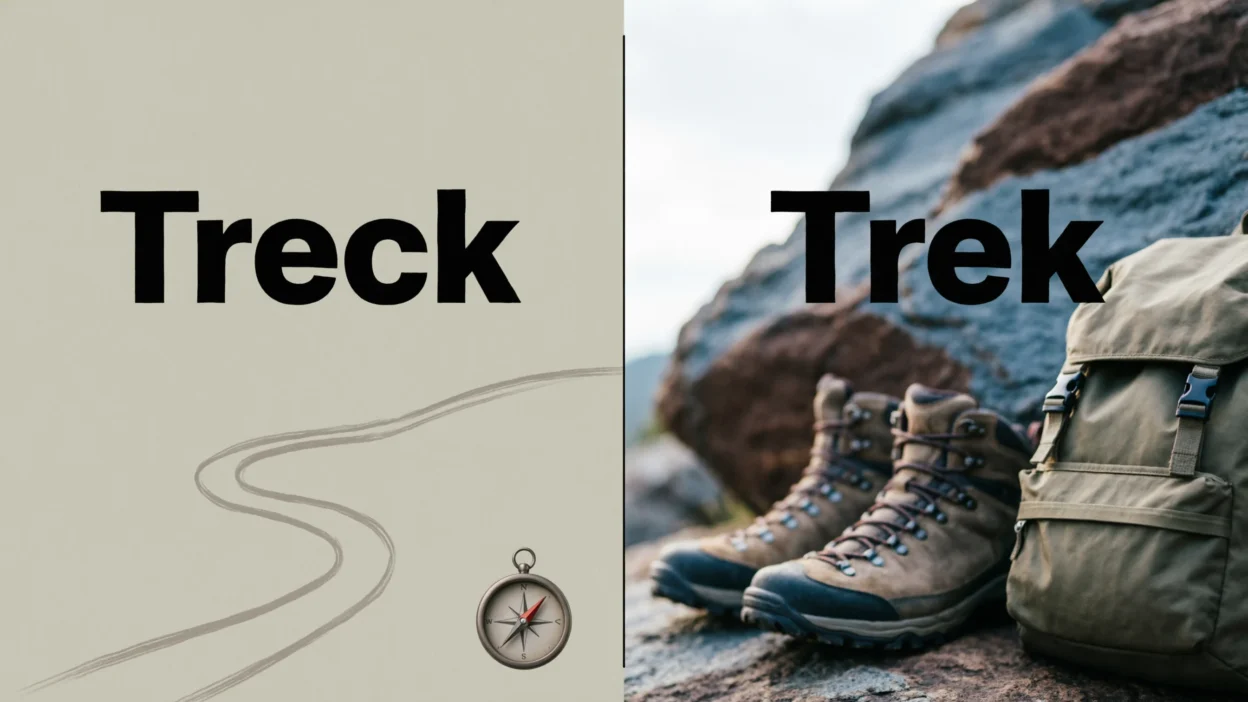
Many students and English learners feel confused about treck and trek.
They look almost the same.
They sound the same when spoken.
Only one letter is different.
So people often ask:
“Is it treck or trek?”
“Which spelling is correct?”
This confusion is very common, especially for beginners and ESL learners. The good news is simple:
There is a very clear answer.
Let’s understand it step by step in easy English.
Quick Answer
Here is the short and simple answer:
- ✅ Trek is the correct spelling.
- ❌ Treck is not a correct English word.
- Use trek when talking about:
- A long walk
- A difficult journey
- Traveling through mountains or rough places
That’s it.
If you remember one thing, remember this:
👉 “Trek” is correct. “Treck” is wrong.”
Where Does the Word “Trek” Come From?
The word trek did not start in English.
It came from South Africa. Long ago, people there used the word “trek” to mean:
- Moving from one place to another
- Traveling by wagon
- Going on a long journey
Over time, English speakers started using the word too.
Today, we use trek to talk about:
- Long walks in nature
- Difficult journeys
- Slow travel through hard places
The spelling has always been T-R-E-K.
There has never been an official English word spelled treck.
The Clear Difference Between Treck and Trek
Now let’s explain the difference in the simplest way possible.
1. Trek
- Real English word
- Correct spelling
- Used in books, news, and daily speech
- Means a long or difficult journey
Example:
- We went on a trek in the mountains.
- They made a long trek across the desert.
2. Treck
- Not a real English word
- Incorrect spelling
- Just a spelling mistake
If you write “treck,” most teachers, examiners, or spell-check tools will mark it as wrong.
So the difference is very simple:
Trek = correct word
Treck = spelling mistake
Easy Comparison Table
| Feature | Trek | Treck |
| Is it a real English word? | ✅ Yes | ❌ No |
| Correct spelling? | ✅ Yes | ❌ No |
| Used in dictionaries? | ✅ Yes | ❌ No |
| Safe to use in exams? | ✅ Yes | ❌ No |
| Meaning | Long or difficult journey | No meaning |
This table makes it very clear.
When Should You Use “Trek”?
Use trek when talking about:
1. Hiking or Walking in Nature
- We went on a trek in the forest.
- The group planned a mountain trek.
2. A Difficult Journey
- The refugees made a long trek to safety.
- It was a tough trek through the snow.
3. A Slow or Tiring Trip
- The daily trek to school takes one hour.
- His trek to success was not easy.
Sometimes, “trek” is also used in a more creative way:
- Her journey through university was a long trek.
In this case, it does not mean walking. It means a long and challenging experience.
Why Do People Write “Treck”?
There are a few simple reasons:
1. Sound Confusion
When we say “trek,” it sounds strong at the end.
Some people think it should be spelled with “ck.”
English has many words that end in “ck,” like:
- back
- neck
- rock
- duck
So learners guess that “trek” should also end with “ck.”
But this is wrong.
English spelling is not always logical.
“Trek” is just spelled with K, not CK.
2. Fast Typing Mistake
Sometimes people type quickly and add an extra “c” by accident.
3. Not Checking Spelling
If someone does not use spell-check or a dictionary, they may not notice the mistake.
Common Mistakes People Make
Here are some common errors:
❌ We went on a treck yesterday.
✅ We went on a trek yesterday.
❌ It was a long treck to the village.
✅ It was a long trek to the village.
❌ They trecked for five hours.
✅ They trekked for five hours.
Notice something important:
When we add -ed or -ing, we double the “k”:
- trek → trekked
- trek → trekking
But we still do NOT add a “c.”
It is never:
- trecked ❌
- trecking ❌
Always:
- trekked ✅
- trekking ✅
Real-Life Examples in Daily Use
Let’s look at how people use “trek” in real life.
1. In Emails
Hi Sara,
We are planning a mountain trek next weekend. Would you like to join us?
2. On Social Media
“Just finished a 10 km trek! So tired but so happy!”
3. In News Reports
“The travelers completed a dangerous trek across the icy region.”
4. In School Writing
“Our class went on a nature trek as part of our science project.”
In all these examples, only trek is correct.
You will never see “treck” in serious writing.
Learning Section for Students and Beginners
If you are learning English, here are some easy tips.
Tip 1: Remember This Sentence
“There is no C in trek.”
Repeat it a few times.
Tip 2: Practice Writing
Write these sentences:
- I went on a trek.
- The trek was difficult.
- We are trekking tomorrow.
- They trekked for hours.
Writing helps your brain remember correct spelling.
Tip 3: Use a Dictionary
If you are unsure, check a dictionary.
You will find “trek.”
You will not find “treck.”
Tip 4: Break the Word
Trek = T + R + E + K
Only four letters.
Simple and clean.
Frequently Asked Questions (FAQ)
1. Is “treck” ever correct?
No. “Treck” is always wrong in standard English.
2. Why does “trek” not have “ck” at the end?
Because that is how the word entered English. English keeps the original spelling.
3. What does “trek” mean exactly?
It means a long or difficult journey, usually on foot.
4. How do you spell the past tense of trek?
The past tense is trekked.
Example: We trekked for three days.
5. How do you spell the -ing form?
It is trekking.
Example: They are trekking in the mountains.
6. Is “trek” only used for mountains?
No. It can be used for:
- Forests
- Deserts
- Snow
- Long difficult life journeys
7. Can “trek” be used in a funny or casual way?
Yes. People sometimes say:
“My trek to the kitchen felt so long!”
This is just a playful way to speak.
8. Is “trek” used in formal writing?
Yes. It is correct in:
- School essays
- News articles
- Books
- Reports
Conclusion
Let’s remove the confusion completely.
There is only one correct spelling:
👉 Trek
“Treck” is simply a spelling mistake.
If you remember nothing else, remember this:
- Trek = real word
- Treck = wrong spelling
Use “trek” when talking about a long, slow, or difficult journey.
English spelling can sometimes feel tricky, but this word is simple once you understand it.
Now you can confidently write and speak without confusion.
And the next time someone asks, “Is it treck or trek?”
You will know the answer immediately. 😊

Daniel Matthew is a language enthusiast, writer, and contributor at Meanefy.com, where he explores the meanings, origins, and nuances of words and phrases. With a deep passion for language, Daniel aims to make complex concepts simple, engaging, and easy to understand for readers of all ages.