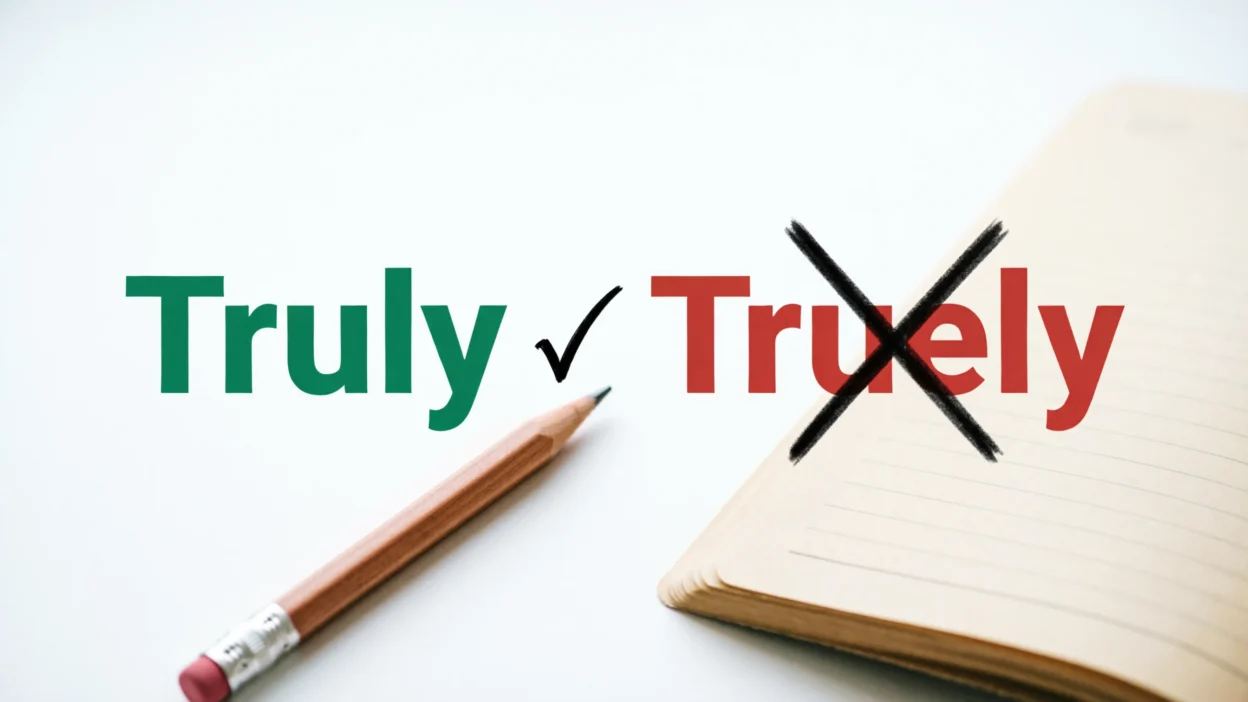
Many people feel unsure when they write truly or truely. They look almost the same. They sound the same when we speak.
This article removes all confusion. We will explain everything in very simple English. By the end, you will know the right word on the first read—and you will feel confident using it every day.
Quick Answer (No Confusion)
- Truly ✅ is the correct spelling
- Truely ❌ is incorrect and should not be used
- Only truly is accepted in standard English
- If you remember one thing, remember this: There is no “e” in truly
Simple Origin and Background
To understand why truly is correct, it helps to look at where the word comes from.
The word true means something is real, honest, or correct.
When we want to describe an action using true, we add -ly to make an adverb.
So:
- true + ly = truly
This change looks small, but English spelling rules matter. When true becomes truly, the e is dropped. This happens with some other words too.
Truely looks logical, but English does not work that way here. Over time, truly became the accepted spelling, and truely was left out.
Clear Explanation of the Difference
There is no meaning difference between truly and truely because truely is not a real English word.
- Truly means:
- honestly
- really
- in a sincere way
Example:
- “I truly believe you.”
- Truely is:
- a spelling mistake
- not accepted in writing
- not found in proper dictionaries
If you use truely, readers may think you made an error or are not careful with spelling.
Comparison Table: Truly vs Truely
| Point | Truly | Truely |
| Correct spelling | Yes | No |
| Used in books | Yes | No |
| Accepted in exams | Yes | No |
| Used in formal writing | Yes | No |
| Means honest or real | Yes | No |
| Should be avoided | No | Yes |
This table makes it simple: Only “truly” is right.
Which One to Use and When
Always use truly. There is no situation where truely is correct.
Use truly when you want to:
- Show honesty
- Show strong feeling
- Say something is real or sincere
Common uses of truly:
- Truly sorry
- Truly happy
- Truly believe
- Truly amazing
If you are writing:
- An email
- A school assignment
- A message
- A story
- A social media post
👉 Use “truly” every time.
Common Mistakes People Make
Many people make the same mistakes again and again. Let’s look at them clearly.
1. Adding an extra “e”
People think:
- true + ly = truely
But this is wrong. The e is dropped.
2. Trusting how it sounds
Both words sound the same when spoken. English spelling does not always match sound.
3. Spellcheck confusion
Some spellcheck tools do not always catch truely, especially in casual writing.
4. Learning the wrong form early
Once a wrong spelling is learned, it can stick. That’s why clear learning now is important.
Everyday Real-Life Examples
Emails
Correct:
- “I truly appreciate your help.”
Incorrect:
- “I truely appreciate your help.”
News Writing
Correct:
- “The event was truly historic.”
Incorrect:
- “The event was truely historic.”
Social Media
Correct:
- “I am truly grateful for all the support.”
Incorrect:
- “I am truely grateful for all the support.”
Daily Conversation (Writing)
Correct:
- “She truly cares about her work.”
Incorrect:
- “She truely cares about her work.”
In every real-life example, truly is the only correct choice.
Short Learning Section for Students and Beginners
Easy Memory Trick
Think of this sentence:
“True things are truly true.”
Notice:
- true → truly
- No extra e
Practice Tip
Whenever you write truely, stop and check. Change it to truly.
Simple Rule
If a word ends in -ly, do not always keep the final e from the base word.
Frequently Asked Questions (FAQ)
1. Is “truely” ever correct?
No. Truely is always incorrect in English.
2. Why do people still use “truely”?
Because it looks logical and sounds right, but English spelling rules are different.
3. Is “truly” formal or informal?
It works in both. You can use truly in casual and formal writing.
4. Can I lose marks in exams for writing “truely”?
Yes. Teachers and examiners count it as a spelling mistake.
5. Does “truly” change the meaning of a sentence?
It adds strength and honesty, but the sentence can still work without it.
6. Are there other words like “truly”?
Yes. Some words drop the final e before adding -ly.
7. How can I remember the correct spelling?
Remember: There is no “e” in truly.
Conclusion
The confusion between truly or truely is very common, but the answer is simple.
- Truly is the correct spelling
- Truely is a mistake
- There is no exception
Once you learn this, you never need to worry again. Use truly with confidence in school, work, and daily life. With this clear understanding, your writing will look cleaner, more correct, and more professional—without stress or doubt.

Anthony Charles is the founder and lead content creator at Meanefy.com, a platform dedicated to exploring word meanings, language nuances, and everyday curiosities. With a passion for language and a keen eye for detail, Anthony aims to make complex words and concepts simple and accessible for readers around the world.