Many people get confused between “tweek” and “tweak”. These two words sound almost the same, but only one of them is correct in English.
If you use the wrong word, your sentence can look strange or wrong. In this guide, we will explain the difference in very simple English, so anyone can understand it easily.
Why People Get Confused
- The words sound similar when spoken.
- Many people see “tweek” online and think it is correct.
- English learners, students, and beginners often mix them up.
The good news: it is easy to remember the correct word once you understand the difference.
Quick Answer
Here is the simplest way to tell the difference:
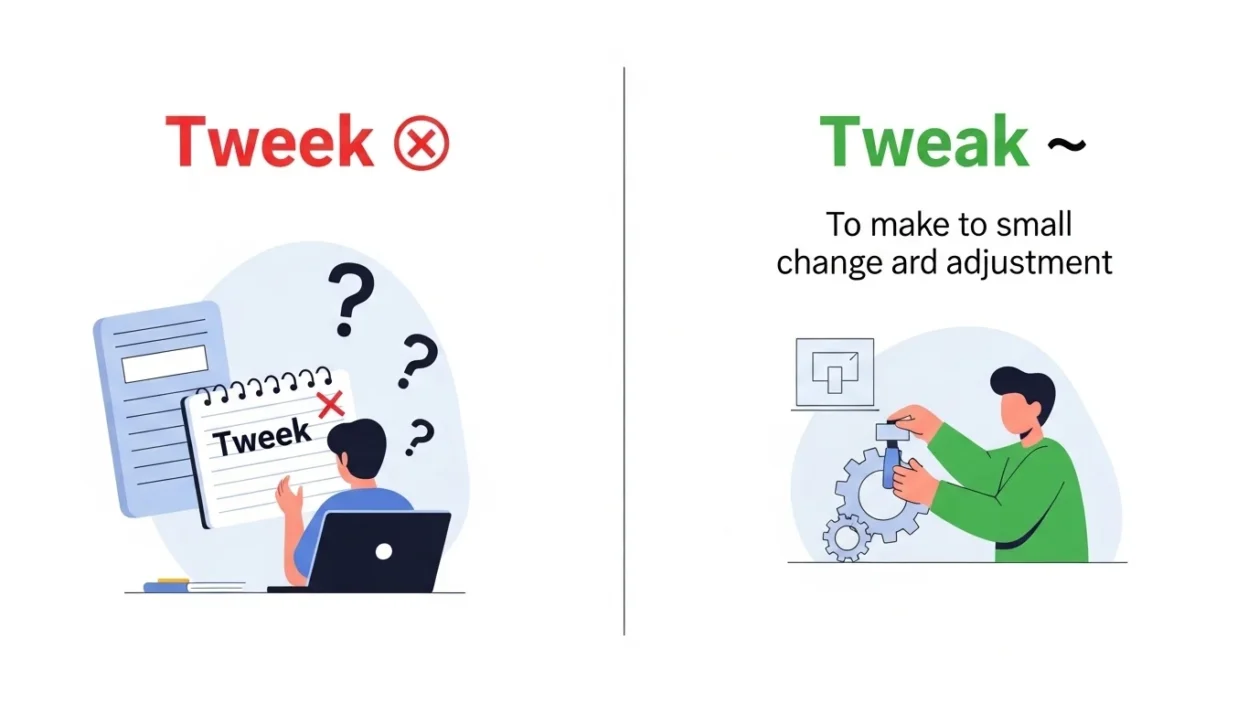
- Tweak ✅ – This is the correct English word. It means:
- To slightly change something to make it better.
- To pull, twist, or pinch something lightly.
- Tweek ❌ – This is not a correct English word. If you see it, it is usually a typo for “tweak” or slang in online communities.
Remember: If you are writing standard English, always use tweak.
Origin / Background
The word tweak comes from Old English “twiccian”, which means to pluck or pinch. Over time, it also started to mean making small adjustments, like fixing a machine or improving a plan.
There is no real origin for “tweek” in English. Sometimes it appears in online writing, but it is incorrect in formal English.
Clear Explanation of the Difference
- Tweak is real and correct. It has two main uses:
- To adjust or improve something:
- Example: “I need to tweak my essay before submitting it.”
- To pull or pinch lightly (usually small, not painful):
- Example: “She tweaked her nose playfully.”
- To adjust or improve something:
- Tweek is not standard English. People often write it by mistake.
Comparison Table
| Feature | Tweak (Correct) | Tweek (Incorrect) |
| Meaning | Small adjustment or pinch | No standard meaning |
| Usage | Writing, speaking, daily life | Typo or slang online |
| Example | “I need to tweak my phone settings.” | “I will tweek my phone settings.” ❌ |
| Formal English | ✅ Correct | ❌ Incorrect |
| Pronunciation | /twiːk/ | Sounds same but wrong |
Which One to Use and When
Use tweak in almost every situation:
- In school or homework – “I tweaked my science project.”
- At work or projects – “We need to tweak the plan.”
- Daily life – “I tweaked the recipe to make it tastier.”
Avoid tweek unless you are quoting someone online who spelled it that way.
Common Mistakes People Make
- Writing “tweek” instead of “tweak.”
- Thinking “tweak” only means “pulling or pinching.” (It also means small adjustments.)
- Using “tweek” in formal emails or reports.
- Forgetting that “tweak” can be both a verb and a noun:
- Verb: “I tweaked the design.”
- Noun: “The tweak improved the design.”
Everyday Real Life Examples
Emails:
- ✅ “I tweaked the presentation slides for clarity.”
- ❌ “I tweeked the slides for clarity.”
News Articles:
- ✅ “The company tweaked its policy after feedback.”
- ❌ “The company tweeked its policy after feedback.”
Social Media:
- ✅ “I just tweaked my profile picture.”
- ❌ “I just tweeked my profile picture.”
Daily Use:
- ✅ “I tweaked the thermostat to make it warmer.”
- ❌ “I tweeked the thermostat to make it warmer.”
Short Learning Section for Students and Beginners
- Step 1: Remember, tweak is correct.
- Step 2: Think of small changes or light pinching.
- Step 3: When writing, check if “tweek” appears—it is probably wrong.
- Step 4: Practice with examples:
- “I tweaked my notes.”
- “He tweaked the recipe.”
Tip: If you hear someone say “tweek,” just replace it with “tweak” in your mind.
FAQ
1. Can I use “tweek” in English?
No. It is not standard English. Always use “tweak.”
2. What does “tweak” mean?
It means to make a small change or adjustment, or to lightly pull or pinch something.
3. Is “tweak” only for computers or technology?
No. You can use it for anything: writing, recipes, machines, or daily life.
4. Can “tweak” be a noun?
Yes. Example: “The tweak improved the recipe.”
5. How do you pronounce “tweak”?
It is pronounced /twiːk/.
6. Why do people write “tweek”?
Usually by mistake, or as slang in online communities.
7. Can “tweak” be used in casual conversation?
Yes, it is common and informal-friendly.
8. Is “tweak” formal or informal?
It is neutral. You can use it in school, work, or everyday life.
Conclusion
In English, the correct word is tweak. It is used for small changes, improvements, or light pinching. The word tweek is incorrect in standard English, even if it is seen online.
To avoid mistakes: always write tweak, think of small adjustments, and practice with real life examples.
After a few tries, using “tweak” correctly will become easy and natural.

Anthony Charles is the founder and lead content creator at Meanefy.com, a platform dedicated to exploring word meanings, language nuances, and everyday curiosities. With a passion for language and a keen eye for detail, Anthony aims to make complex words and concepts simple and accessible for readers around the world.