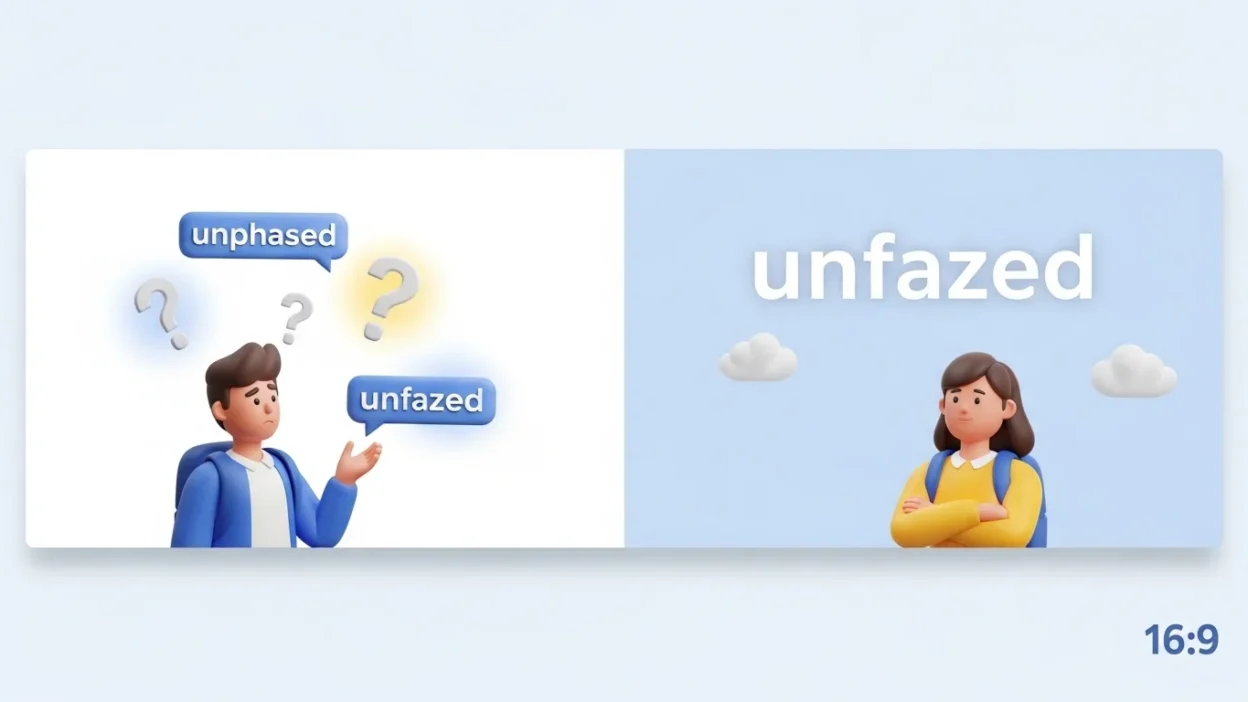
Many learners feel confused when they see “unphased” and “unfazed.”
At first glance, these two words look very similar. They sound similar too. Because of this, people often think both are correct or have the same meaning.
But here is the truth: only one of them is correct in most everyday English.
This article will explain everything in a very simple way so you can understand it clearly on your first read.
Quick Answer
- ✅ Unfazed = correct word
→ Meaning: calm, not surprised, not worried - ❌ Unphased = usually incorrect
→ Often a spelling mistake of “unfazed” - 👉 Use “unfazed” when talking about staying calm or not reacting
Simple Origin and Background
To understand the difference, it helps to look at where the words come from.
Unfazed
- Comes from the word “faze”
- “Faze” means: to disturb, surprise, or upset someone
- So, unfazed means: not disturbed or not upset
Example:
- “The loud noise didn’t faze her.”
- “She was unfazed by the noise.”
Unphased
- Comes from the word “phase”
- “Phase” means: a stage or step in a process
Example:
- “This is just a phase in life.”
👉 Because of this meaning, “unphased” does NOT mean calm or relaxed.
That is why using it instead of “unfazed” is usually wrong.
Clear Explanation of the Difference
Let’s break it down in the easiest way:
1. Meaning
- Unfazed → not affected emotionally
- Unphased → not in a phase (rare and not commonly used this way)
2. Usage
- Unfazed → used in daily speaking and writing
- Unphased → almost never used in this context
3. Common Reality
In real life:
- When people write “unphased,” they usually mean “unfazed”
- It is simply a spelling mistake
Comparison Table
| Feature | Unfazed ✅ | Unphased ❌ |
| Correct word | Yes | Usually no |
| Meaning | Calm, not disturbed | Not related to emotions |
| Common use | Very common | Rare / incorrect usage |
| Root word | Faze (to disturb) | Phase (a stage) |
| Example | “She stayed unfazed.” | (Usually incorrect) |
Which One to Use and When
Always Use “Unfazed” When:
You want to show someone is:
- Calm
- Not scared
- Not surprised
- Not affected by something
Examples:
- “He was unfazed by the criticism.”
- “She stayed unfazed during the exam.”
- “They were unfazed by the bad news.”
Do NOT Use “Unphased” in These Cases
Wrong:
- “She was unphased by the noise.” ❌
Correct:
- “She was unfazed by the noise.” ✅
Rare Case for “Unphased”
Technically, “unphased” could mean:
- “Not divided into phases”
But this is:
- Very rare
- Not used in daily English
- Not useful for beginners
👉 So, for learning purposes: avoid “unphased.”
Common Mistakes People Make
Here are mistakes many learners (and even native speakers) make:
1. Spelling mistake
- Writing “unphased” instead of “unfazed”
2. Confusing sound
- Both words sound similar, so people mix them up
3. Thinking both are correct
- Only “unfazed” is correct for emotional meaning
4. Using “phase” meaning wrongly
- “Phase” has nothing to do with emotions
Everyday Real Life Examples
Let’s see how “unfazed” is used in real life.
1. In Emails
- “Despite the delay, the team remained unfazed.”
- “She was unfazed by the sudden changes.”
2. In News
- “The player remained unfazed under pressure.”
- “The leader appeared unfazed by the criticism.”
3. On Social Media
- “Haters can’t stop me. I’m unfazed.”
- “She stayed unfazed even after all the comments.”
4. In Daily Conversation
- “You don’t look worried at all!”
- “Yeah, I’m unfazed.”
5. In School or Exams
- “He was unfazed during the test.”
- “She stayed unfazed even when time was running out.”
Learning Section for Students and Beginners
Here is a simple trick to remember forever:
Memory Trick
- Fazed → Fear
- Unfazed → No fear
👉 Both “fazed” and “fear” start with F
So:
- If there is no fear, use unfazed
Practice Sentences
Fill in the blank:
- She was ______ by the loud noise.
- He remained ______ during the interview.
- They were ______ by the unexpected result.
Answers:
- unfazed
- unfazed
- unfazed
Simple Rule
👉 If you are talking about emotions → use unfazed
FAQ Section
1. Is “unphased” a real word?
Yes, but it is very rare and not used to describe emotions. Most of the time, it is a mistake.
2. Which is correct: unphased or unfazed?
Unfazed is correct for almost all situations.
3. Why do people write “unphased”?
Because it sounds similar to “unfazed,” so people confuse the spelling.
4. What does “unfazed” mean?
It means:
- Not worried
- Not surprised
- Calm and relaxed
5. Can I use “unphased” in formal writing?
No. It is best to avoid it unless you are using it in its rare, technical meaning.
6. Is “unfazed” formal or informal?
It can be used in both:
- Formal writing (news, essays)
- Informal speech (daily conversation)
7. How can I remember the correct word?
Think:
- F = Fear
- Unfazed = No fear
8. Is this mistake common?
Yes, very common even among native speakers.
Conclusion
The confusion between “unphased” and “unfazed” is very common, but the solution is simple.
- Unfazed is the correct word
- It means staying calm and not being affected
- Unphased is usually just a spelling mistake
If you remember one thing, remember this:
👉 When talking about emotions, always use “unfazed.”
With this simple rule, you will never make this mistake again.

Anthony Charles is the founder and lead content creator at Meanefy.com, a platform dedicated to exploring word meanings, language nuances, and everyday curiosities. With a passion for language and a keen eye for detail, Anthony aims to make complex words and concepts simple and accessible for readers around the world.