Many students, learners and even native English speakers get confused between useable and usable.
Both words look similar and sound almost the same, so it’s easy to make mistakes. This guide will explain the difference in the simplest way possible, so you can understand it on the first read.
- Both words come from the verb “use”, so they seem very similar.
- The spelling difference is small: useable has an extra “e” before “able.”
- Some English dictionaries accept useable, but usable is much more common in everyday English.
- Because of this, many people are unsure which one to write.
By the end of this article, you will know exactly when to use usable and why useable is rarely needed.
Quick Answer
Here’s the simple version:
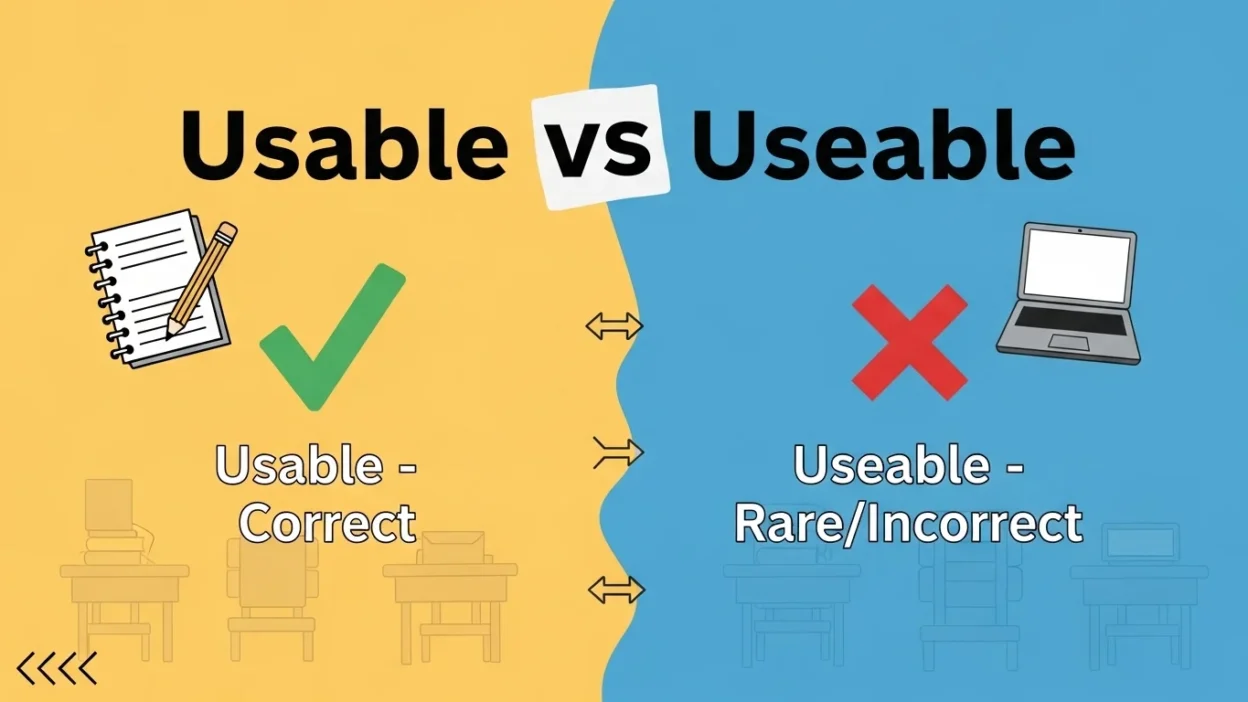
- Usable ✅ – Correct and most common. Use this in almost all situations.
- Useable ⚠️ – Rarely used. Sometimes accepted, but not standard.
Rule of thumb: If you are writing for school, work, emails, or social media, always use usable.
A Simple Background
Both words come from the verb “use”, which means to do something with an object or idea.
- When we add -able to a verb, it usually means “can be used.”
- For example:
- Read → readable (can be read)
- Understand → understandable (can be understood)
- Use → usable (can be used)
- For example:
- The form useable adds an extra “e” to keep the “e” from “use,” but English spelling rules usually drop that extra “e” before -able.
That is why usable is the standard spelling today.
Clear Explanation of the Difference
- Usable
- Means: Something can be used easily.
- Example: “This tool is usable for beginners.”
- Useable
- Means: Same as usable, but rarely written.
- Example: “The old printer is useable.” (Possible but unusual)
Important: Most native speakers and writers only use usable. Using useable may look like a spelling mistake.
Comparison Table
| Feature | Usable | Useable |
| Correctness | ✅ Correct and standard | ⚠️ Rare, nonstandard |
| Frequency | Very common | Very rare |
| Meaning | Can be used | Can be used |
| Example sentence | “This app is usable on any phone.” | “This app is useable on any phone.” (less common) |
| Recommended use | Always | Only in special cases |
Which One to Use and When
- Always use “usable” for:
- Homework and school essays
- Emails and letters
- Social media posts
- News articles or any formal writing
- Avoid “useable” unless:
- You are quoting old texts or dictionaries that use it
- You want to show that it is rarely used
Simple rule: If you’re unsure, write usable.
Common Mistakes People Make
- Writing useable in school essays → teacher may mark it wrong.
- Mixing it with other “-able” words incorrectly → e.g., writeable instead of writable.
- Thinking “useable” is the British spelling → it is not. Both British and American English prefer usable.
- Using usable for adjectives that are not about “use” → e.g., “This idea is useable” is okay, but “This idea is understandable” is better English.
Everyday Real Life Examples
Emails:
- Correct: “Please make sure the new template is usable for all staff.”
- Incorrect: “Please make sure the new template is useable for all staff.”
News Headlines:
- “The park is now usable after repairs.”
Social Media:
- “This filter is so usable on TikTok!”
Daily Life:
- “The coffee machine is old but still usable.”
- “Make the website more usable for mobile users.”
Notice how usable fits naturally in all these examples.
Learning Section for Students and Beginners
Tip 1: Remember the short rule:
- Usable = can be used
- Think: usable has only one “e” → simpler, correct.
Tip 2: Read simple English texts and notice spelling:
- Newspapers, school books, emails
Tip 3: Practice with sentences:
- “This bag is ___.” → usable ✅
- “The app is ___ on my phone.” → usable ✅
Tip 4: Don’t overthink. If you’re writing “can be used,” just write usable.
FAQ: Simple Questions and Answers
- Is “useable” wrong?
- Not exactly wrong, but it is rare. Usable is preferred.
- Can I use “useable” in exams?
- It’s safer to write usable. Teachers may see useable as a mistake.
- Do Americans and British English use different spellings?
- No, both use usable.
- What does “usable” mean?
- Something that can be used easily.
- Can I use “usable” for ideas or websites?
- Yes. Example: “This website is very usable.”
- Is there a pronunciation difference?
- Almost none. Both sound like /ˈjuːzəbl/.
- Are there other “-able” words with a silent “e”?
- Yes. Examples:
- Write → writable
- Notice → noticeable
- Yes. Examples:
- Why not keep the extra “e” in useable?
- English drops the “e” before -able for simplicity.
Conclusion
To remove all confusion:
- Use usable for everything. It is correct, simple, and standard.
- Useable is rarely needed and may look like a spelling mistake.
- Remember the rule: “-able” words usually drop the “e” from the verb.
- Practice with daily sentences, emails, and reading to see usable in action.
Now you can confidently write usable and never worry about useable again.

Daniel Matthew is a language enthusiast, writer, and contributor at Meanefy.com, where he explores the meanings, origins, and nuances of words and phrases. With a deep passion for language, Daniel aims to make complex concepts simple, engaging, and easy to understand for readers of all ages.