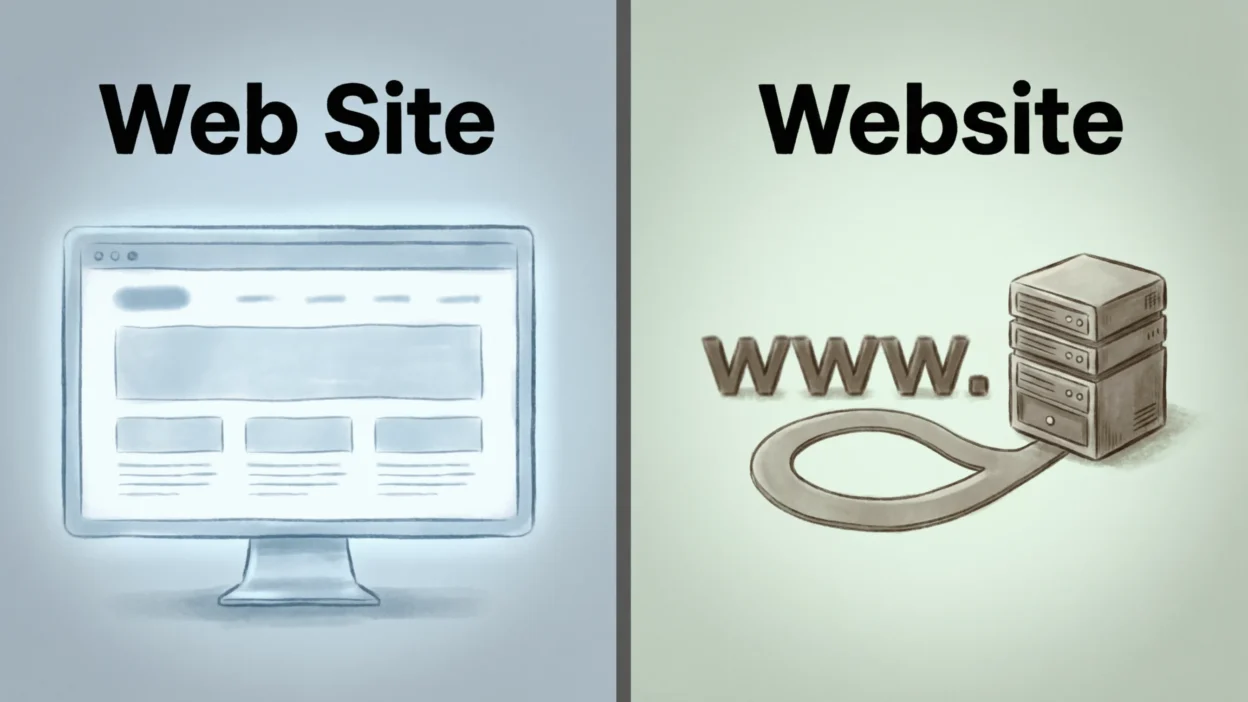
Many people feel confused about this question: Should we write “web site” or “website”?
You may see both forms in books, homework, emails, or online posts. One has a hyphen. The other does not. So which one is correct?
If you are a student, an learner, or someone who just wants clear English, this guide will help you understand the difference in very simple words.
By the end, you will feel confident and calm about using the correct form.
Why Do People Get Confused?
English changes over time. Words grow and change their spelling. Sometimes two words join together. Sometimes a hyphen is used. Later, the hyphen disappears.
That is exactly what happened with web site and website.
Many learners see both spellings and think they are different words. But they are not. Let’s make everything clear step by step.
Quick Answer
Here is the simple answer:
- ✅ Website (one word, no hyphen) is correct in modern English.
- ❌ Web site (with a hyphen) is old-fashioned and rarely used today.
- In school, exams, emails, and professional writing, use website.
- If you see web site, it is not wrong, but it is outdated.
If you remember only one thing, remember this:
Today, we write website, not web-site.
Simple Background: How the Word Started
To understand this better, let’s look at how the word was created.
The word website comes from two words:
- web – short for “World Wide Web”
- site – a place
In the early days of the internet, people wrote the words separately:
- web site
Then, they started joining them with a hyphen:
- web-site
After some years, English changed again. The two words became one word:
- website
This is very common in English. For example:
- e-mail → email
- on-line → online
Over time, people stop using the hyphen.
Clear Explanation of the Difference
Now let’s explain the difference in very simple words.
1. Website (Correct Modern Form)
- One word
- No hyphen
- Used in books, schools, newspapers, and daily writing
- Accepted everywhere today
Example:
- I made a website for my school project.
- This website has useful information.
This is the standard spelling now.
2. Web site (Old Form)
- Has a hyphen
- Used many years ago
- Rare in modern writing
- Looks old-fashioned
Example:
- This web-site contains many articles.
You might see this in very old books or old documents. But it is not common today.
Easy Comparison Table
Here is a simple table to help you see the difference quickly:
| Feature | Website | Web-site |
| Number of words | One | One (with hyphen) |
| Hyphen | No | Yes |
| Modern spelling | Yes | No |
| Common today | Very common | Very rare |
| Recommended for students | Yes | No |
The table makes it clear: website is the correct choice today.
Which One Should You Use?
The answer is simple:
Always use website.
Use it in:
- School essays
- Homework
- Exams
- Emails
- Job applications
- Social media posts
- Daily writing
There is almost no reason to use web site in 2026.
If your teacher checks your spelling, they will expect you to write website.
Common Mistakes People Make
Even though the rule is simple, some mistakes still happen.
1. Using a hyphen by habit
Some people think:
“It has two parts, so I must use a hyphen.”
This is not true anymore. English has already changed.
Wrong:
- Please visit our web site.
Correct:
- Please visit our website.
2. Writing it as two words
Some learners write:
- web site
This is also old style.
Correct modern spelling:
- website
3. Capitalizing both letters
Some people write:
- WebSite
- Web Site
This is not correct.
Correct:
- website
Only use a capital letter at the start of a sentence.
Example:
- This website is very helpful.
Everyday Real Life Examples
Let’s see how we use website in daily life.
1. In Emails
- Please check the website for more details.
- I found this information on your website.
2. In News Articles
- The company launched a new website.
- The website crashed because many people visited it.
3. On Social Media
- My website is finally ready!
- I shared my art on my website.
4. In School
- Our teacher asked us to create a website.
- I used a website to research my topic.
In all these cases, we use website no hyphen.
Short Learning Section for Students and Beginners
Here is a small learning guide to help you remember:
Step 1: Break the word
- web + site
Step 2: Join them
- website
Step 3: Practice writing
Write these sentences:
- I built a website.
- This website is easy to use.
- The website has many photos.
If you practice writing it correctly, your brain will remember the modern spelling.
Memory Trick
Think about these words:
- email (not e-mail)
- online (not on-line)
- website (not web-site)
English likes to remove hyphens over time.
FAQ Section
Here are common questions students ask.
1. Is “website” wrong?
It is not completely wrong, but it is old-fashioned. Today, we use website.
2. Is “web site” correct?
In very old writing, yes. But in modern English, we write website as one word.
3. Why did English remove the hyphen?
English changes over time. When two words become very common together, they often join into one word.
4. Should I use “Website” with a capital W?
Only at the beginning of a sentence.
Correct:
- This website is helpful.
Correct:
- Website design is interesting.
5. What about plural form?
The plural form is:
- websites
Example:
- I visited three websites today.
No hyphen in the plural form.
6. Do teachers prefer “website”?
Yes. In modern English classes, website is the correct spelling.
7. Is it different in British and American English?
No. Both use website today.
8. Will “web site” come back in the future?
Very unlikely. English has already accepted website as the normal spelling.
Conclusion
Now the confusion is gone.
Let’s repeat the main point clearly:
- Website is the correct modern spelling.
- Web site is old and rarely used.
- Always write website in school, exams, and daily life.
English changes with time. Many words lose their hyphen and become one word. “Website” is one of them.
If you remember only one rule from this article, remember this:
In 2026 and beyond, the correct spelling is website.
Now you can write with confidence and no confusion.

Anthony Charles is the founder and lead content creator at Meanefy.com, a platform dedicated to exploring word meanings, language nuances, and everyday curiosities. With a passion for language and a keen eye for detail, Anthony aims to make complex words and concepts simple and accessible for readers around the world.