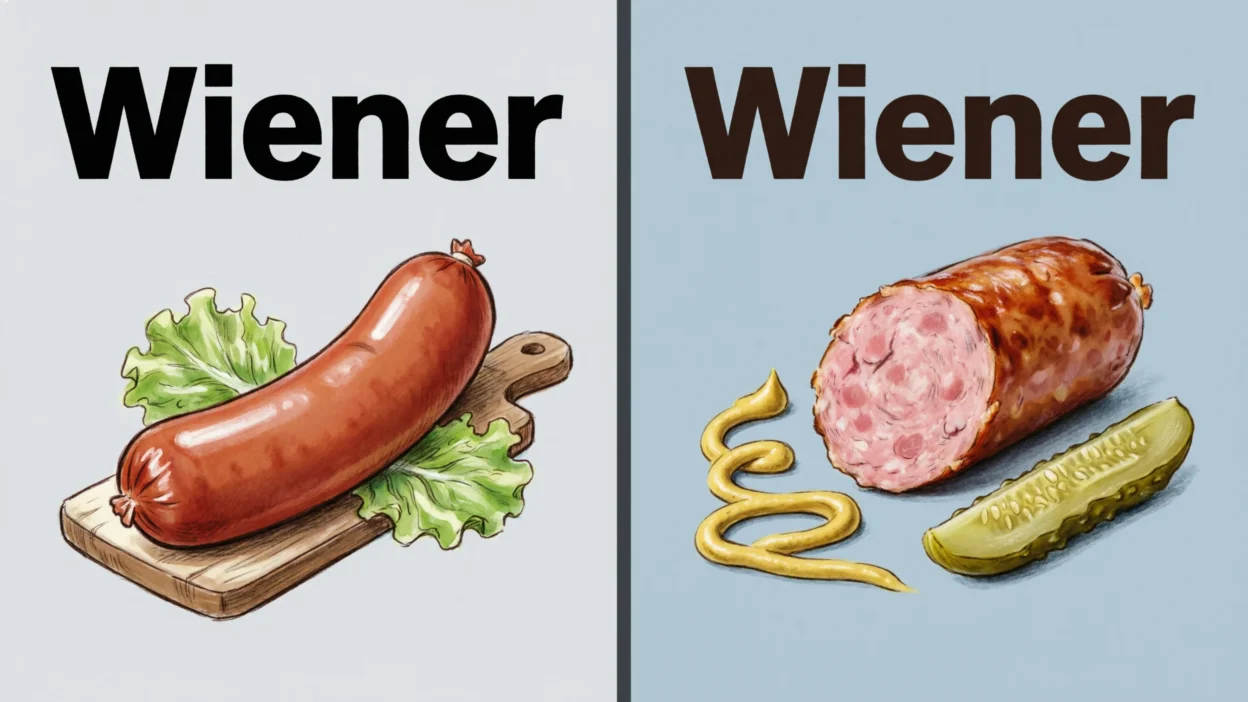
Many people feel confused when they see the words weiner and wiener. They look almost the same. The only difference is the position of the letters “e” and “i.”
But even though they look similar, they do not always mean the same thing. Sometimes they refer to food. Sometimes they refer to a person’s last name. And sometimes one spelling is simply a mistake.
If you are a student, an learner, or just someone who wants clear English, this guide will help you understand everything in a very simple way.
Let’s make it easy.
Quick Answer
Here is the short and simple explanation:
- Wiener is the correct spelling for:
- A type of sausage (like a hot dog)
- Something related to Vienna, Austria
- A person’s last name (for example, someone named Wiener)
- Weiner:
- Is often a spelling mistake of wiener
- Can also be a real last name (for example, someone named Weiner)
👉 When talking about food, “wiener” is usually correct.
Simple Background: Where Do These Words Come From?
The word wiener comes from the city of Vienna in Austria.
In German, Vienna is called Wien (pronounced “veen”).
So:
- Wien = Vienna
- Wiener = “from Vienna”
A long time ago, a sausage from Vienna became popular. People called it a “Wiener sausage.” Later, in English-speaking countries, it became known as a wiener, which is another word for a hot dog.
Over time, many people started spelling it as weiner by mistake. The letters “ie” and “ei” often confuse English learners.
Remember this helpful tip:
In many English words, “i” comes before “e” after certain sounds — so wiener is spelled with “ie.”
The Clear Difference Between Weiner and Wiener
Let’s explain it in the simplest way possible.
1. Meaning
- Wiener usually means:
- A sausage (hot dog)
- Something from Vienna
- A family name
- Weiner:
- Is usually a spelling error
- Can also be a family name
2. Usage
If you are writing about food, especially hot dogs, the correct spelling is almost always:
✅ Wiener
If you are writing a person’s name, check how they spell it. Some families spell it Wiener, and others spell it Weiner.
For example:
- Anthony Weiner (spelled W-e-i-n-e-r)
This shows that Weiner can be correct — but only for names.
Easy Comparison Table
| Feature | Wiener | Weiner |
| Correct spelling for hot dog? | ✅ Yes | ❌ No (usually wrong) |
| Comes from Vienna? | ✅ Yes | ❌ No |
| Can be a last name? | ✅ Yes | ✅ Yes |
| Common spelling mistake? | ❌ No | ✅ Yes |
| Used in dictionaries for sausage? | ✅ Yes | ❌ No |
This table helps you see the difference quickly.
Which One Should You Use?
Here is a simple rule you can follow.
Use Wiener when:
- Talking about a hot dog
- “I ate a wiener at the baseball game.”
- Talking about something from Vienna
- “Wiener music comes from Vienna.”
- Writing the name of someone who spells it that way
Use Weiner when:
- Writing someone’s last name and it is spelled that way
- “Mr. Weiner sent an email.”
If you are not talking about a person’s name, and you mean the sausage, use:
👉 Wiener
Common Mistakes People Make
Let’s look at mistakes learners often make.
1. Switching the letters
Many people write:
❌ weiner dog
✅ wiener dog
The correct spelling for the sausage (and for the dog breed nickname) is wiener.
2. Thinking both are always correct
Some people believe both spellings are equal. That is not true.
- For food → Wiener
- For a person’s name → depends on their spelling
3. Not checking names carefully
If you are writing about a real person, always check how they spell their name.
For example:
- Anthony Weiner uses “ei”
- Other families may use “ie”
Names are personal. Always copy them exactly.
Everyday Real Life Examples
Let’s see how this works in daily life.
In an Email
Correct:
“Please buy 10 wieners for the party.”
Wrong:
“Please buy 10 weiners for the party.”
On Social Media
Correct:
“Nothing is better than a grilled wiener in summer!”
In News Writing
Correct:
“The festival served traditional Viennese food, including wieners.”
If the article talks about a person:
“Mr. Weiner spoke at the event.”
At School
Teacher says:
“Remember, wiener is spelled W-I-E-N-E-R.”
Students often mix up the letters. This is very common.
A Short Learning Section for Students and Beginners
Here is an easy way to remember the difference.
Memory Trick
Think of Vienna.
- Vienna → Wien → Wiener
- Wiener → sausage
Both Vienna and Wiener have “ie.”
This can help you remember the correct spelling.
Simple Practice
Fill in the blank:
- I ate a ______ at lunch.
- Mr. ______ is our new teacher.
Answers:
- wiener
- (Depends on the teacher’s name — could be Wiener or Weiner)
Pronunciation Help
Both words are usually pronounced the same way in English:
/WEE-ner/
That is another reason people get confused. They sound the same, but they are spelled differently.
FAQ Section
1. Is “weiner” always wrong?
No. It is correct if it is someone’s last name. But for food, it is usually wrong.
2. Is “wiener” the correct spelling for hot dog?
Yes. “Wiener” is the standard spelling for the sausage.
3. Why do people spell it as “weiner”?
Because the letters “ie” and “ei” are confusing in English. The words sound the same, so people guess the spelling.
4. Do both words sound the same?
Yes. They are usually pronounced the same in English.
5. Does “wiener” only mean sausage?
Mostly yes. It can also mean “from Vienna,” but in everyday English, it usually means a type of sausage.
6. Is it connected to Vienna?
Yes. The word “wiener” comes from Vienna in Austria.
7. What about “wiener dog”?
“Wiener dog” is a nickname for the dachshund dog because it looks long like a sausage. The spelling is wiener, not weiner.
8. Should I worry too much about this?
No. Just remember one simple rule:
- Food → Wiener
- Name → Check the spelling
That’s enough.
Conclusion
The confusion between weiner and wiener happens because the words look almost the same and sound exactly the same.
But the difference is simple:
- Wiener is the correct spelling for a sausage and something related to Vienna.
- Weiner is usually a spelling mistake — except when it is someone’s last name.
If you remember that wiener comes from Vienna, you will not forget the correct spelling.
Now you can write the word with confidence and never feel confused again.

Daniel Matthew is a language enthusiast, writer, and contributor at Meanefy.com, where he explores the meanings, origins, and nuances of words and phrases. With a deep passion for language, Daniel aims to make complex concepts simple, engaging, and easy to understand for readers of all ages.