Many students and English learners feel confused when they see “whos” and “whose.” They look very similar, and when we speak, they sound almost the same. Because of this, many people are not sure which one is correct.
The good news is that the difference is actually very simple. Once you understand how each word works, you will be able to choose the correct one easily.
This guide explains everything in very clear and simple English so you can understand it the first time you read it.
Quick Answer
Here is the short and simple answer:
- Whose → shows possession (ownership)
- Whos → not a correct word in standard English
- If you want to say “who is” or “who has,” you should write who’s with an apostrophe.
Examples:
- Whose bag is this?
- Who’s coming to the meeting?
Important reminder:
- Whose = possession
- Who’s = who is / who has
- Whos = incorrect spelling
Where the Words Come From
To understand the difference better, it helps to know how the words developed.
Whose
The word whose has been used in English for many hundreds of years. It comes from the word who, and it is used to ask about ownership or belonging.
For example:
- Whose phone is ringing?
- Whose idea was this?
Here, we are asking which person owns something.
Who’s
The word who’s is a short form (contraction). It combines two words:
- who + is = who’s
- who + has = who’s
Examples:
- Who’s at the door? (Who is at the door?)
- Who’s finished the homework? (Who has finished the homework?)
Whos
The word whos without an apostrophe is not correct English. It usually appears because someone forgets the apostrophe in who’s.
The Main Difference Explained Simply
Let’s make the difference very clear.
Whose
Use whose when talking about ownership.
It answers questions like:
- Who owns this?
- Who does this belong to?
Examples:
- Whose jacket is on the chair?
- Whose dog is barking outside?
- Whose car is parked here?
In each sentence, we are asking who the owner is.
Who’s
Use who’s when you mean:
- who is
- who has
Examples:
- Who’s ready for lunch?
- Who’s your teacher this year?
- Who’s seen my notebook?
You can test it by replacing who’s with who is or who has.
Example:
- Who’s coming tonight?
- Who is coming tonight? ✔
If the sentence still makes sense, who’s is correct.
Quick Comparison Table
| Word | Meaning | Usage | Example |
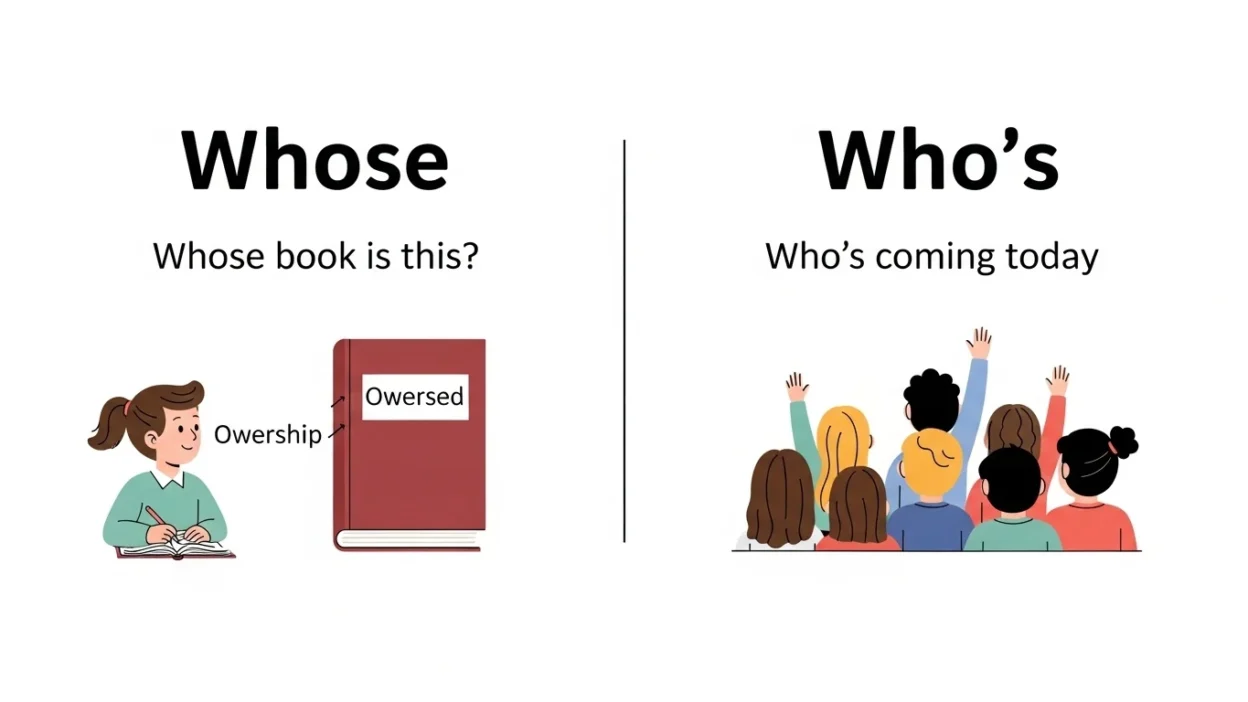
| Whose | Shows possession | Ask who owns something | Whose book is this? |
| Who’s | Short form of “who is” or “who has” | Used in statements or questions | Who’s coming today? |
| Whos | Incorrect spelling | Should not be used | ❌ Whos car is this? |
Which One Should You Use?
Use this simple guide to choose the right word.
Use whose when talking about ownership
Examples:
- Whose phone is on the table?
- Whose house is that?
- Whose idea was this project?
Think of it like this:
Whose = belonging to someone
Use who’s when you mean “who is” or “who has”
Examples:
- Who’s your favorite teacher?
- Who’s coming to the party?
- Who’s finished the assignment?
Quick trick:
If you can replace the word with who is, then who’s is correct.
Common Mistakes People Make
Many learners make the same mistakes. Here are the most common ones.
Mistake 1: Writing “whos”
Example:
❌ Whos bag is this?
✔ Whose bag is this?
Remember: whos is not a real word in standard English.
Mistake 2: Using “who’s” for possession
Example:
❌ Who’s book is this?
✔ Whose book is this?
Because the sentence asks about ownership, we must use whose.
Mistake 3: Forgetting the apostrophe
Example:
❌ Whos coming to the meeting?
✔ Who’s coming to the meeting?
Without the apostrophe, the word is incorrect.
Everyday Real Life Examples
Let’s look at how these words appear in real situations.
In Emails
Correct:
- Whose report is attached to this email?
- Who’s responsible for sending the files?
In School
Students often ask:
- Whose notebook is this?
- Who’s the class monitor today?
Teachers might say:
- Whose homework is missing?
- Who’s ready to present?
On Social Media
You may see posts like:
- Who’s watching the game tonight?
- Whose photo is this?
Incorrect posts sometimes appear too:
- ❌ Whos watching the game?
In Daily Conversations
People often ask questions like:
- Whose phone is ringing?
- Who’s at the door?
- Whose turn is it?
- Who’s driving today?
These examples show how often these words appear in everyday life.
A Simple Learning Trick for Students
Here is a helpful trick that many students use.
The “who is” test
When you see who’s, try replacing it with who is.
Example:
Sentence:
Who’s calling me?
Test:
Who is calling me?
If the sentence still works, who’s is correct.
The “ownership” test
If the sentence talks about belonging, use whose.
Example:
Sentence:
Whose backpack is on the floor?
The question asks about ownership, so whose is correct.
Quick Memory Tip
You can remember it like this:
- Whose → owner
- Who’s → who is
Even though the spelling is different, this simple idea helps many learners.
Practice Sentences
Try to choose the correct word.
- ______ jacket is on the chair?
- ______ coming to the meeting?
- ______ idea was this plan?
- ______ finished the homework?
Answers:
- Whose
- Who’s
- Whose
- Who’s
Practicing like this helps you remember the difference.
Frequently Asked Questions (FAQ)
1. Is “whos” a real word?
No. Whos is not correct in standard English. It is usually a spelling mistake for who’s.
2. What does “whose” mean?
Whose is used to ask about ownership or belonging.
Example:
Whose laptop is this?
3. What does “who’s” mean?
Who’s is a short form of:
- who is
- who has
Example:
Who’s coming to the meeting?
4. How can I quickly check if “who’s” is correct?
Replace it with who is.
Example:
Who’s at the door?
Who is at the door?
If it still makes sense, the word is correct.
5. Can “whose” be used in statements?
Yes, not only in questions.
Example:
- I met a student whose father is a doctor.
6. Why do people confuse these words?
They sound almost the same when spoken. Because of this, many writers mix them up when typing.
7. Is this mistake common for native speakers?
Yes. Even native English speakers sometimes confuse whose and who’s.
8. Which word is used more often?
Both are common. Whose appears often in questions about ownership, while who’s appears when people shorten who is.
Conclusion
The difference between whos and whose becomes very simple once you understand the basic rule.
Remember these key points:
- Whose is used for possession or ownership.
- Who’s is a short form of who is or who has.
- Whos without an apostrophe is incorrect.
A quick way to check your sentence is to use the “who is” test. If the sentence works with who is, then who’s is the correct choice. If you are asking about ownership, then you should use whose.
With a little practice, this small grammar problem becomes very easy to solve. Soon, choosing the correct word will feel natural whenever you write or speak in English.

Steven Mark is a writer, researcher, and contributor at Meanefy.com, a platform dedicated to exploring word meanings, language nuances, and everyday linguistic curiosities. With a passion for words and clear communication, Steven focuses on making language simple, engaging, and accessible to all readers.