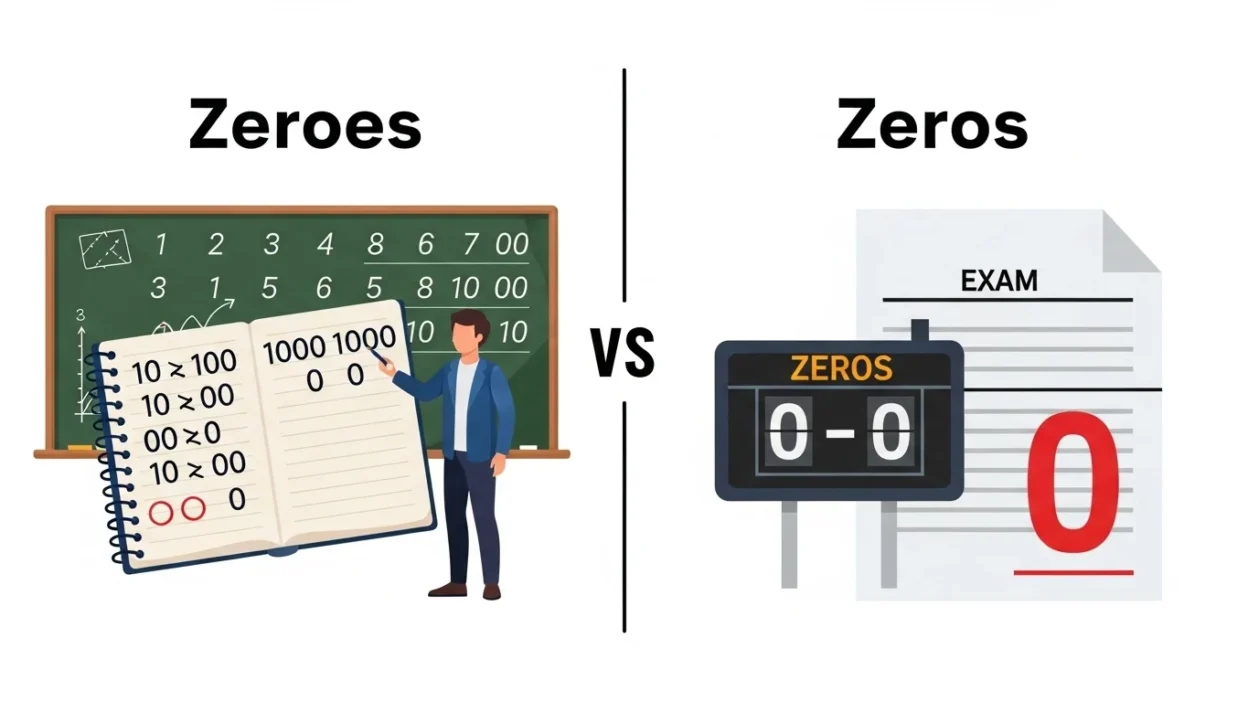
Many people feel unsure when writing the plural of zero. Should it be zeros or zeroes?
You may see both spellings in books, newspapers, school work, and online posts. Because both forms exist, learners often wonder which one is correct and which one is wrong.
The good news is that this confusion is easy to solve.
In this guide, you will learn the difference between zeroes and zeros in very simple English. By the end, you will know when to use each one and how to avoid common mistakes.
Quick Answer
Here is the simple answer first.
- Zeros – the most common modern spelling
- Zeroes – an older spelling that is still sometimes used
- Both forms are correct, but zeros is usually preferred today
In most situations, especially in school writing, zeros is the safer and simpler choice.
Example:
- The number 1000 has three zeros. ✔
- The number 1000 has three zeroes. ✔ (less common)
The Simple Origin of the Word
To understand the spelling, it helps to know a little about the word zero.
The word zero came into English many centuries ago. It originally came from Arabic and then moved through other languages before reaching English.
Over time, English speakers created plural forms in different ways. Some words ending in -o form plurals by adding:
- -s
- -es
Because of this pattern, people began writing:
- zeros
- zeroes
Both forms developed naturally in English.
Today, modern writing usually prefers the simpler form with -s.
The Main Difference Between Zeroes and Zeros
The truth is that the meaning is exactly the same.
Both words mean:
- more than one zero
- the plural form of zero
Example meanings:
- Several 0 digits
- A score of nothing
- Empty results
So the difference is not about meaning.
The difference is mainly about spelling style and modern usage.
Zeros (Modern and Common)
Most modern writing uses zeros.
It is shorter and simpler.
You will often see zeros in:
- school textbooks
- math writing
- newspapers
- everyday English
Example:
- The code contains four zeros.
Zeroes (Older Style)
The spelling zeroes is older and less common today.
It still appears sometimes, especially in:
- older books
- some formal writing
- certain style preferences
Example:
- The number ends with two zeroes.
Again, the meaning stays the same.
Quick Comparison Table
| Feature | Zeros | Zeroes |
| Meaning | plural of zero | plural of zero |
| Correct spelling | Yes | Yes |
| Modern usage | Very common | Less common |
| Preferred in school writing | Yes | Usually no |
| Length | Shorter | Longer |
| Best choice for learners | Recommended | Optional |
Summary:
Both are correct, but zeros is more widely used today.
Which One Should You Use?
If you want a simple rule, follow this one:
Use zeros in most situations.
This includes:
- school writing
- math work
- essays
- emails
- everyday communication
Example:
- The number 10,000 has four zeros.
- I accidentally added two extra zeros.
When might someone use zeroes?
Some writers prefer zeroes because many English words ending in -o add -es.
Examples:
- hero → heroes
- potato → potatoes
- tomato → tomatoes
Because of this pattern, some people also write zero → zeroes.
However, modern usage still favors zeros.
Common Mistakes People Make
Here are some mistakes learners often make.
1. Thinking One Is Wrong
Some students believe:
- zeros = correct
- zeroes = wrong
This is not true.
Both spellings are correct.
2. Using an Apostrophe
A common mistake is writing:
- zero’s ❌
- zero’s in the number ❌
The apostrophe is not needed for plurals.
Correct:
- zeros ✔
- zeroes ✔
Example:
❌ The number has three zero’s.
✔ The number has three zeros.
3. Mixing Spellings in One Text
Another mistake is switching between the two.
Example:
❌ The number has two zeros and three zeroes.
It is better to choose one style and stay consistent.
Everyday Real Life Examples
Let’s look at how these words appear in daily life.
In Emails
- Please remove the extra zeros from the price.
- The account number ends with two zeros.
In News or Reports
- The company added three zeros to its sales number this year.
- The final score had two zeros on the board.
In Social Media
- I accidentally typed too many zeros in the amount!
- My bank balance has too many zeros after the decimal.
In School and Math
- Write the number with four zeros.
- The answer should not include extra zeros.
Even in casual writing, zeros is the form you will see most often.
Learning Tip for Students and Beginners
If you are learning English, here is the easiest rule to remember.
Simple Memory Rule
Use zeros.
Why?
- It is shorter
- It is more common
- It is widely accepted
Teachers, textbooks, and modern writing usually prefer zeros.
So if you are unsure, zeros is the safest choice.
FAQ (Frequently Asked Questions)
1. Is it zeros or zeroes?
Both spellings are correct. However, zeros is more common in modern English.
2. Which spelling should students use?
Students should usually use zeros because it is simpler and widely accepted in modern writing.
3. Do zeros and zeroes have different meanings?
No. They mean exactly the same thing. Both are plural forms of zero.
4. Is “zero’s” correct?
No. The apostrophe should not be used when making the plural of zero.
Correct forms:
- zeros
- zeroes
5. Why do some people write zeroes?
Some writers follow the pattern of words ending in -o that add -es for the plural.
Examples:
- hero → heroes
- tomato → tomatoes
So they write zero → zeroes.
6. Which spelling appears more in modern writing?
Today, zeros appears more often in books, school writing, and everyday English.
7. Can I use zeroes in formal writing?
Yes, it is still considered correct. However, many modern writers prefer zeros.
8. Do math teachers prefer zeros?
In most cases, yes. Math books and teachers usually use zeros.
Conclusion
The confusion between zeroes and zeros is very common, especially for students and English learners.
Here is the key idea to remember:
- Both spellings are correct.
- Zeros is the modern and more common form.
- Zeroes is an older spelling that still appears sometimes.
If you want the safest and simplest choice, just use zeros.
Once you remember this small rule, you will never feel confused about zeroes vs zeros again.

Daniel Matthew is a language enthusiast, writer, and contributor at Meanefy.com, where he explores the meanings, origins, and nuances of words and phrases. With a deep passion for language, Daniel aims to make complex concepts simple, engaging, and easy to understand for readers of all ages.