Many English learners feel confused about “further” and “farther.” Even native speakers sometimes mix them up.
The reason is simple: both words come from the idea of “far,” and both can talk about distance. Because of this, they look and sound very similar.
But don’t worry. Once you understand one small idea, the difference becomes easy. This guide will explain everything in very simple English so you can understand it on your first read.
Quick Answer (Simple and Clear)
Here is the easiest way to remember:
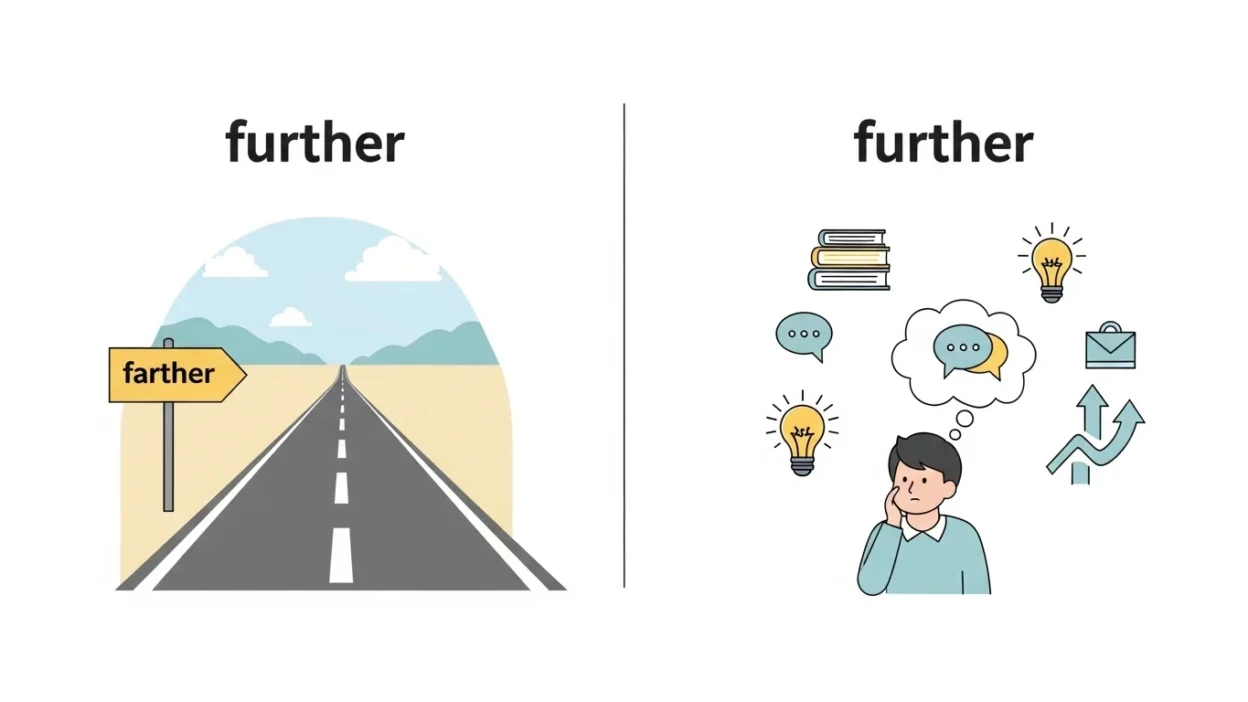
- Farther = physical distance (real space)
- Further = more or extra (ideas, time, or degree)
Quick examples:
- The school is farther down the road. ✅ (real distance)
- We need to discuss this further. ✅ (idea, not distance)
Simple Background: Where Do These Words Come From?
Both “further” and “farther” come from the word “far.”
In old English:
- “Farther” was used for real distance you can see or measure
- “Further” slowly became used for ideas, time, or extra amount
Over time, people started mixing them. Today, in casual English, some people use “further” for everything. But in correct and clear English, there is still a useful difference.
The Clear Difference (Very Easy Explanation)
Let’s break it down into one simple idea:
1. “Farther” = Distance You Can Measure
Use farther when you are talking about:
- Roads
- Places
- Physical movement
- Anything you can measure in meters, miles, or steps
👉 Think: Can I measure it?
If yes → use farther
Examples:
- The park is farther than the shop.
- He ran farther than me.
- The hotel is farther away than we thought.
2. “Further” = Not Physical (Ideas, Time, Amount)
Use further when you are talking about:
- Ideas
- Discussions
- Time
- Extra amount
👉 Think: Can I measure it with a ruler?
If no → use further
Examples:
- Let’s talk about this further.
- I need further information.
- We will continue this further tomorrow.
Comparison Table
| Feature | Farther | Further |
| Main use | Physical distance | Ideas, time, or extra amount |
| Can you measure it? | Yes | No |
| Example | The car is farther away | We need further discussion |
| Easy trick | Think “far” = distance | Think “more” or “extra” |
Which One Should You Use and When?
Here’s a simple guide you can follow every time:
Use farther when:
- You are talking about real places
- You can see or measure the distance
- You are comparing physical positions
Examples:
- My house is farther from school than yours.
- She walked farther than anyone else.
- The next village is farther down the road.
Use further when:
- You are talking about ideas or thoughts
- You want to say “more” or “extra”
- You are talking about time or progress
Examples:
- We need to study this topic further.
- For further details, contact us.
- Let’s not go further with this argument.
Helpful Tip
If you are not sure, you can often use “further” safely, especially in modern English. But for learning and exams, it is better to follow the correct rule.
Common Mistakes People Make
Let’s look at some mistakes and fix them:
❌ Mistake 1: Using “further” for physical distance
- Wrong: The shop is further down the street.
- Correct: The shop is farther down the street.
❌ Mistake 2: Using “farther” for ideas
- Wrong: We need to discuss this farther.
- Correct: We need to discuss this further.
❌ Mistake 3: Thinking they always mean the same
Some people believe both words are always equal. This is not true in formal or clear English.
❌ Mistake 4: Forgetting the “measure rule”
Always ask:
👉 Can I measure it?
This simple question will help you avoid most mistakes.
Everyday Real Life Examples
Let’s see how these words are used in daily life.
1. In Emails
- Please send me further details about the project.
- We cannot go further without your approval.
2. In News
- The investigation will continue further.
- The fire spread farther than expected.
3. On Social Media
- I don’t want to take this conversation any further.
- We walked farther than we planned today!
4. In Daily Conversation
- Can we drive farther to find a better place?
- Let’s not argue further.
5. In School
- The teacher asked us to research the topic further.
- He threw the ball farther than his friend.
Learning Section (For Students and Beginners)
Here is a simple way to practice:
Step 1: Ask yourself
- Is it a real distance? → use farther
- Is it an idea or more amount? → use further
Step 2: Try these sentences
Fill in the blanks:
- The river is ______ than I thought.
- We need ______ explanation.
- She ran ______ than her brother.
- Let’s discuss this ______ tomorrow.
Answers:
- farther
- further
- farther
- further
Step 3: Make your own sentences
Try writing:
- 2 sentences with “farther”
- 2 sentences with “further”
This will help you remember faster.
Frequently Asked Questions (FAQ)
1. Can I use “further” instead of “farther”?
Yes, in casual English people often do. But for correct and clear writing, it’s better to follow the rule.
2. Is “farther” only for distance?
Yes, mainly for physical distance you can measure.
3. Is “further” only for ideas?
Mostly yes. It is used for ideas, time, and extra amount.
4. Which one is more common?
“Further” is more common because it has more uses.
5. Can both be correct in one sentence?
Sometimes yes, but the meaning changes:
- He moved farther (distance)
- He moved further (could mean progress or idea)
6. How can I remember the difference easily?
Think:
- Farther → Far → Distance
- Further → More → Extra
7. Do native speakers always follow this rule?
Not always. Many mix them, especially in speaking. But in writing, the rule is still important.
8. Is it important for exams?
Yes. Many exams check this difference, so it’s good to learn it correctly.
Conclusion
The difference between “further” and “farther” is simple once you know the basic idea.
- Use farther for real, physical distance
- Use further for ideas, time, or extra amount
Always ask yourself one question:
👉 Can I measure it?
If yes → farther
If no → further
With a little practice, this will become natural for you. Keep using both words in your daily writing and speaking, and soon you won’t feel confused at all.

Steven Mark is a writer, researcher, and contributor at Meanefy.com, a platform dedicated to exploring word meanings, language nuances, and everyday linguistic curiosities. With a passion for words and clear communication, Steven focuses on making language simple, engaging, and accessible to all readers.