Many learners feel confused when they see “incase” and “in case.” They look almost the same, so it is easy to think they mean the same thing. But here is the problem: only one of them is correct in standard English.
This small difference can make your writing look clear and correct or confusing and wrong. Don’t worry. In this guide, you will learn the difference in a very simple way, with clear examples you can understand right away.
Quick Answer
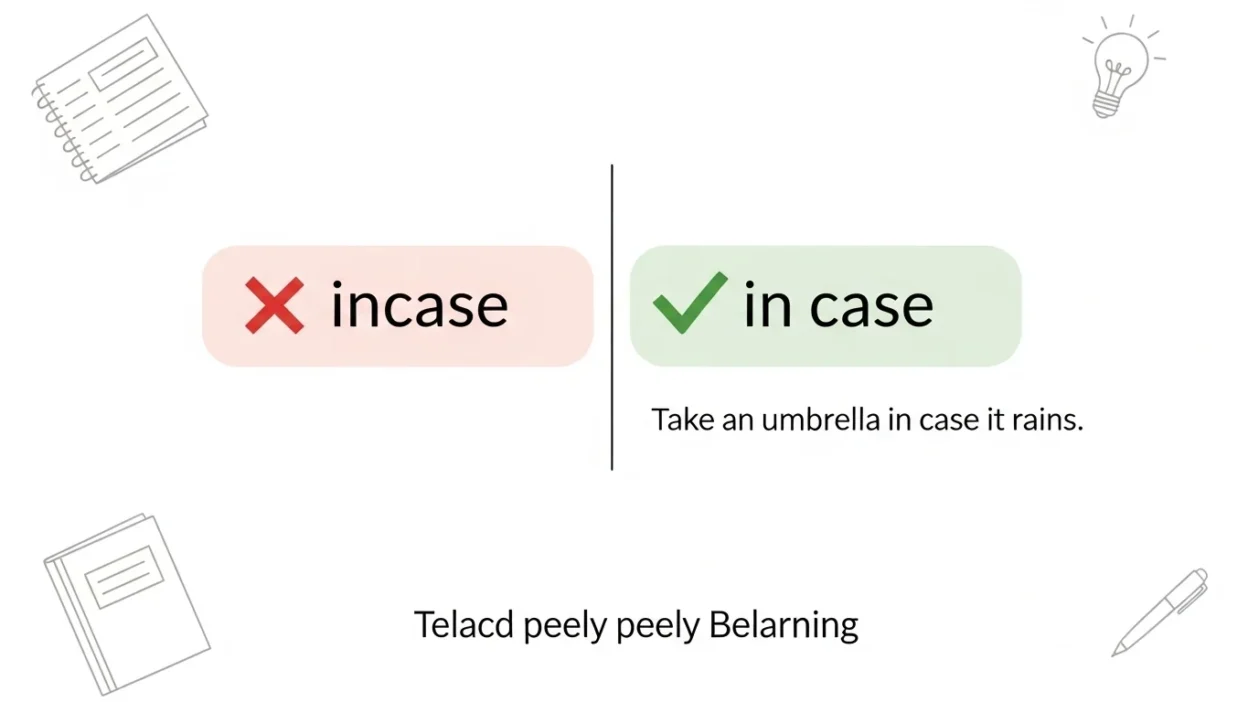
- ✅ “In case” (two words) is correct
- ❌ “Incase” (one word) is not correct in standard English
- Use “in case” when you mean:
- “because something might happen”
- “as a precaution”
👉 Example:
- Take an umbrella in case it rains.
Simple Background
The phrase “in case” comes from everyday spoken English. It has been used for a long time to talk about possible situations.
Think of it like this:
- “case” = situation or event
- “in case” = if that situation happens
Over time, people sometimes started writing it as one word (incase), but this form is not accepted in correct English writing.
Clear Explanation of the Difference
1. What “In Case” Means
“In case” is used when you want to be prepared for something that might happen.
It shows:
- caution
- planning
- preparation
👉 Example:
- Bring water in case you feel thirsty.
This means: Bring water because you might feel thirsty later.
2. What “Incase” Means
“Incase” (one word) is not a correct word in standard English.
- It is often a spelling mistake
- It may appear in informal writing, but it is not correct
👉 Example (wrong):
- ❌ I brought a jacket incase it gets cold.
👉 Correct version:
- ✅ I brought a jacket in case it gets cold.
Comparison Table
| Feature | In Case (Correct) | Incase (Incorrect) |
| Spelling | Two words | One word |
| Meaning | For a possible situation | No accepted meaning |
| Usage | Formal and informal English | Not standard |
| Example | Take money in case you need it | ❌ Take money incase you need it |
| Correct? | ✅ Yes | ❌ No |
Which One Should You Use and When?
Always Use “In Case”
Use “in case” when you are talking about:
- something that might happen
- preparing for a situation
- being careful
👉 Common patterns:
- in case + subject + verb
- in case of + noun
Examples:
- Call me in case you need help.
- Take a map in case you get lost.
- In case of fire, leave the building quickly.
👉 Easy tip:
If you can replace it with “if something happens,” then “in case” is correct.
Common Mistakes People Make
1. Writing “incase” as one word
❌ Incorrect:
- I saved the file incase my computer crashes.
✅ Correct:
- I saved the file in case my computer crashes.
2. Confusing “in case” with “if”
These two are similar, but not the same.
- In case = before something happens (preparation)
- If = talking about a possible situation
👉 Example:
- Take an umbrella in case it rains. (before rain)
- Take an umbrella if it rains. (when rain happens)
3. Using “in case of” incorrectly
“In case of” is followed by a noun, not a full sentence.
❌ Incorrect:
- In case of it rains, stay inside.
✅ Correct:
- In case of rain, stay inside.
4. Overusing it
Sometimes learners use “in case” too often.
Try to use it only when you really mean preparation.
Everyday Real Life Examples
1. Emails
- Please keep a copy of the document in case we need it later.
- I am sending this again in case you missed it.
2. School or Study
- Bring extra pens in case one stops working.
- Study early in case you get busy tomorrow.
3. Social Media
- Saving this post in case I need it later 😊
- Download the video in case it gets deleted.
4. News or Announcements
- People stored food in case of a storm.
- Emergency teams are ready in case something goes wrong.
5. Daily Life
- Lock the door in case someone tries to enter.
- Wear a jacket in case it gets cold.
- Charge your phone in case the power goes out.
Learning Section for Students and Beginners
Easy Rule to Remember
👉 Always write “in case” (two words)
👉 Never write “incase”
Practice Tip
Try this simple test:
Ask yourself:
“Am I talking about something that might happen?”
If yes → use “in case”
Quick Practice Sentences
Fill in the blank:
- Take a bag ______ you need it.
- Save your work ______ the system crashes.
- Bring water ______ you get thirsty.
👉 Answers:
- in case
- in case
- in case
Memory Trick
Think of it like this:
- “In case” = “in a situation”
So:
- In case it rains = In a situation where it rains
FAQ Section
1. Is “incase” ever correct?
No. “Incase” is not correct in standard English. Always use “in case.”
2. Why do people write “incase”?
Because it sounds like one word when we speak. But in writing, it must stay as two words.
3. Can I use “in case of” in sentences?
Yes, but use it with a noun.
👉 Example:
- In case of fire, call for help.
4. What is the difference between “in case” and “if”?
- In case = preparation before something happens
- If = condition when something happens
5. Is “in case” formal or informal?
It can be used in both formal and informal English.
6. Can I start a sentence with “in case”?
Yes.
👉 Example:
- In case you need help, call me.
7. Is “just in case” correct?
Yes. It is very common.
👉 Example:
- I took extra money just in case.
8. Can I use it in exams?
Yes. It is correct and safe to use in all types of writing.
Conclusion
The difference between “incase” and “in case” is simple:
- ✅ “In case” is correct and useful
- ❌ “Incase” is not correct
Remember:
- Use “in case” when you are preparing for something that might happen
- Always write it as two words
With this easy rule, you can avoid mistakes and feel more confident in your writing. Keep practicing, and soon it will feel natural to you.

Anthony Charles is the founder and lead content creator at Meanefy.com, a platform dedicated to exploring word meanings, language nuances, and everyday curiosities. With a passion for language and a keen eye for detail, Anthony aims to make complex words and concepts simple and accessible for readers around the world.