Many English learners get confused when they see the words “shiney” and “shiny.” At first glance, they look almost the same. Because of this small difference, people often think both are correct or mean different things.
But in real English, only one of them is correct. The other is a common spelling mistake that appears very often in writing, especially in messages, social media posts, and student homework.
In this article, you will learn the simple truth behind these two words. You will understand what is correct, why the mistake happens, and how to always use the right form with confidence.
Quick Answer
Here is the easiest explanation:
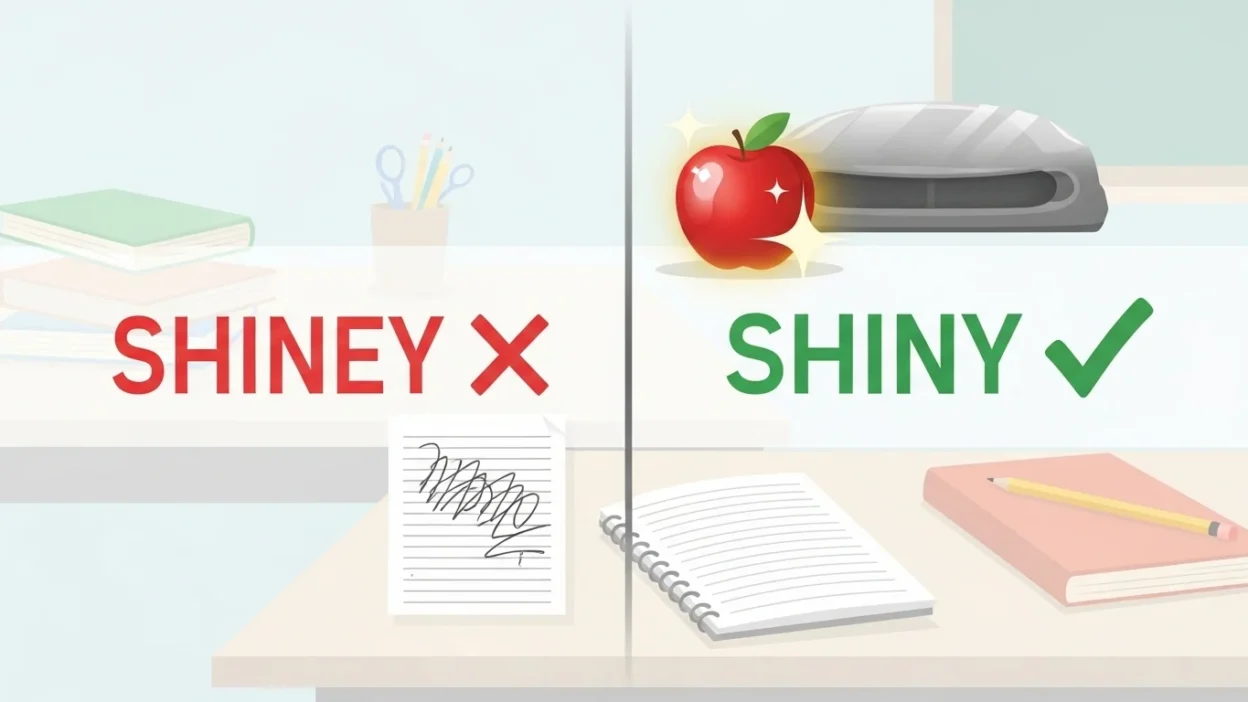
- ✅ Shiny = correct word
- ❌ Shiney = incorrect spelling (common mistake)
Meaning of “shiny”:
- Something that gives or reflects light
- Something bright, clean, or polished
Example:
- The floor is shiny after cleaning.
Simple Origin and Background
The word “shiny” comes from the verb “shine.”
- “Shine” means to give light or glow
- When we describe something that has that quality, we add y
So:
- shine + y = shiny (correct form)
In English, this is a normal pattern:
- sun → sunny
- fog → foggy
- mess → messy
- shine → shiny
The mistake “shiney” happens because people think they should keep the full word “shine” and just add “y.” But English spelling does not work that way for this word.
Clear Explanation of the Difference
The difference between shiney and shiny is very simple:
1. Shiny (Correct Form)
“Shiny” is the only correct spelling in modern English.
It is used to describe:
- Objects that reflect light
- Clean and polished things
- Bright surfaces
Examples:
- shiny car
- shiny shoes
- shiny hair
- shiny metal
2. Shiney (Incorrect Form)
“Shiney” is NOT correct in standard English.
It is:
- a spelling mistake
- sometimes seen in informal writing
- not accepted in exams, books, or formal writing
Even though it looks natural, it is wrong.
Easy Comparison Table
| Feature | Shiny | Shiney |
| Correct spelling | Yes | No |
| Meaning | Bright or reflective | No real meaning |
| Used in exams | Yes | No |
| Used in books | Yes | No |
| Common mistake level | Low | High (wrong form) |
| Based on word “shine” | Yes | Incorrect formation |
Which One to Use and When
You should always use “shiny” in all situations.
Use “shiny” when talking about:
- Clean objects
- Bright surfaces
- Something reflecting light
- Attractive appearance
Examples of correct usage:
- The car looks shiny after washing.
- She has shiny black hair.
- The new phone has a shiny screen.
- The coins are shiny and old.
Never use “shiney” in:
- School exams
- Formal writing
- Emails
- Articles
- Assignments
Even in casual writing, it is better to avoid the wrong spelling completely.
Common Mistakes People Make
Many learners make the same mistakes with this word. Here are the most common ones:
1. Adding “e” by habit
People think:
- shine + y = shiney ❌
But correct is:
- shiny ✅
2. Hearing the pronunciation
“Shiny” is pronounced in a way that can make the “e” sound like it is there. This leads to spelling confusion.
3. Copying incorrect social media spelling
On social media, people often write fast and incorrectly. Learners copy this without checking.
4. Not learning word patterns
English has patterns like:
- shine → shiny
- bake → bakery (different pattern)
Without learning patterns, spelling becomes confusing.
Everyday Real Life Examples
Let’s see how “shiny” is used in real life situations.
1. Daily life
- I cleaned my room, and now the floor is shiny.
- Her shoes look shiny and new.
2. School or homework
- The teacher asked us to describe a shiny object.
- The shiny surface of the metal was easy to notice.
3. Social media posts
- “Got a shiny new phone today!”
- “Love my shiny nails 💅”
4. Emails (simple and polite)
- We received a shiny new product for testing.
- The package includes a shiny metal design.
5. News or descriptions
- The museum displayed a shiny golden artifact.
- The building has a shiny glass exterior.
Short Learning Section for Beginners
If you are a student or ESL learner, here is an easy way to remember:
Simple Rule:
👉 If you mean “bright or reflecting light,” use shiny
Memory Trick:
Think:
- “Shiny = shine + y (but without the e)”
Or remember:
- “No E in shiny!”
Practice Words:
Try using “shiny” in your own sentences:
- shiny coin
- shiny mirror
- shiny surface
The more you practice, the easier it becomes.
FAQ (Frequently Asked Questions)
1. Is “shiney” a real English word?
No, “shiney” is not a correct English word. It is a spelling mistake.
2. What is the correct spelling: shiney or shiny?
The correct spelling is shiny.
3. Why do people write “shiney”?
People write it by mistake because they think it comes directly from “shine” + “y.”
4. Does “shiny” only mean something bright?
Mostly yes, but it can also mean something clean, polished, or attractive.
5. Can I use “shiney” in informal writing?
It is better not to use it at all because it is incorrect.
6. Is “shiny” used in formal English?
Yes, “shiny” is fully correct and used in both formal and informal English.
7. How can I stop making this mistake?
Practice writing the word correctly and remember: there is no “e” in “shiny.”
8. Is “shiny” an adjective?
Yes, “shiny” is an adjective that describes nouns like car, shoes, or surface.
Conclusion
The confusion between “shiney” and “shiny” is very common, but the answer is very simple.
- Shiny is the correct spelling and real English word.
- Shiney is just a common spelling mistake.
If you remember the rule that “shine + y becomes shiny (without e),” you will never make this mistake again.
With a little practice, you can easily use “shiny” in your speaking and writing with confidence.

Daniel Matthew is a language enthusiast, writer, and contributor at Meanefy.com, where he explores the meanings, origins, and nuances of words and phrases. With a deep passion for language, Daniel aims to make complex concepts simple, engaging, and easy to understand for readers of all ages.