Many English learners and even native speakers get confused between “smoky” and “smokey.”
Both words look almost the same, and both seem correct. Because of this, people often mix them up in writing.
You might see “smoky room,” “smokey eyes,” or even “smokey flavor” online and wonder which one is right. The truth is simple, but it depends on the situation and meaning.
In this article, you will learn the clear difference between these two words in very easy English so you never feel confused again.
Quick Answer
Here is the fastest way to understand the difference:
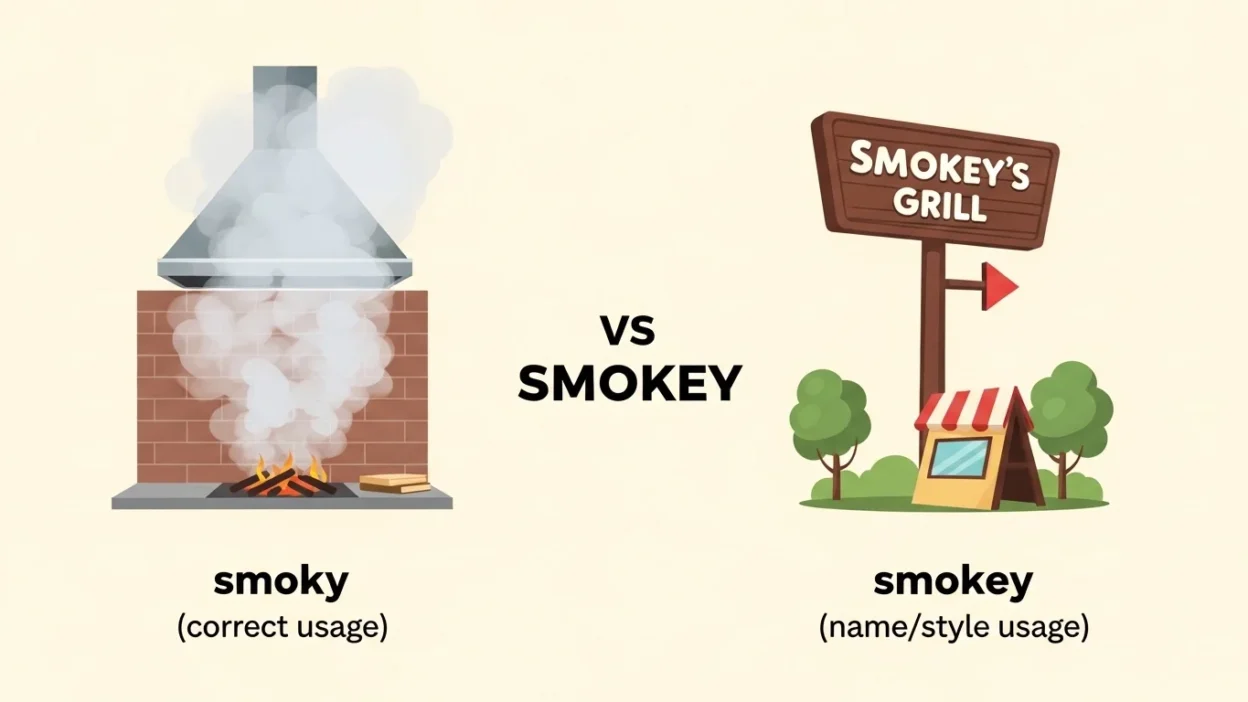
- Smoky → The correct general spelling (most situations)
- Smokey → Used sometimes in names or special style writing
More details:
- Use smoky when talking about smoke or something full of smoke
- Use smoky for smell, air, food flavor, or atmosphere
- Use smokey mainly in names (like “Smokey Bear”) or informal branding
👉 Simple rule:
“Smoky” is normal English. “Smokey” is special or stylistic.
Origin or Background of the Words
The word comes from “smoke.”
- Smoke → smoky (adjective form)
In English, when we turn a noun into an adjective, we often add “ y”:
- sun → sunny
- rain → rainy
- fog → foggy
- smoke → smoky
So the natural spelling is smoky.
Later, people started using “smokey” as a creative spelling. It appeared in:
- Brand names
- Cartoon or character names
- Informal writing styles
One famous example is “Smokey Bear,” a character used in fire safety campaigns. Because of this, many people started seeing “smokey” and assumed it was correct everywhere.
But in normal English grammar, “smoky” is the standard form.
Clear Explanation of the Difference
1. Smoky (Main Correct Form)
Smoky is used when something has smoke or is related to smoke.
It describes:
- Air filled with smoke
- Smell of smoke
- Taste like smoke
- A dark or unclear atmosphere caused by smoke
Examples:
- The room was smoky after the fire.
- I don’t like smoky air.
- The BBQ had a smoky flavor.
2. Smokey (Special or Non Standard Use)
Smokey is not the main grammar form. It is mostly used:
- In names (people, characters, mascots)
- In branding or creative writing
- In informal or stylistic spelling
Examples:
- Smokey Bear (famous character)
- Smokey Joe (nickname or brand name)
- A café named “Smokey Grill”
👉 Important point:
Even if you see “smokey” online, it does not always mean correct grammar. It may just be a name choice.
Comparison Table
| Feature | Smoky | Smokey |
| Correct grammar form | Yes | No (usually) |
| Used in dictionaries | Yes | Limited use |
| Meaning | Full of smoke or related to smoke | Mostly a name or style |
| Common usage | Writing, speaking, exams | Brands, characters, nicknames |
| Example | smoky room, smoky flavor | Smokey Bear, Smokey Joe |
| Formal writing | Always used | Avoid |
Which One to Use and When
To avoid mistakes, follow this simple guide:
Use “smoky” when:
- Writing essays
- Taking exams
- Describing smell, air, or food
- Speaking or writing in formal English
- Talking about real smoke situations
Examples:
- The kitchen became smoky while cooking.
- The air feels smoky today.
- I like smoky flavored chips.
Use “smokey” when:
- It is part of a proper name
- You are writing about a brand or character
- You are copying an existing spelling used in a title
Examples:
- Smokey Bear teaches fire safety.
- I went to Smokey’s BBQ restaurant.
Common Mistakes People Make
Many learners make simple mistakes with these words. Here are the most common ones:
1. Using “smokey” in formal writing
Wrong:
- The room was smokey.
Correct:
- The room was smoky.
2. Thinking both spellings are equal
Many people believe both are correct. In reality:
- Only smoky is standard English grammar
3. Copying names into general writing
Example mistake:
- The air is smokey (because of Smokey Bear)
But this is incorrect because the sentence is not a name.
4. Overusing “smokey” in food descriptions
Wrong:
- This burger has a smokey taste.
Correct:
- This burger has a smoky taste.
Everyday Real Life Examples
Let’s see how these words are used in daily life.
1. School or exam writing
- The factory produced smoky air that affected the environment.
2. Social media post
- Enjoying a smoky BBQ dinner tonight 🔥
3. Restaurant menu
- Smoky grilled chicken
- Smoky cheese burger
4. News report style
- The building was filled with smoky air after the fire incident.
5. Brand or shop name
- Smokey’s BBQ House (name, not grammar rule)
6. Casual conversation
- “The kitchen is so smoky, open the window!”
Short Learning Section for Beginners
Here is an easy way to remember:
Think of it like this:
- Smoky = grammar word (normal English)
- Smokey = name word (special use)
Memory trick:
👉 “Y” in smoky means “Yes, correct grammar”
👉 “Ey” in smokey means “Extra style or name”
Practice sentences:
Try filling in the blank:
- The air is very ______ after cooking.
- I saw Smokey Bear in a cartoon.
- The BBQ has a ______ flavor.
Answers:
- smoky
- Smokey
- smoky
FAQ (Frequently Asked Questions)
1. Is “smokey” correct English?
It is not standard English. It is mostly used in names or creative writing.
2. What is the correct spelling: smoky or smokey?
The correct spelling in grammar is smoky.
3. Why do some people write “smokey”?
Because it is used in names, brands, or informal style writing.
4. Can I use “smokey” in exams?
No, you should always use smoky in exams.
5. Is “smoky” used for food taste?
Yes. We say “smoky flavor” for grilled or BBQ taste.
6. Is “Smokey Bear” written correctly?
Yes, because it is a proper name, not grammar.
7. Are “smoky” and “smokey” pronounced the same?
Yes, both are usually pronounced the same way.
8. What is the easiest way to remember the difference?
Remember: smoky = normal English, smokey = name or style.
Conclusion
The confusion between “smoky” and “smokey” is very common, but the rule is actually simple.
- Smoky is the correct and standard English word. You use it in almost all real situations like writing, speaking, exams, food descriptions, and daily communication.
- Smokey is mostly used for names, characters, or creative spelling and should not be used in formal grammar.
If you remember just one thing, remember this:
👉 Use “smoky” unless it is a name.
With this simple rule, you will never feel confused again when writing or speaking English.