Many learners feel confused about “whomever” and “whoever.”
They look almost the same, but they are used in different ways.
The problem is simple:
Both words talk about people, but they change depending on how they are used in a sentence.
Don’t worry. In this guide, you will understand the difference clearly and easily on your first read.
Quick Answer
Here is the easiest way to remember:
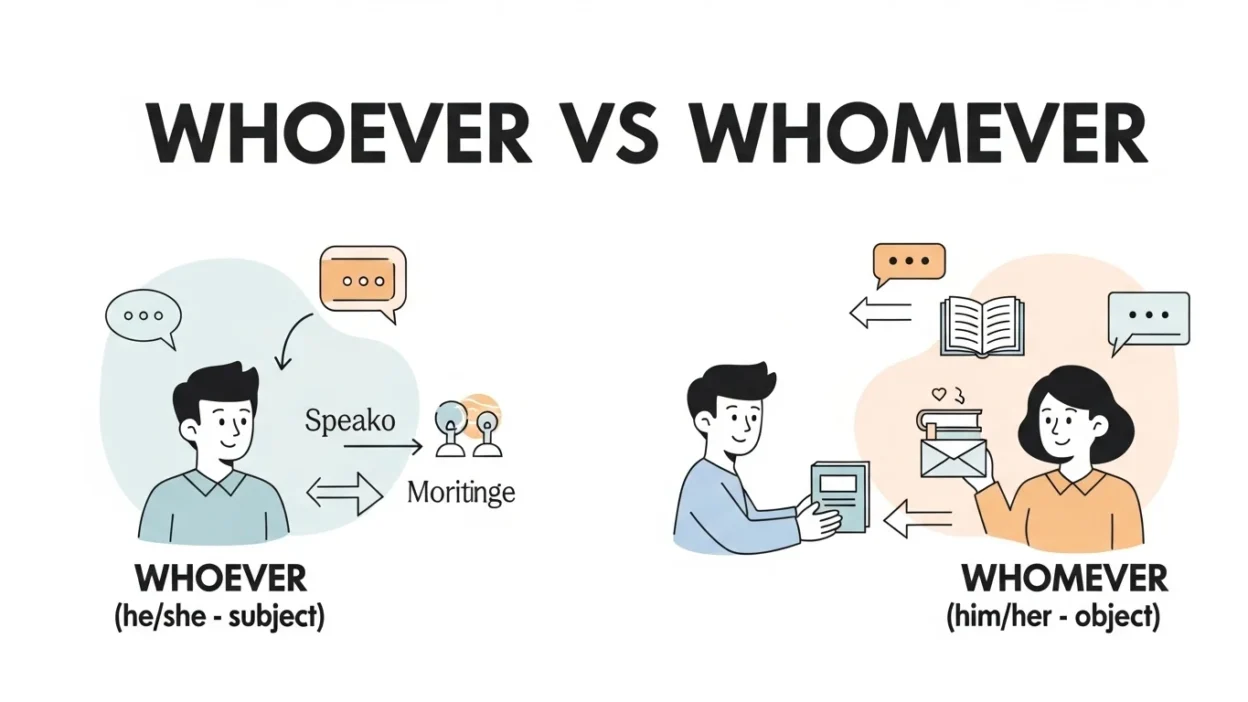
- Whoever = subject (the doer of the action)
- Whomever = object (the receiver of the action)
👉 Quick test:
- If you can replace it with he/she → use whoever
- If you can replace it with him/her → use whomever
Examples:
- Whoever wants to join is welcome. (he → correct)
- Give the prize to whomever you choose. (him → correct)
Simple Background
Both words come from:
- who
- whom
These are old English words used to talk about people.
- Who = subject (like he, she)
- Whom = object (like him, her)
Now, when we add ever, we get:
- whoever
- whomever
These words mean:
👉 “any person who” or “it does not matter who”
Clear Explanation of the Difference
Let’s make it very simple.
1. Whoever = the doer (subject)
Use whoever when the person is doing the action.
Example:
- Whoever calls me will get a reply.
Ask:
👉 Who is calling?
Answer: Whoever = the doer
2. Whomever = the receiver (object)
Use whomever when the person is receiving the action.
Example:
- I will help whomever you choose.
Ask:
👉 You choose whom?
Answer: Whomever = receiver
Important Tip
Sometimes the sentence looks tricky.
But don’t look at the whole sentence.
👉 Look only at the part with whoever/whomever.
Comparison Table
| Feature | Whoever | Whomever |
| Role | Subject (doer) | Object (receiver) |
| Replace with | He / She | Him / Her |
| Common use | Very common | Less common |
| Example | Whoever wins gets a prize | Give it to whomever you like |
| Difficulty | Easy | Slightly tricky |
Which One to Use and When
Use whoever when:
- The person is doing something
- You can replace it with he/she
Examples:
- Whoever finishes first will win.
- Talk to whoever is in charge.
- Whoever made this did a great job.
Use whomever when:
- The person is receiving the action
- You can replace it with him/her
Examples:
- Give the gift to whomever you want.
- Invite whomever you like.
- I will support whomever they select.
Simple Trick (Very Important)
Break the sentence into a smaller part.
Example:
- She will hire whoever you recommend.
Check:
👉 You recommend who? → him/her
So correct form:
👉 She will hire whomever you recommend.
Common Mistakes People Make
1. Using “whoever” everywhere
Many people use whoever all the time because it sounds easier.
❌ Give it to whoever you choose.
✅ Give it to whomever you choose.
2. Overthinking the sentence
Long sentences can confuse you.
👉 Solution: break the sentence into parts.
3. Ignoring the small clause
Example:
- Choose whoever you like.
Check inside:
👉 you like him → object → whomever
Correct:
✅ Choose whomever you like.
4. Thinking “whomever” is always formal
Yes, it is more formal but still important in correct grammar.
Everyday Real Life Examples
Emails
- Please send the file to whoever needs it.
- Give access to whomever you trust.
School or College
- Whoever studies hard will succeed.
- Ask whomever you think can help.
News Style
- Whoever wins the election will lead the country.
- The award will go to whomever the judges select.
Social Media
- Whoever wants to join, message me!
- Tag whomever you want to invite.
Daily Conversation
- I’ll talk to whoever is available.
- Give it to whomever is responsible.
Learning Section for Students and Beginners
Here is a simple step by step method:
Step 1: Find the clause
Look at the part with whoever/whomever.
Step 2: Replace it
- Try he/she
- Try him/her
Step 3: Choose correctly
- If he/she fits → use whoever
- If him/her fits → use whomever
Practice Examples
- ______ arrives first will get a seat.
👉 he arrives → Whoever - Give it to ______ you trust.
👉 you trust him → Whomever - ______ made this mistake should fix it.
👉 he made → Whoever - Invite ______ you want.
👉 you want him → Whomever
FAQ Section
1. Is “whomever” still used today?
Yes, but less often. Many people prefer “whoever” in casual speech.
2. Can I always use “whoever”?
In informal English, yes.
But in correct grammar, you should still use “whomever” when needed.
3. Why is this topic confusing?
Because sentences can be long, and the real subject or object is hidden inside.
4. Is “whom” the same as “whomever”?
No, but they are related.
- whom = object
- whomever = “any person who” (object form)
5. What is the easiest way to learn this?
Use the he/him test:
- he → whoever
- him → whomever
6. Do native speakers always follow this rule?
Not always. Many people mix them, especially in speech.
7. Is “whomever” too formal for daily use?
Yes, it sounds more formal. But it is still correct and useful.
8. Should beginners worry too much about this?
No. Learn the rule slowly. Understanding is more important than perfection.
Conclusion
The difference between whoever and whomever is actually simple:
- Whoever = subject (he/she)
- Whomever = object (him/her)
If you remember just one thing, remember this:
👉 Use the he/him test
At first, it may feel difficult but with practice, it becomes natural.
Keep practicing with small sentences, and soon you will use both words with confidence.

Daniel Matthew is a language enthusiast, writer, and contributor at Meanefy.com, where he explores the meanings, origins, and nuances of words and phrases. With a deep passion for language, Daniel aims to make complex concepts simple, engaging, and easy to understand for readers of all ages.