Many people feel confused when they see “whose” and “whos.” These two forms look very similar, but they are not used in the same way.
In fact, one of them is correct in standard English, and the other is usually not used at all.
If you are a student, an learner or just someone who wants to improve your English, this guide will help you understand everything clearly.
By the end, you will know exactly when to use “whose” and why “whos” is almost always wrong.
Quick Answer
Here is the simple truth:
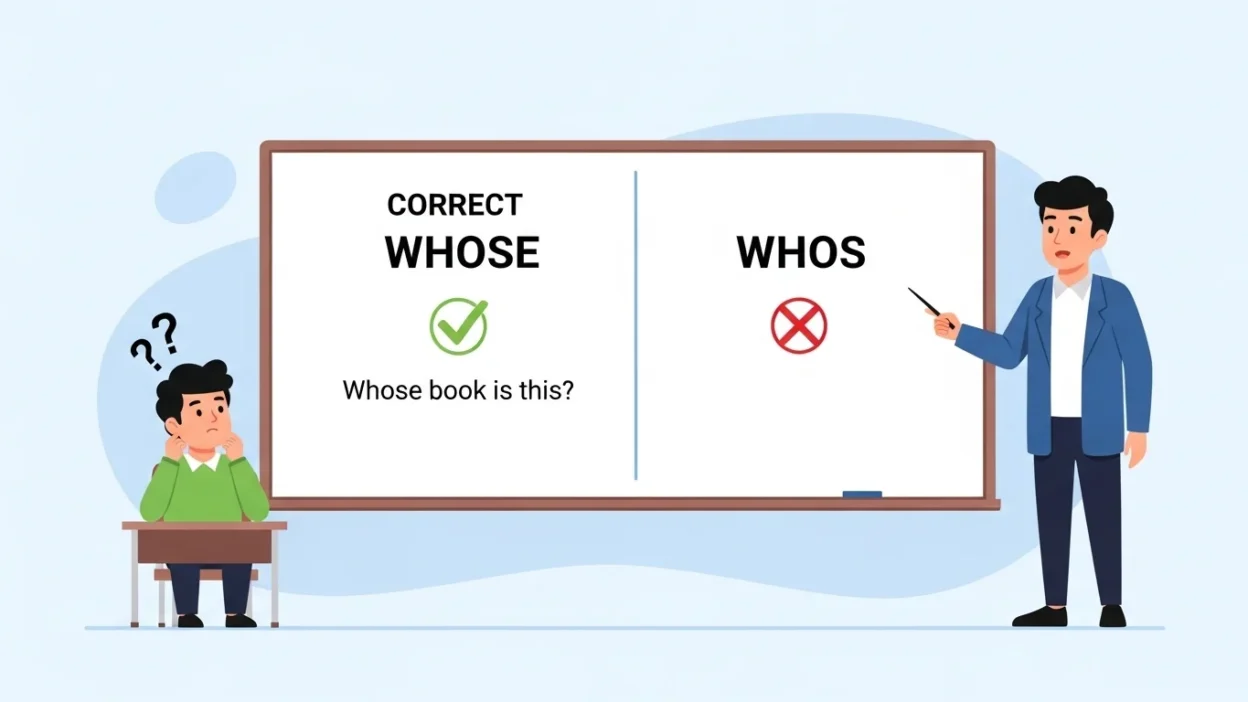
- Whose = correct word
→ shows possession (something belongs to someone) - Whos = not a standard English word
→ usually a mistake or typo
Example:
- ✅ Whose book is this?
- ❌ Whos book is this?
Simple Background Explanation
To understand this better, let’s look at how English forms work.
In English, we often use special words to ask questions about people:
- Who
- Whose
- Whom (less common in daily use)
The word “whose” comes from “who.” It is used to talk about ownership or belonging.
For example:
- Who = a person
- Whose = something that belongs to that person
Over time, “whose” became the correct form used in both speaking and writing.
On the other hand, “whos” without the apostrophe is not a real word in proper English. People sometimes write it by mistake when they mean:
- “who’s” (who is / who has), or
- “whose”
Clear Explanation of the Difference
Let’s break it down in the simplest way possible.
1. What does “whose” mean?
“Whose” is used to ask or show ownership.
It answers the question:
👉 “Who does this belong to?”
Examples:
- Whose phone is ringing?
- Whose shoes are these?
- Do you know whose car is parked outside?
In all these sentences, we are asking about the owner.
2. What about “whos”?
“Whos” is not correct in standard English.
People often confuse it with:
- “who’s” (with an apostrophe)
Important Note:
- Who’s = who is / who has
- Whose = belonging to someone
Example:
- Who’s coming to the party? (Who is)
- Whose bag is this? (belongs to someone)
Comparison Table
| Word | Meaning | Correct? | Example |
| Whose | Shows ownership | ✅ Yes | Whose pen is this? |
| Whos | Not a real standard word | ❌ No | ❌ Whos pen is this? |
| Who’s | Short form of “who is” or “who has” | ✅ Yes | Who’s ready? |
Which One to Use and When
Use “whose” when:
- You are asking about ownership
- You are talking about something belonging to someone
Examples:
- Whose idea was this?
- Whose jacket are you wearing?
- I don’t know whose keys these are.
Do NOT use “whos”
Instead, ask yourself:
👉 Do I mean “who is”?
- If yes → use who’s
- If no → use whose
Simple Trick to Remember
Try this easy test:
Replace the word with “who is”
- If the sentence still makes sense → use who’s
- If not → use whose
Example:
- ___ bag is this?
Try:
- Who is bag is this ❌ (wrong)
→ So the correct word is: Whose bag is this
Common Mistakes People Make
Here are some mistakes learners often make:
1. Writing “whos” instead of “whose”
❌ Whos phone is this?
✅ Whose phone is this?
2. Confusing “whose” and “who’s”
❌ Who’s book is on the table?
✅ Whose book is on the table?
3. Forgetting the apostrophe in “who’s”
❌ Whos coming today?
✅ Who’s coming today?
4. Using “whose” for actions instead of ownership
❌ Whose going to the store?
✅ Who’s going to the store?
Everyday Real Life Examples
Let’s look at how people use “whose” in daily life.
1. In Emails
- Whose responsibility is this task?
- Do you know whose report this is?
2. In School
- Whose notebook is on my desk?
- Whose turn is it to speak?
3. On Social Media
- Whose post is this?
- Whose dog is this? So cute!
4. In News or Conversations
- Police are trying to find whose car was involved.
- No one knows whose fault it was.
5. At Home
- Whose charger is this?
- Whose clothes are in the washing machine?
Short Learning Section for Students and Beginners
If you are just starting to learn English, remember these simple points:
Key Rules
- Whose = belonging to someone
- Who’s = who is / who has
- Whos = incorrect
Practice Sentences
Fill in the blanks:
- ___ bag is this?
- ___ coming with us?
- ___ idea was this?
- ___ ready to start?
Answers:
- Whose
- Who’s
- Whose
- Who’s
Easy Memory Tip
Think like this:
- “Whose” → has “se” → like “something owned”
- “Who’s” → has apostrophe → short form
FAQ Section
1. Is “whos” ever correct?
No. “Whos” without an apostrophe is not correct in standard English.
2. What is the difference between “whose” and “who’s”?
- Whose = ownership
- Who’s = who is / who has
3. Can “whose” be used for things, not just people?
Yes.
Example:
- Whose car is this?
- Whose phone is ringing?
4. Why do people write “whos”?
Usually, it is a typing mistake or confusion between “whose” and “who’s.”
5. How can I remember the difference easily?
Use this trick:
- Try replacing with “who is”
- If it works → use “who’s”
- If not → use “whose”
6. Is “whose” used in questions only?
No. It can also be used in statements.
Example:
- I know whose book this is.
7. Is “whose” formal or informal?
It is used in both formal and informal English.
8. Can I avoid confusion completely?
Yes. Just remember:
- Ownership → whose
- Action (who is) → who’s
Conclusion
Understanding the difference between “whose” and “whos” is actually very simple once you see the pattern.
- “Whose” is the correct word and is used to show ownership.
- “Whos” is not a standard word and should be avoided.
- Many people confuse it with “who’s,” which means “who is.”
If you remember just one thing, remember this:
👉 Whose = belongs to someone
With a little practice, you will never feel confused again. Keep using it in your daily writing and speaking, and it will soon become natural.