Many English learners get confused between “ate” and “eaten.”
Both words come from the verb “eat,” so they look very similar. Because of this, students often use the wrong one in sentences.
For example:
- ❌ I have ate breakfast.
- ❌ Yesterday I eaten pizza.
These sentences sound wrong in English, but the mistake is very common.
The good news is that the difference is actually simple once you understand how each word works. In this article, you will learn:
- what “ate” means
- what “eaten” means
- when to use each one
- common mistakes to avoid
- easy examples from daily life
By the end, the confusion should completely disappear.
Quick Answer
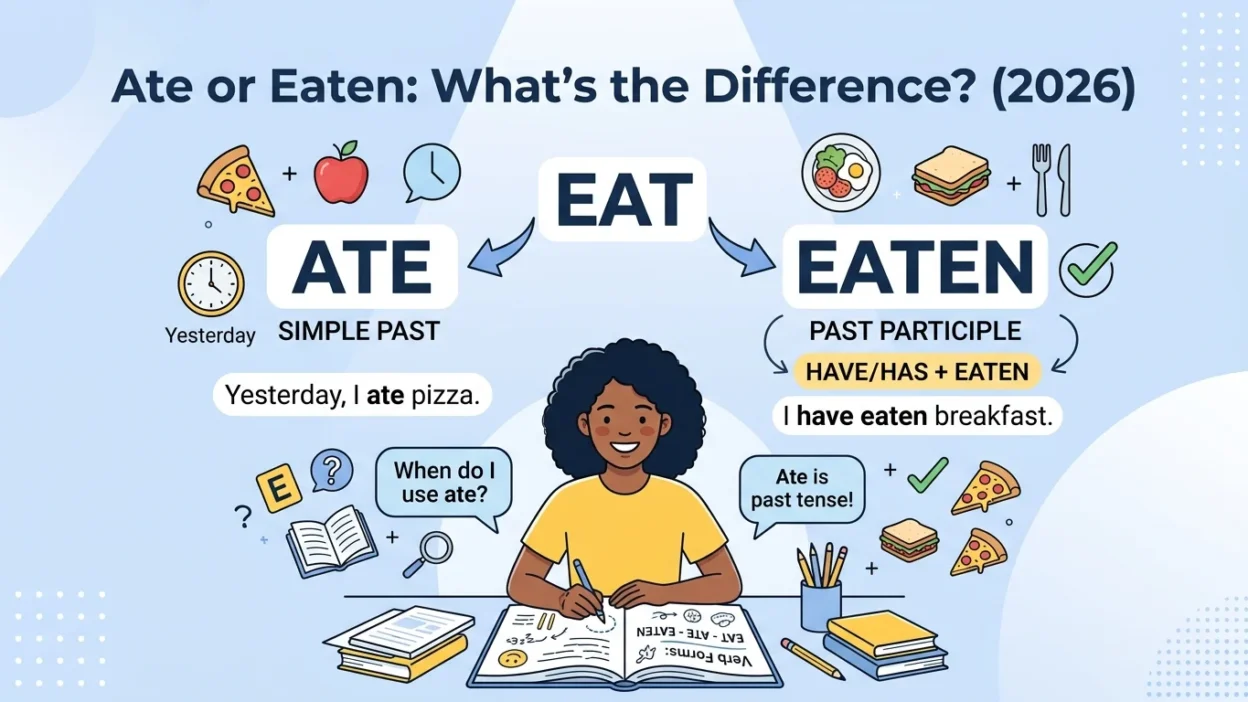
- Ate = simple past tense of eat
- Example: I ate lunch.
- Eaten = past participle of eat
- Example: I have eaten lunch.
Easy Rule
- Use ate for actions finished in the past.
- Use eaten with helping verbs like:
- have
- has
- had
- was
- were
- been
Background of the Word
The base verb is:
- eat
English verbs often change form depending on time and grammar.
Here are the three main forms:
| Verb Form | Word |
| Base form | eat |
| Past tense | ate |
| Past participle | eaten |
This happens with many English verbs:
| Base Verb | Past Tense | Past Participle |
| go | went | gone |
| see | saw | seen |
| write | wrote | written |
| eat | ate | eaten |
So, “ate” and “eaten” are simply different forms of the same verb.
The Difference Between Ate and Eaten
Ate
“Ate” is the simple past tense form.
Use it when talking about something that already happened in the past.
Structure
- Subject + ate + object
Examples
- I ate breakfast.
- She ate an apple.
- We ate dinner late.
- They ate at a restaurant yesterday.
In all these examples, the action is finished.
Time Words Often Used with “Ate”
- yesterday
- last night
- last week
- this morning
- an hour ago
Example Sentences
- I ate pizza yesterday.
- He ate too much at the party.
- We ate before the movie started.
Eaten
“Eaten” is the past participle form.
You usually cannot use “eaten” alone. It normally needs a helping verb.
Common Helping Verbs
- have
- has
- had
- was
- were
Examples
- I have eaten lunch.
- She has eaten already.
- They had eaten before we arrived.
- The cake was eaten quickly.
Important Tip
If there is no helping verb, do not use “eaten.”
Correct:
- ✅ I have eaten.
Wrong:
- ❌ I eaten.
Comparison
| Feature | Ate | Eaten |
| Verb type | Past tense | Past participle |
| Can it stand alone? | Yes | Usually no |
| Needs helping verb? | No | Yes |
| Common helpers | None | have, has, had |
| Example | I ate rice. | I have eaten rice. |
| Talks about | Finished past action | Completed action with helper verb |
Which One Should You Use?
Use “Ate” When Talking About the Past
Choose “ate” when you simply want to say something happened before now.
Examples
- I ate breakfast at 8 a.m.
- She ate all the cookies.
- We ate together yesterday.
- My dog ate my sandwich.
These are direct past actions.
Use “Eaten” with Helping Verbs
Choose “eaten” when your sentence includes words like:
- have
- has
- had
Examples
- I have eaten already.
- She has eaten dinner.
- They had eaten before class started.
Here, the helping verb changes the grammar of the sentence.
Easy Trick to Remember
Try removing the helping verb.
Example:
- I have eaten lunch.
Remove “have”:
- I eaten lunch. ❌
It sounds wrong.
Now look at this:
- I ate lunch. ✅
This sentence is complete by itself.
So remember:
- ate works alone
- eaten usually needs help
Common Mistakes People Make
Mistake: Using “Eaten” Without a Helping Verb
Wrong:
- ❌ I eaten breakfast.
Correct:
- ✅ I ate breakfast.
- ✅ I have eaten breakfast.
Mistake: Using “Ate” with “Have”
Wrong:
- ❌ I have ate lunch.
Correct:
- ✅ I have eaten lunch.
After “have,” use the past participle form.
Mistake: Mixing Past Tense and Past Participle
Wrong:
- ❌ She had ate already.
Correct:
- ✅ She had eaten already.
Mistake: Forgetting the Time Meaning
Wrong:
- ❌ I have eaten yesterday.
Correct:
- ✅ I ate yesterday.
- ✅ I ate pizza yesterday.
“Have eaten” usually does not go with a finished past time like “yesterday.”
Everyday Real Life Examples
In Daily Conversation
- I ate too much today.
- Have you eaten yet?
- We ate at a new café.
- She has eaten already.
In Text Messages
- “I already ate.”
- “Have you eaten?”
- “I haven’t eaten anything today.”
In Emails
- “I ate before the meeting.”
- “The guests have eaten dinner already.”
On Social Media
- “Just ate the best burger ever!”
- “I’ve eaten so much during vacation.”
In News or Stories
- “The children ate lunch at school.”
- “Most of the food had been eaten before help arrived.”
Short Learning Section for Students and Beginners
Here is a very simple learning pattern:
Step One: Learn the Three Forms
- eat
- ate
- eaten
Say them aloud several times.
Step Two: Remember the Main Rule
- ate = simple past
- eaten = with helping verb
Step Three: Practice Small Sentences
With “Ate”
- I ate rice.
- He ate bread.
- We ate early.
With “Eaten”
- I have eaten rice.
- He has eaten bread.
- We had eaten early.
Step Four: Listen to Real English
Watch English videos or movies and notice:
- “I ate…”
- “Have you eaten…?”
Hearing the words again and again helps your brain remember them naturally.
Simple Practice Exercise
Choose the correct word.
Questions
- I ___ breakfast this morning.
- She has ___ already.
- They ___ pizza yesterday.
- We had ___ before the game.
Answers
- ate
- eaten
- ate
- eaten
FAQ
Is “ate” correct English?
Yes. “Ate” is the correct past tense of “eat.”
Example:
- I ate dinner.
Is “eaten” correct English?
Yes. “Eaten” is also correct, but it usually needs a helping verb.
Example:
- I have eaten dinner.
Can I say “I eaten”?
No. That sentence is incorrect.
- I ate.
- I have eaten.
Which is more common: “ate” or “eaten”?
Both are common, but they are used in different sentence structures.
- I ate lunch.
- I have eaten lunch.
Why does “eaten” need a helping verb?
Because “eaten” is a past participle, not a complete past tense verb by itself.
It needs words like:
- have
- has
- had
Can I use “eaten” in passive voice?
Yes.
Example:
- The cake was eaten by the children.
Is “have ate” wrong?
Yes.
Correct:
- have eaten
Wrong:
- have ate
How can I remember the difference easily?
Remember this simple line:
- ate works alone
- eaten needs help
That rule solves most mistakes.
Conclusion
“Ate” and “eaten” both come from the verb “eat,” but they are used differently.
Use ate for simple past actions:
- I ate lunch.
Use eaten with helping verbs:
- I have eaten lunch.
The biggest thing to remember is:
- ate can stand alone
- eaten usually cannot
Once you practice a few examples, the difference becomes very easy. Keep reading, listening, and making your own sentences, and soon using “ate” and “eaten” will feel natural.

Daniel Matthew is a language enthusiast, writer, and contributor at Meanefy.com, where he explores the meanings, origins, and nuances of words and phrases. With a deep passion for language, Daniel aims to make complex concepts simple, engaging, and easy to understand for readers of all ages.