Many English learners get confused by chose and chosen because both words come from the verb choose. They look similar, sound close, and talk about making a decision. Because of this, students often use the wrong one in speaking and writing.
The good news is that the difference is actually very simple once you understand the grammar pattern behind them.
In this guide, you will learn:
- What chose means
- What chosen means
- When to use each word
- Common mistakes to avoid
- Easy examples from daily life
By the end, the confusion will be completely gone.
Quick Answer
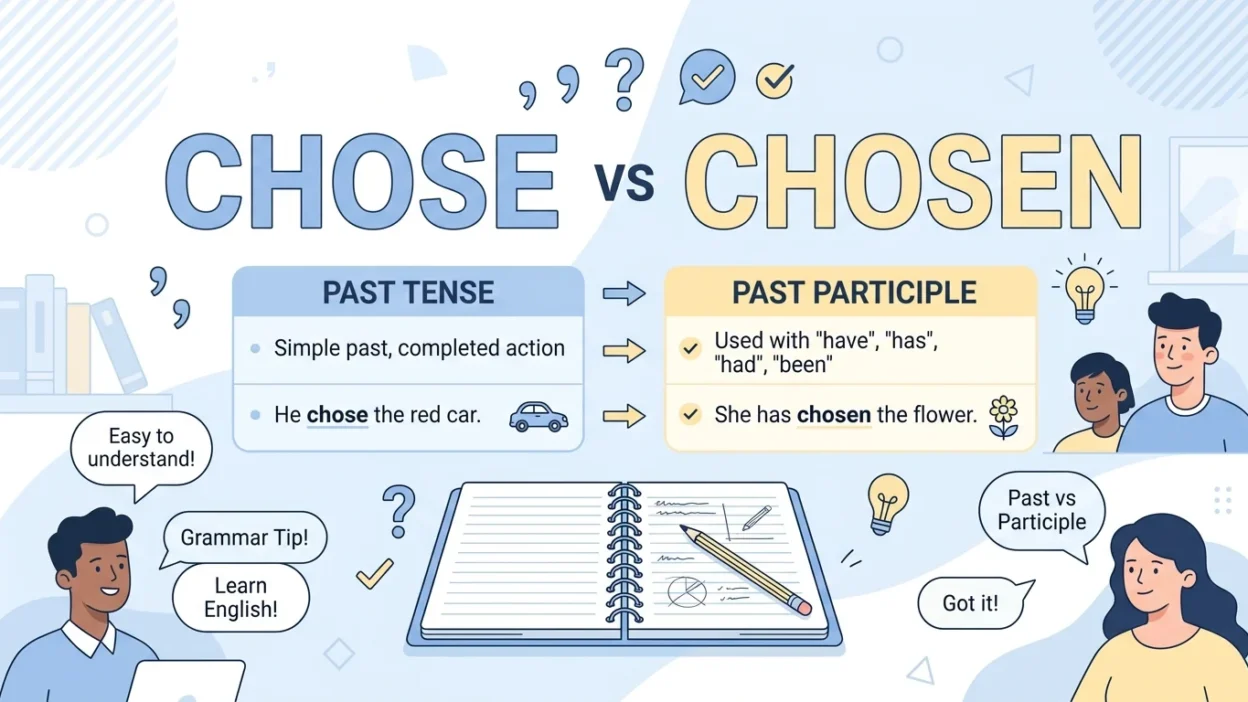
- Chose = simple past tense of choose
- Used for actions completed in the past
- Example: I chose the blue shirt yesterday.
- Chosen = past participle of choose
- Usually used with has, have, had, was, or were
- Example: She has chosen a new phone.
Easy Pattern
| Verb Form | Word |
| Base verb | choose |
| Past tense | chose |
| Past participle | chosen |
Simple Background Explanation
The verb choose is an irregular verb in English. This means it does not follow the normal “-ed” rule.
For example:
- walk → walked
- play → played
But with choose, the forms change differently:
- choose
- chose
- chosen
English has many irregular verbs like this:
- break → broke → broken
- speak → spoke → spoken
- write → wrote → written
Once you learn the pattern, it becomes much easier.
The Difference Between Chose and Chosen
What Does “Chose” Mean?
Chose is the simple past form of choose.
Use it when talking about a decision made in the past.
Structure
- Subject + chose + object
Examples
- I chose pizza for dinner.
- They chose a new teacher.
- She chose the red bag.
- We chose to stay home.
In all these examples, the action already happened and finished.
What Does “Chosen” Mean?
Chosen is the past participle form of choose.
It is usually used with helping verbs like:
- has
- have
- had
- was
- were
Structure
- has/have/had + chosen
- was/were + chosen
Examples
- He has chosen a career path.
- They have chosen a winner.
- The team was chosen carefully.
- I had chosen the wrong answer.
Notice that chosen normally does not stand alone.
Easy Comparison
| Feature | Chose | Chosen |
| Verb type | Past tense | Past participle |
| Main use | Finished past action | Used with helping verbs |
| Common helpers | None needed | has, have, had, was, were |
| Example | I chose tea. | I have chosen tea. |
| Time focus | Past action | Completed action or passive form |
| Can stand alone? | Yes | Usually no |
Which One Should You Use?
Use “Chose” When Talking About a Past Decision
Use chose if the action happened in the past and the sentence does not need a helping verb.
Examples
- I chose this school last year.
- She chose the green dress yesterday.
- We chose a movie after dinner.
- My parents chose our vacation place.
Think of chose as a completed action in the past.
Use “Chosen” With Helping Verbs
Use chosen when the sentence includes words like:
- has
- have
- had
- was
- were
Examples
- She has chosen her subjects.
- They have chosen a new manager.
- A winner was chosen today.
- I had chosen the wrong road.
If you see a helping verb, chosen is usually the correct choice.
A Very Easy Trick to Remember
Ask Yourself This Question:
“Is there a helping verb in the sentence?”
If NO:
Use chose
- I chose coffee.
If YES:
Use chosen
- I have chosen coffee.
This small trick helps many students avoid mistakes.
Common Mistakes People Make
Using “Chosen” Without a Helping Verb
❌ Incorrect:
- I chosen the black shoes.
✅ Correct:
- I chose the black shoes.
- I have chosen the black shoes.
Using “Chose” After “Has” or “Have”
❌ Incorrect:
- She has chose a new laptop.
✅ Correct:
- She has chosen a new laptop.
Mixing Tenses
❌ Incorrect:
- Yesterday, I have chosen a gift.
✅ Correct:
- Yesterday, I chose a gift.
or
✅ Correct:
- I have chosen a gift already.
Confusing Pronunciation
Some learners also confuse the pronunciation.
Simple Pronunciation Guide
- Choose → sounds like “chooz”
- Chose → sounds like “chohz”
- Chosen → sounds like “choh-zuhn”
Reading them aloud can help you remember the difference.
Everyday Real Life Examples
In Emails
Using “Chose”
- I chose the morning meeting time.
- We chose your design idea.
Using “Chosen”
- We have chosen your application.
- The final date has been chosen.
On Social Media
Examples
- I chose peace over stress.
- She has chosen happiness.
- The winner was chosen randomly.
In News Reports
Examples
- The committee chose a new leader.
- A new president was chosen yesterday.
- Judges have chosen the finalists.
In Daily Conversations
Examples
- Why did you chose that restaurant? ❌
- Why did you choose that restaurant? ✅
- I chose that restaurant because it was cheap. ✅
- We have chosen a place for dinner. ✅
Learning Section for Students and Beginners
Simple Grammar Pattern
Here is the full verb pattern again:
| Base Form | Past Tense | Past Participle |
| choose | chose | chosen |
Mini Practice
Fill in the blanks:
Questions
- She has _____ a new phone.
- I _____ the blue jacket yesterday.
- They had _____ the wrong answer.
- We _____ to stay home last night.
Answers
- chosen
- chose
- chosen
- chose
Easy Memory Tip
Think about this pattern:
- choose → chose → chosen
It is similar to:
- speak → spoke → spoken
- break → broke → broken
The final form often ends in -en.
FAQ
Is “chose” the same as “chosen”?
No.
Chose is the past tense, while chosen is the past participle.
Can I say “I chosen”?
No.
You should say:
- I chose
or - I have chosen
Why do we use “chosen” with “has” or “have”?
Because chosen is a past participle. Past participles usually need helping verbs.
Example:
- She has chosen wisely.
Which is correct: “was chose” or “was chosen”?
✅ Correct:
- was chosen
❌ Incorrect:
- was chose
Is “chosen” always used with helping verbs?
Most of the time, yes.
Examples:
- has chosen
- have chosen
- was chosen
Which word is more common in daily English?
Both are common, but they are used in different grammar situations.
- Chose is common for simple past actions.
- Chosen is common in perfect tenses and passive voice.
How can I remember the difference easily?
Use this rule:
- No helping verb → chose
- Helping verb present → chosen
Can “chosen” be used as an adjective?
Yes.
Examples:
- the chosen player
- a chosen leader
In these cases, it describes a noun.
Conclusion
The difference between chose and chosen becomes easy once you understand their grammar roles.
Remember This Simple Rule
- Chose = simple past tense
- I chose the red shirt.
- Chosen = past participle
- I have chosen the red shirt.
If there is a helping verb like has, have, had, was, or were, you will usually need chosen.
The more you read, write, and practice these forms, the more natural they will feel. Soon, choosing between chose and chosen will become simple and automatic.

Anthony Charles is the founder and lead content creator at Meanefy.com, a platform dedicated to exploring word meanings, language nuances, and everyday curiosities. With a passion for language and a keen eye for detail, Anthony aims to make complex words and concepts simple and accessible for readers around the world.